

176
M. A. Mateo, J. Cebri ´
an, K. Dunton, and T. Mutchler
transport of virtually the entire seagrass production out of the bed.
iii. Low palatability of seagrass carbon. Lower mineralization rates are shown by microbes on seagrass detritus than on macro- and microalgal detritus and this might explain why it has being observed that seagrass carbon is not the dominant
carbon source for bacterial metabolism. On the
other hand, Del Giorgio and Cole (1998) found
that bacterial growth efficiencies were similar
for macrophyte and microalgal material.
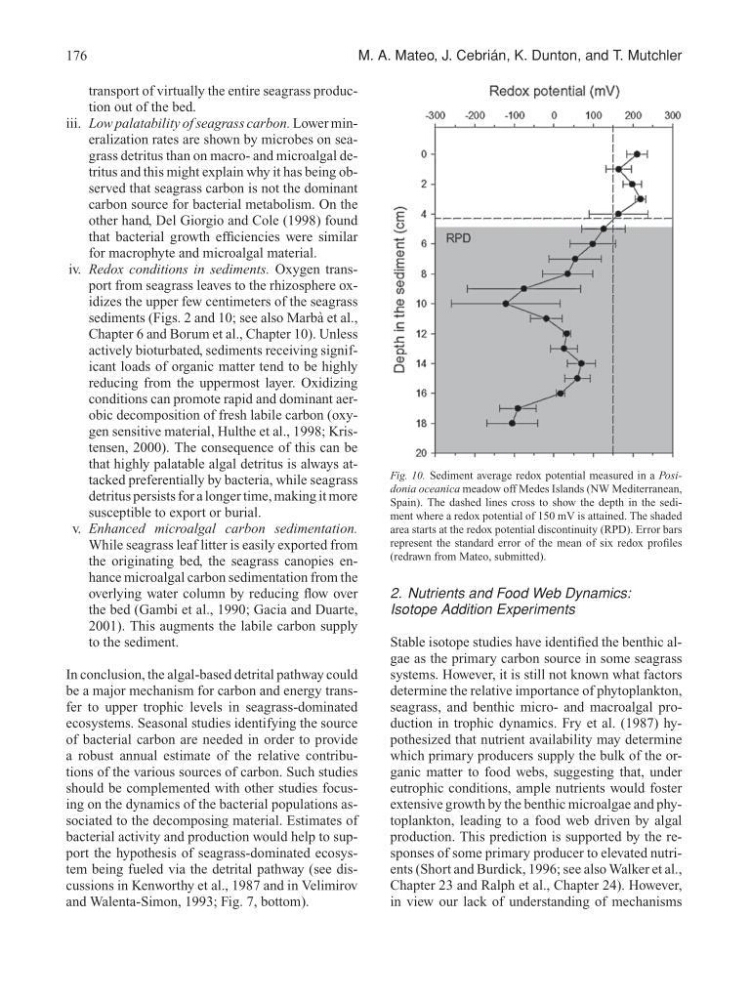
iv. Redox conditions in sediments. Oxygen transport from seagrass leaves to the rhizosphere oxidizes the upper few centimeters of the seagrass
sediments (Figs. 2 and 10; see also Marb` a et al.,
Chapter 6 and Borum et al., Chapter 10). Unless
actively bioturbated, sediments receiving significant loads of organic matter tend to be highly
reducing from the uppermost layer. Oxidizing
conditions can promote rapid and dominant aerobic decomposition of fresh labile carbon (oxygen sensitive material, Hulthe et al., 1998; Kristensen, 2000). The consequence of this can be
that highly palatable algal detritus is always attacked preferentially by bacteria, while seagrass
detritus persists for a longer time, making it more
susceptible to export or burial.
v. Enhanced microalgal carbon sedimentation.
While seagrass leaf litter is easily exported from
the originating bed, the seagrass canopies enhance microalgal carbon sedimentation from the
overlying water column by reducing flow over
the bed (Gambi et al., 1990; Gacia and Duarte,
2001). This augments the labile carbon supply
to the sediment.
In conclusion, the algal-based detrital pathway could
be a major mechanism for carbon and energy transfer to upper trophic levels in seagrass-dominated
ecosystems. Seasonal studies identifying the source
of bacterial carbon are needed in order to provide
a robust annual estimate of the relative contributions of the various sources of carbon. Such studies
should be complemented with other studies focusing on the dynamics of the bacterial populations associated to the decomposing material. Estimates of
bacterial activity and production would help to support the hypothesis of seagrass-dominated ecosystem being fueled via the detrital pathway (see discussions in Kenworthy et al., 1987 and in Velimirov
and Walenta-Simon, 1993; Fig. 7, bottom).
Fig. 10. Sediment average redox potential measured in a Posidonia oceanica meadow off Medes Islands (NW Mediterranean,
Spain). The dashed lines cross to show the depth in the sediment where a redox potential of 150 mV is attained. The shaded
area starts at the redox potential discontinuity (RPD). Error bars
represent the standard error of the mean of six redox profiles
(redrawn from Mateo, submitted).
2. Nutrients and Food Web Dynamics:
Isotope Addition Experiments
Stable isotope studies have identified the benthic algae as the primary carbon source in some seagrass
systems. However, it is still not known what factors
determine the relative importance of phytoplankton,
seagrass, and benthic micro- and macroalgal production in trophic dynamics. Fry et al. (1987) hypothesized that nutrient availability may determine
which primary producers supply the bulk of the organic matter to food webs, suggesting that, under
eutrophic conditions, ample nutrients would foster
extensive growth by the benthic microalgae and phytoplankton, leading to a food web driven by algal
production. This prediction is supported by the responses of some primary producer to elevated nutrients (Short and Burdick, 1996; see also Walker et al.,
Chapter 23 and Ralph et al., Chapter 24). However,
in view our lack of understanding of mechanisms
M. A. Mateo, J. Cebri ´
an, K. Dunton, and T. Mutchler
transport of virtually the entire seagrass production out of the bed.
iii. Low palatability of seagrass carbon. Lower mineralization rates are shown by microbes on seagrass detritus than on macro- and microalgal detritus and this might explain why it has being observed that seagrass carbon is not the dominant
carbon source for bacterial metabolism. On the
other hand, Del Giorgio and Cole (1998) found
that bacterial growth efficiencies were similar
for macrophyte and microalgal material.
iv. Redox conditions in sediments. Oxygen transport from seagrass leaves to the rhizosphere oxidizes the upper few centimeters of the seagrass
sediments (Figs. 2 and 10; see also Marb` a et al.,
Chapter 6 and Borum et al., Chapter 10). Unless
actively bioturbated, sediments receiving significant loads of organic matter tend to be highly
reducing from the uppermost layer. Oxidizing
conditions can promote rapid and dominant aerobic decomposition of fresh labile carbon (oxygen sensitive material, Hulthe et al., 1998; Kristensen, 2000). The consequence of this can be
that highly palatable algal detritus is always attacked preferentially by bacteria, while seagrass
detritus persists for a longer time, making it more
susceptible to export or burial.
v. Enhanced microalgal carbon sedimentation.
While seagrass leaf litter is easily exported from
the originating bed, the seagrass canopies enhance microalgal carbon sedimentation from the
overlying water column by reducing flow over
the bed (Gambi et al., 1990; Gacia and Duarte,
2001). This augments the labile carbon supply
to the sediment.
In conclusion, the algal-based detrital pathway could
be a major mechanism for carbon and energy transfer to upper trophic levels in seagrass-dominated
ecosystems. Seasonal studies identifying the source
of bacterial carbon are needed in order to provide
a robust annual estimate of the relative contributions of the various sources of carbon. Such studies
should be complemented with other studies focusing on the dynamics of the bacterial populations associated to the decomposing material. Estimates of
bacterial activity and production would help to support the hypothesis of seagrass-dominated ecosystem being fueled via the detrital pathway (see discussions in Kenworthy et al., 1987 and in Velimirov
and Walenta-Simon, 1993; Fig. 7, bottom).
Fig. 10. Sediment average redox potential measured in a Posidonia oceanica meadow off Medes Islands (NW Mediterranean,
Spain). The dashed lines cross to show the depth in the sediment where a redox potential of 150 mV is attained. The shaded
area starts at the redox potential discontinuity (RPD). Error bars
represent the standard error of the mean of six redox profiles
(redrawn from Mateo, submitted).
2. Nutrients and Food Web Dynamics:
Isotope Addition Experiments
Stable isotope studies have identified the benthic algae as the primary carbon source in some seagrass
systems. However, it is still not known what factors
determine the relative importance of phytoplankton,
seagrass, and benthic micro- and macroalgal production in trophic dynamics. Fry et al. (1987) hypothesized that nutrient availability may determine
which primary producers supply the bulk of the organic matter to food webs, suggesting that, under
eutrophic conditions, ample nutrients would foster
extensive growth by the benthic microalgae and phytoplankton, leading to a food web driven by algal
production. This prediction is supported by the responses of some primary producer to elevated nutrients (Short and Burdick, 1996; see also Walker et al.,
Chapter 23 and Ralph et al., Chapter 24). However,
in view our lack of understanding of mechanisms