

174
M. A. Mateo, J. Cebri ´
an, K. Dunton, and T. Mutchler
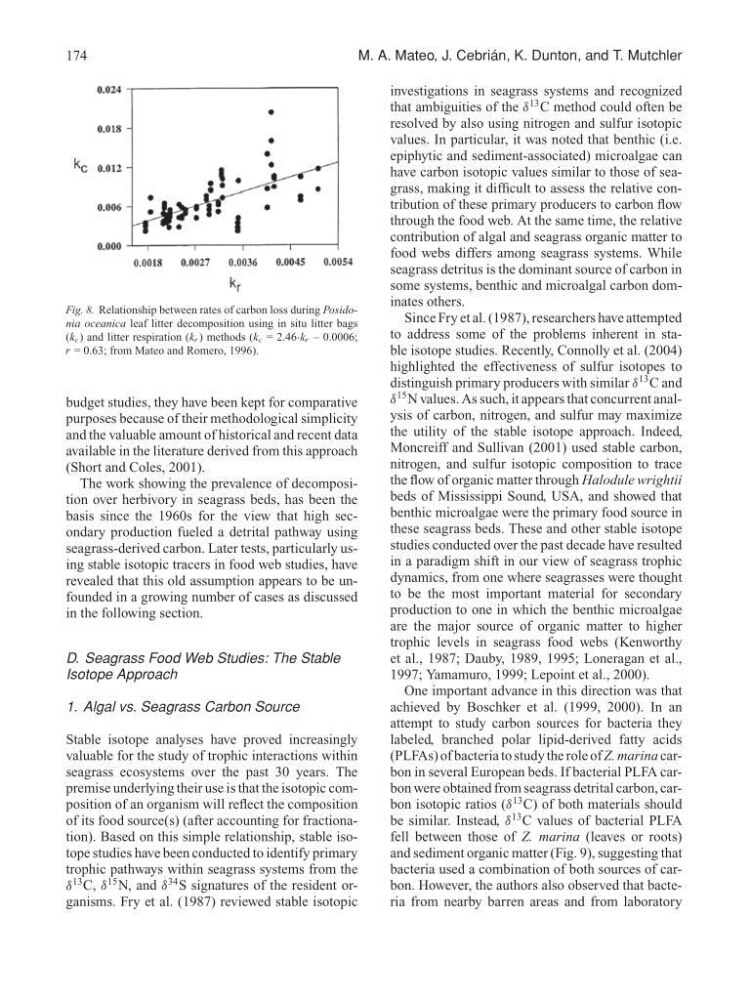
Fig. 8. Relationship between rates of carbon loss during Posidonia oceanica leaf litter decomposition using in situ litter bags
(k c ) and litter respiration (k r ) methods (k c = 2.46·k r – 0.0006;
r = 0.63; from Mateo and Romero, 1996).
budget studies, they have been kept for comparative
purposes because of their methodological simplicity
and the valuable amount of historical and recent data
available in the literature derived from this approach
(Short and Coles, 2001).
The work showing the prevalence of decomposition over herbivory in seagrass beds, has been the
basis since the 1960s for the view that high secondary production fueled a detrital pathway using
seagrass-derived carbon. Later tests, particularly using stable isotopic tracers in food web studies, have
revealed that this old assumption appears to be unfounded in a growing number of cases as discussed
in the following section.
D. Seagrass Food Web Studies: The Stable
Isotope Approach
1. Algal vs. Seagrass Carbon Source
Stable isotope analyses have proved increasingly
valuable for the study of trophic interactions within
seagrass ecosystems over the past 30 years. The
premise underlying their use is that the isotopic composition of an organism will reflect the composition
of its food source(s) (after accounting for fractionation). Based on this simple relationship, stable isotope studies have been conducted to identify primary
trophic pathways within seagrass systems from the
δ
13 C, δ
15 N, and δ
34 S signatures of the resident organisms. Fry et al. (1987) reviewed stable isotopic
investigations in seagrass systems and recognized
that ambiguities of the δ
13 C method could often be
resolved by also using nitrogen and sulfur isotopic
values. In particular, it was noted that benthic (i.e.
epiphytic and sediment-associated) microalgae can
have carbon isotopic values similar to those of seagrass, making it difficult to assess the relative contribution of these primary producers to carbon flow
through the food web. At the same time, the relative
contribution of algal and seagrass organic matter to
food webs differs among seagrass systems. While
seagrass detritus is the dominant source of carbon in
some systems, benthic and microalgal carbon dominates others.
Since Fry et al. (1987), researchers have attempted
to address some of the problems inherent in stable isotope studies. Recently, Connolly et al. (2004)
highlighted the effectiveness of sulfur isotopes to
distinguish primary producers with similar δ
13 C and
δ
15 N values. As such, it appears that concurrent analysis of carbon, nitrogen, and sulfur may maximize
the utility of the stable isotope approach. Indeed,
Moncreiff and Sullivan (2001) used stable carbon,
nitrogen, and sulfur isotopic composition to trace
the flow of organic matter through Halodule wrightii
beds of Mississippi Sound, USA, and showed that
benthic microalgae were the primary food source in
these seagrass beds. These and other stable isotope
studies conducted over the past decade have resulted
in a paradigm shift in our view of seagrass trophic
dynamics, from one where seagrasses were thought
to be the most important material for secondary
production to one in which the benthic microalgae
are the major source of organic matter to higher
trophic levels in seagrass food webs (Kenworthy
et al., 1987; Dauby, 1989, 1995; Loneragan et al.,
1997; Yamamuro, 1999; Lepoint et al., 2000).
One important advance in this direction was that
achieved by Boschker et al. (1999, 2000). In an
attempt to study carbon sources for bacteria they
labeled, branched polar lipid-derived fatty acids
(PLFAs) of bacteria to study the role of Z. marina carbon in several European beds. If bacterial PLFA carbon were obtained from seagrass detrital carbon, carbon isotopic ratios (δ
13 C) of both materials should
be similar. Instead, δ
13 C values of bacterial PLFA
fell between those of Z. marina (leaves or roots)
and sediment organic matter (Fig. 9), suggesting that
bacteria used a combination of both sources of carbon. However, the authors also observed that bacteria from nearby barren areas and from laboratory
M. A. Mateo, J. Cebri ´
an, K. Dunton, and T. Mutchler
Fig. 8. Relationship between rates of carbon loss during Posidonia oceanica leaf litter decomposition using in situ litter bags
(k c ) and litter respiration (k r ) methods (k c = 2.46·k r – 0.0006;
r = 0.63; from Mateo and Romero, 1996).
budget studies, they have been kept for comparative
purposes because of their methodological simplicity
and the valuable amount of historical and recent data
available in the literature derived from this approach
(Short and Coles, 2001).
The work showing the prevalence of decomposition over herbivory in seagrass beds, has been the
basis since the 1960s for the view that high secondary production fueled a detrital pathway using
seagrass-derived carbon. Later tests, particularly using stable isotopic tracers in food web studies, have
revealed that this old assumption appears to be unfounded in a growing number of cases as discussed
in the following section.
D. Seagrass Food Web Studies: The Stable
Isotope Approach
1. Algal vs. Seagrass Carbon Source
Stable isotope analyses have proved increasingly
valuable for the study of trophic interactions within
seagrass ecosystems over the past 30 years. The
premise underlying their use is that the isotopic composition of an organism will reflect the composition
of its food source(s) (after accounting for fractionation). Based on this simple relationship, stable isotope studies have been conducted to identify primary
trophic pathways within seagrass systems from the
δ
13 C, δ
15 N, and δ
34 S signatures of the resident organisms. Fry et al. (1987) reviewed stable isotopic
investigations in seagrass systems and recognized
that ambiguities of the δ
13 C method could often be
resolved by also using nitrogen and sulfur isotopic
values. In particular, it was noted that benthic (i.e.
epiphytic and sediment-associated) microalgae can
have carbon isotopic values similar to those of seagrass, making it difficult to assess the relative contribution of these primary producers to carbon flow
through the food web. At the same time, the relative
contribution of algal and seagrass organic matter to
food webs differs among seagrass systems. While
seagrass detritus is the dominant source of carbon in
some systems, benthic and microalgal carbon dominates others.
Since Fry et al. (1987), researchers have attempted
to address some of the problems inherent in stable isotope studies. Recently, Connolly et al. (2004)
highlighted the effectiveness of sulfur isotopes to
distinguish primary producers with similar δ
13 C and
δ
15 N values. As such, it appears that concurrent analysis of carbon, nitrogen, and sulfur may maximize
the utility of the stable isotope approach. Indeed,
Moncreiff and Sullivan (2001) used stable carbon,
nitrogen, and sulfur isotopic composition to trace
the flow of organic matter through Halodule wrightii
beds of Mississippi Sound, USA, and showed that
benthic microalgae were the primary food source in
these seagrass beds. These and other stable isotope
studies conducted over the past decade have resulted
in a paradigm shift in our view of seagrass trophic
dynamics, from one where seagrasses were thought
to be the most important material for secondary
production to one in which the benthic microalgae
are the major source of organic matter to higher
trophic levels in seagrass food webs (Kenworthy
et al., 1987; Dauby, 1989, 1995; Loneragan et al.,
1997; Yamamuro, 1999; Lepoint et al., 2000).
One important advance in this direction was that
achieved by Boschker et al. (1999, 2000). In an
attempt to study carbon sources for bacteria they
labeled, branched polar lipid-derived fatty acids
(PLFAs) of bacteria to study the role of Z. marina carbon in several European beds. If bacterial PLFA carbon were obtained from seagrass detrital carbon, carbon isotopic ratios (δ
13 C) of both materials should
be similar. Instead, δ
13 C values of bacterial PLFA
fell between those of Z. marina (leaves or roots)
and sediment organic matter (Fig. 9), suggesting that
bacteria used a combination of both sources of carbon. However, the authors also observed that bacteria from nearby barren areas and from laboratory