

116
R. J. Orth, M. C. Harwell and G. J. Inglis
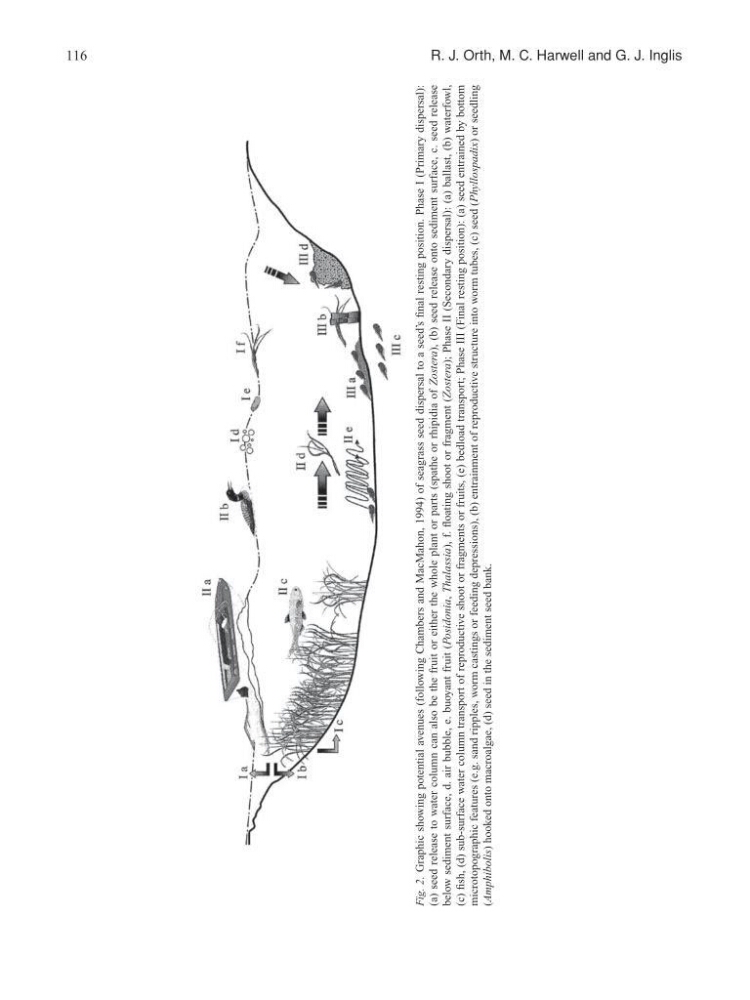
Fig. 2.
Graphic showing potential avenues (following Chambers and MacMahon, 1994) of seagrass seed dispersal to a seed’s final resting position. Phase I (Primary dispersal):
(a) seed release to water column can also be the fruit or either the whole plant or parts (spathe or rhipidia of Zostera), (b) seed release onto sediment surface, c. seed release
below sediment surface, d. air bubble, e. buoyant fruit (Posidonia, Thalassia), f. floating shoot or fragment (Zostera); Phase II (Secondary dispersal): (a) ballast, (b) waterfowl,
(c) fish, (d) sub-surface water column transport of reproductive shoot or fragments or fruits, (e) bedload transport; Phase III (Final resting position): (a) seed entrained by bottom
microtopographic features (e.g. sand ripples, worm castings or feeding depressions), (b) entrainment of reproductive structure into worm tubes, (c) seed (Phyllospadix) or seedling
(Amphibolis) hooked onto macroalgae, (d) seed in the sediment seed bank.
R. J. Orth, M. C. Harwell and G. J. Inglis
Fig. 2.
Graphic showing potential avenues (following Chambers and MacMahon, 1994) of seagrass seed dispersal to a seed’s final resting position. Phase I (Primary dispersal):
(a) seed release to water column can also be the fruit or either the whole plant or parts (spathe or rhipidia of Zostera), (b) seed release onto sediment surface, c. seed release
below sediment surface, d. air bubble, e. buoyant fruit (Posidonia, Thalassia), f. floating shoot or fragment (Zostera); Phase II (Secondary dispersal): (a) ballast, (b) waterfowl,
(c) fish, (d) sub-surface water column transport of reproductive shoot or fragments or fruits, (e) bedload transport; Phase III (Final resting position): (a) seed entrained by bottom
microtopographic features (e.g. sand ripples, worm castings or feeding depressions), (b) entrainment of reproductive structure into worm tubes, (c) seed (Phyllospadix) or seedling
(Amphibolis) hooked onto macroalgae, (d) seed in the sediment seed bank.