

Chapter 5 Seagrass Seeds and Dispersal Strategies
117
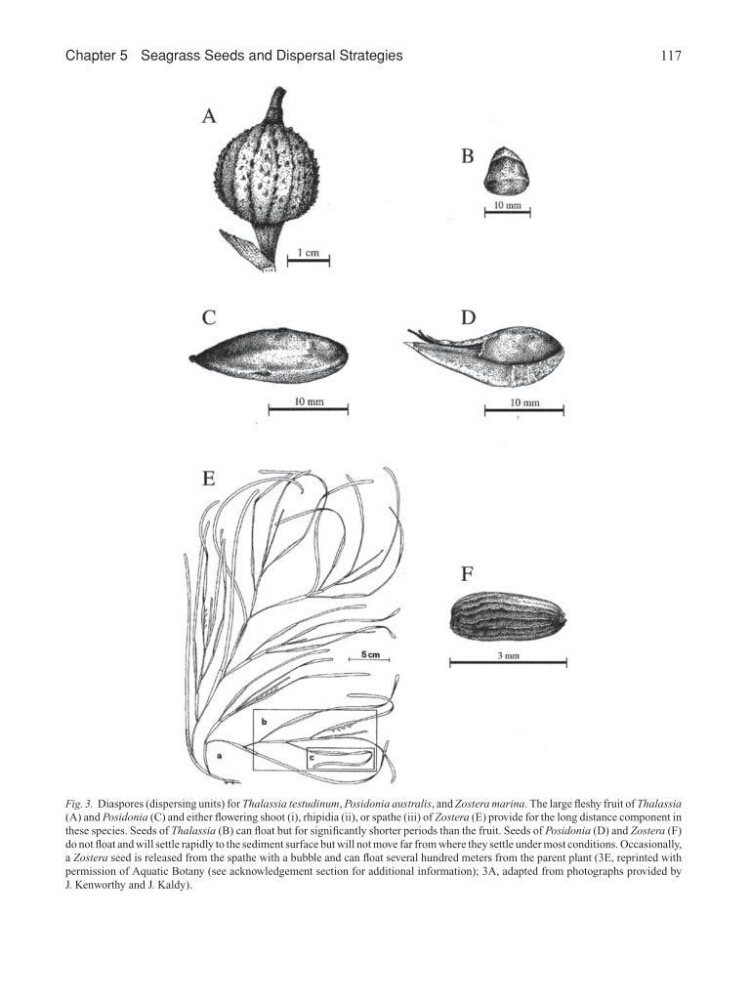
Fig. 3. Diaspores (dispersing units) for Thalassia testudinum, Posidonia australis, and Zostera marina. The large fleshy fruit of Thalassia
(A) and Posidonia (C) and either flowering shoot (i), rhipidia (ii), or spathe (iii) of Zostera (E) provide for the long distance component in
these species. Seeds of Thalassia (B) can float but for significantly shorter periods than the fruit. Seeds of Posidonia (D) and Zostera (F)
do not float and will settle rapidly to the sediment surface but will not move far from where they settle under most conditions. Occasionally,
a Zostera seed is released from the spathe with a bubble and can float several hundred meters from the parent plant (3E, reprinted with
permission of Aquatic Botany (see acknowledgement section for additional information); 3A, adapted from photographs provided by
J. Kenworthy and J. Kaldy).
117
Fig. 3. Diaspores (dispersing units) for Thalassia testudinum, Posidonia australis, and Zostera marina. The large fleshy fruit of Thalassia
(A) and Posidonia (C) and either flowering shoot (i), rhipidia (ii), or spathe (iii) of Zostera (E) provide for the long distance component in
these species. Seeds of Thalassia (B) can float but for significantly shorter periods than the fruit. Seeds of Posidonia (D) and Zostera (F)
do not float and will settle rapidly to the sediment surface but will not move far from where they settle under most conditions. Occasionally,
a Zostera seed is released from the spathe with a bubble and can float several hundred meters from the parent plant (3E, reprinted with
permission of Aquatic Botany (see acknowledgement section for additional information); 3A, adapted from photographs provided by
J. Kenworthy and J. Kaldy).