

The Black Sea
441
between 0.5 - 32 m depth. Depending on the area and season, the biomass
ranges between 1.5-8.0 kg m- 2 and may reach up to 21 kgm- 2
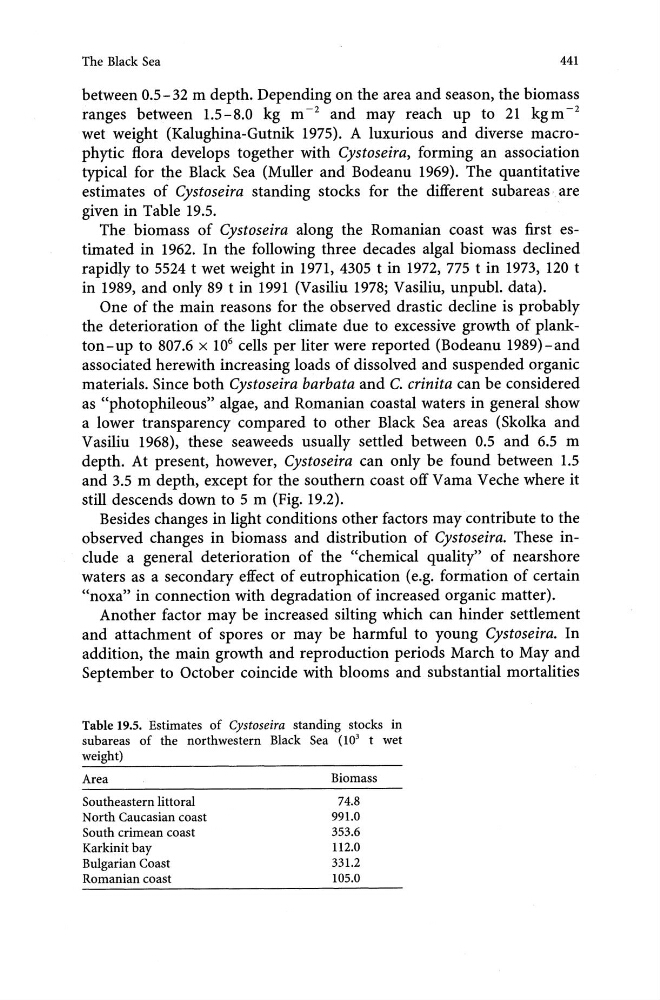
wet weight (Kalughina-Gutnik 1975). A luxurious and diverse macrophytic flora develops together with Cystoseira, forming an association
typical for the Black Sea (Muller and Bodeanu 1969). The quantitative
estimates of Cystoseira standing stocks for the different subareas are
given in Table 19.5.
The biomass of Cystoseira along the Romanian coast was first estimated in 1962. In the following three decades algal biomass declined
rapidly to 5524 t wet weight in 1971, 4305 t in 1972, 775 t in 1973, 120 t
in 1989, and only 89 t in 1991 (Vasiliu 1978; Vasiliu, unpubl. data).
One of the main reasons for the observed drastic decline is probably
the deterioration of the light climate due to excessive growth of plankton-up to 807.6 x 10 6 cells per liter were reported (Bodeanu 1989)-and
associated herewith increasing loads of dissolved and suspended organic
materials. Since both Cystoseira barbata and C. crinita can be considered
as "photophileous" algae, and Romanian coastal waters in general show
a lower transparency compared to other Black Sea areas (Skolka and
Vasiliu 1968), these seaweeds usually settled between 0.5 and 6.5 m
depth. At present, however, Cystoseira can only be found between 1.5
and 3.5 m depth, except for the southern coast off Varna Veche where it
still descends down to 5 m (Fig. 19.2).
Besides changes in light conditions other factors may contribute to the
observed changes in biomass and distribution of Cystoseira. These include a general deterioration of the "chemical quality" of nearshore
waters as a secondary effect of eutrophication (e.g. formation of certain
"noxa" in connection with degradation of increased organic matter).
Another factor may be increased silting which can hinder settlement
and attachment of spores or may be harmful to young Cystoseira. In
addition, the main growth and reproduction periods March to May and
September to October coincide with blooms and substantial mortalities
Table 19.5. Estimates of Cystoseira standing stocks in
subareas of the northwestern Black Sea (10 3 t wet
weight)
Area
Southeastern littoral
North Caucasian coast
South crimean coast
Karkinit bay
Bulgarian Coast
Romanian coast
Biomass
74.8
991.0
353.6
112.0
331.2
105.0
441
between 0.5 - 32 m depth. Depending on the area and season, the biomass
ranges between 1.5-8.0 kg m- 2 and may reach up to 21 kgm- 2
wet weight (Kalughina-Gutnik 1975). A luxurious and diverse macrophytic flora develops together with Cystoseira, forming an association
typical for the Black Sea (Muller and Bodeanu 1969). The quantitative
estimates of Cystoseira standing stocks for the different subareas are
given in Table 19.5.
The biomass of Cystoseira along the Romanian coast was first estimated in 1962. In the following three decades algal biomass declined
rapidly to 5524 t wet weight in 1971, 4305 t in 1972, 775 t in 1973, 120 t
in 1989, and only 89 t in 1991 (Vasiliu 1978; Vasiliu, unpubl. data).
One of the main reasons for the observed drastic decline is probably
the deterioration of the light climate due to excessive growth of plankton-up to 807.6 x 10 6 cells per liter were reported (Bodeanu 1989)-and
associated herewith increasing loads of dissolved and suspended organic
materials. Since both Cystoseira barbata and C. crinita can be considered
as "photophileous" algae, and Romanian coastal waters in general show
a lower transparency compared to other Black Sea areas (Skolka and
Vasiliu 1968), these seaweeds usually settled between 0.5 and 6.5 m
depth. At present, however, Cystoseira can only be found between 1.5
and 3.5 m depth, except for the southern coast off Varna Veche where it
still descends down to 5 m (Fig. 19.2).
Besides changes in light conditions other factors may contribute to the
observed changes in biomass and distribution of Cystoseira. These include a general deterioration of the "chemical quality" of nearshore
waters as a secondary effect of eutrophication (e.g. formation of certain
"noxa" in connection with degradation of increased organic matter).
Another factor may be increased silting which can hinder settlement
and attachment of spores or may be harmful to young Cystoseira. In
addition, the main growth and reproduction periods March to May and
September to October coincide with blooms and substantial mortalities
Table 19.5. Estimates of Cystoseira standing stocks in
subareas of the northwestern Black Sea (10 3 t wet
weight)
Area
Southeastern littoral
North Caucasian coast
South crimean coast
Karkinit bay
Bulgarian Coast
Romanian coast
Biomass
74.8
991.0
353.6
112.0
331.2
105.0