

440
F. Vasiliu
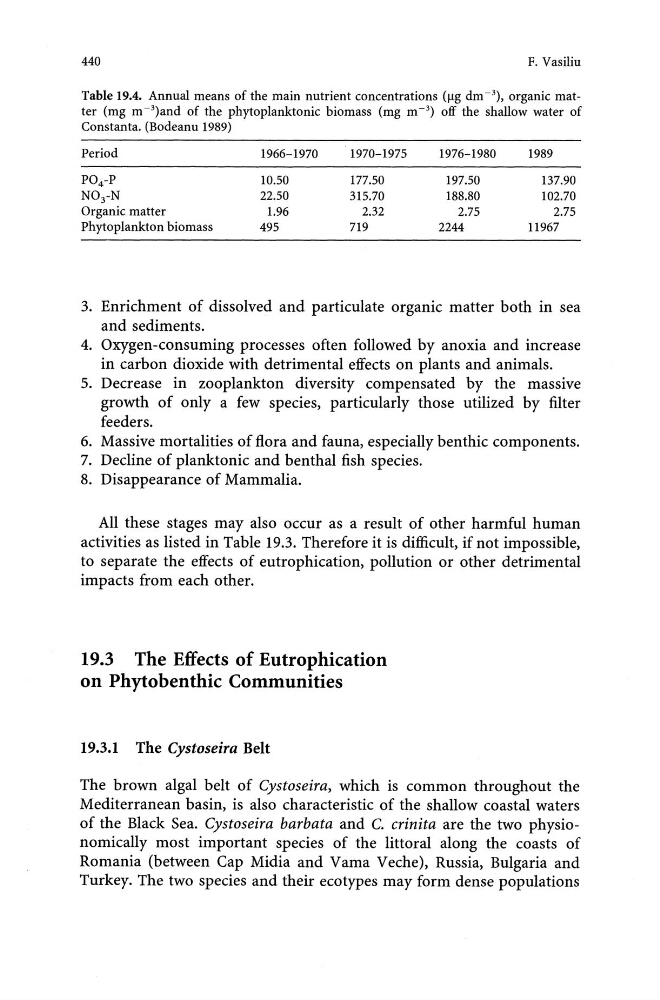
Table 19.4. Annual means of the main nutrient concentrations (I-!g dm- 3 ), organic matter (mg m- 3 )and of the phytoplanktonic biomass (mg m- 3 ) off the shallow water of
Constanta. (Bodeanu 1989)
Period
1966-1970
1970-1975
1976-1980
1989
P0 4 -P
10.50
177.50
197.50
137.90
N0 3 -N
22.50
315.70
188.80
102.70
Organic matter
1.96
2.32
2.75
2.75
Phytoplankton biomass
495
719
2244
11967
3. Enrichment of dissolved and particulate organic matter both in sea
and sediments.
4. Oxygen-consuming processes often followed by anoxia and increase
in carbon dioxide with detrimental effects on plants and animals.
5. Decrease in zooplankton diversity compensated by the massive
growth of only a few species, particularly those utilized by filter
feeders.
6. Massive mortalities of flora and fauna, especially benthic components.
7. Decline of planktonic and benthal fish species.
8. Disappearance of Mammalia.
All these stages may also occur as a result of other harmful human
activities as listed in Table 19.3. Therefore it is difficult, if not impossible,
to separate the effects of eutrophication, pollution or other detrimental
impacts from each other.
19.3 The Effects of Eutrophication
on Phytobenthic Communities
19.3.1 The Cystoseira Belt
The brown algal belt of Cystoseira, which is common throughout the
Mediterranean basin, is also characteristic of the shallow coastal waters
of the Black Sea. Cystoseira barbata and C. crinita are the two physionomically most important species of the littoral along the coasts of
Romania (between Cap Midia and Varna Veche), Russia, Bulgaria and
Turkey. The two species and their ecotypes may form dense populations
F. Vasiliu
Table 19.4. Annual means of the main nutrient concentrations (I-!g dm- 3 ), organic matter (mg m- 3 )and of the phytoplanktonic biomass (mg m- 3 ) off the shallow water of
Constanta. (Bodeanu 1989)
Period
1966-1970
1970-1975
1976-1980
1989
P0 4 -P
10.50
177.50
197.50
137.90
N0 3 -N
22.50
315.70
188.80
102.70
Organic matter
1.96
2.32
2.75
2.75
Phytoplankton biomass
495
719
2244
11967
3. Enrichment of dissolved and particulate organic matter both in sea
and sediments.
4. Oxygen-consuming processes often followed by anoxia and increase
in carbon dioxide with detrimental effects on plants and animals.
5. Decrease in zooplankton diversity compensated by the massive
growth of only a few species, particularly those utilized by filter
feeders.
6. Massive mortalities of flora and fauna, especially benthic components.
7. Decline of planktonic and benthal fish species.
8. Disappearance of Mammalia.
All these stages may also occur as a result of other harmful human
activities as listed in Table 19.3. Therefore it is difficult, if not impossible,
to separate the effects of eutrophication, pollution or other detrimental
impacts from each other.
19.3 The Effects of Eutrophication
on Phytobenthic Communities
19.3.1 The Cystoseira Belt
The brown algal belt of Cystoseira, which is common throughout the
Mediterranean basin, is also characteristic of the shallow coastal waters
of the Black Sea. Cystoseira barbata and C. crinita are the two physionomically most important species of the littoral along the coasts of
Romania (between Cap Midia and Varna Veche), Russia, Bulgaria and
Turkey. The two species and their ecotypes may form dense populations