

Greece
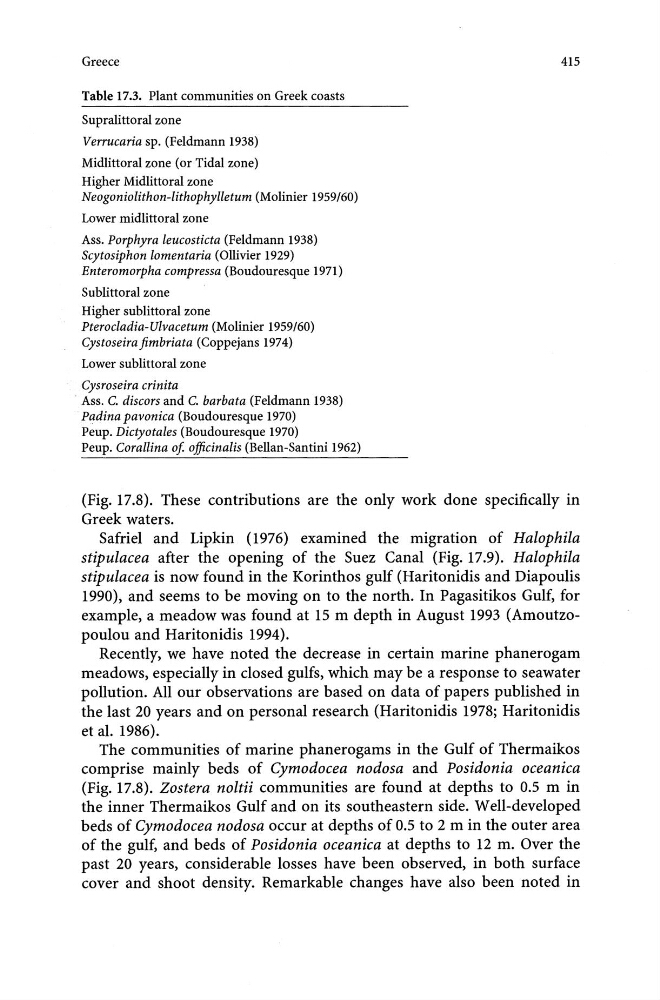
Table 17.3. Plant communities on Greek coasts
Supralittoral zone
Verrucaria sp. (Feldmann 1938)
Midlittoral zone (or Tidal zone)
Higher Midlittoral zone
Neogoniolithon-lithophylletum (Molinier 1959/60)
Lower midlittoral zone
Ass. Porphyra leucosticta (Feldmann 1938)
Scytosiphon lomentaria (Ollivier 1929)
Enteromorpha compressa (Boudouresque 1971)
Sublittoral zone
Higher sublittoral zone
Pterocladia-Ulvacetum (Molinier 1959/60)
Cystoseira fimbriata (Coppejans 1974)
Lower sublittoral zone
Cysroseira crinita
Ass. C. discors and C. barbata (Feldmann 1938)
Padina pavonica (Boudouresque 1970)
Peup. Dictyotales (Boudouresque 1970)
Peup. Corallina of officinalis (BeHan-Santini 1962)
415
(Fig. 17.8). These contributions are the only work done specifically in
Greek waters.
Safriel and Lipkin (1976) examined the migration of Halophila
stipulacea after the opening of the Suez Canal (Fig. 17.9). Halophila
stipulacea is now found in the Korinthos gulf (Haritonidis and Diapoulis
1990), and seems to be moving on to the north. In Pagasitikos Gulf, for
example, a meadow was found at 15 m depth in August 1993 (Amoutzopoulou and Haritonidis 1994).
Recently, we have noted the decrease in certain marine phanerogam
meadows, especially in closed gulfs, which may be a response to seawater
pollution. All our observations are based on data of papers published in
the last 20 years and on personal research (Haritonidis 1978; Haritonidis
et al. 1986).
The communities of marine phanerogams in the Gulf of Thermaikos
comprise mainly beds of Cymodocea nodosa and Posidonia oceanica
(Fig. 17.8). Zostera noltii communities are found at depths to 0.5 m in
the inner Thermaikos Gulf and on its southeastern side. Well-developed
beds of Cymodocea nodosa occur at depths of 0.5 to 2 m in the outer area
of the gulf, and beds of Posidonia oceanica at depths to 12 m. Over the
past 20 years, considerable losses have been observed, in both surface
cover and shoot density. Remarkable changes have also been noted in
Table 17.3. Plant communities on Greek coasts
Supralittoral zone
Verrucaria sp. (Feldmann 1938)
Midlittoral zone (or Tidal zone)
Higher Midlittoral zone
Neogoniolithon-lithophylletum (Molinier 1959/60)
Lower midlittoral zone
Ass. Porphyra leucosticta (Feldmann 1938)
Scytosiphon lomentaria (Ollivier 1929)
Enteromorpha compressa (Boudouresque 1971)
Sublittoral zone
Higher sublittoral zone
Pterocladia-Ulvacetum (Molinier 1959/60)
Cystoseira fimbriata (Coppejans 1974)
Lower sublittoral zone
Cysroseira crinita
Ass. C. discors and C. barbata (Feldmann 1938)
Padina pavonica (Boudouresque 1970)
Peup. Dictyotales (Boudouresque 1970)
Peup. Corallina of officinalis (BeHan-Santini 1962)
415
(Fig. 17.8). These contributions are the only work done specifically in
Greek waters.
Safriel and Lipkin (1976) examined the migration of Halophila
stipulacea after the opening of the Suez Canal (Fig. 17.9). Halophila
stipulacea is now found in the Korinthos gulf (Haritonidis and Diapoulis
1990), and seems to be moving on to the north. In Pagasitikos Gulf, for
example, a meadow was found at 15 m depth in August 1993 (Amoutzopoulou and Haritonidis 1994).
Recently, we have noted the decrease in certain marine phanerogam
meadows, especially in closed gulfs, which may be a response to seawater
pollution. All our observations are based on data of papers published in
the last 20 years and on personal research (Haritonidis 1978; Haritonidis
et al. 1986).
The communities of marine phanerogams in the Gulf of Thermaikos
comprise mainly beds of Cymodocea nodosa and Posidonia oceanica
(Fig. 17.8). Zostera noltii communities are found at depths to 0.5 m in
the inner Thermaikos Gulf and on its southeastern side. Well-developed
beds of Cymodocea nodosa occur at depths of 0.5 to 2 m in the outer area
of the gulf, and beds of Posidonia oceanica at depths to 12 m. Over the
past 20 years, considerable losses have been observed, in both surface
cover and shoot density. Remarkable changes have also been noted in