

414
300
200
i
100
o
c
• NO:!-N
y .10.989 ·10"'6(·2.8591e-2x)
• NO:!·N y .38.341 ·10 A (-2.1732e-2x)
o N!4-N y.371.43·10 A (-6.39708-2x)
• PO.-p
y_ 40.302 '10 A (-6.4266e-3x)
120
Time (hours)
240
S. Haritonidis
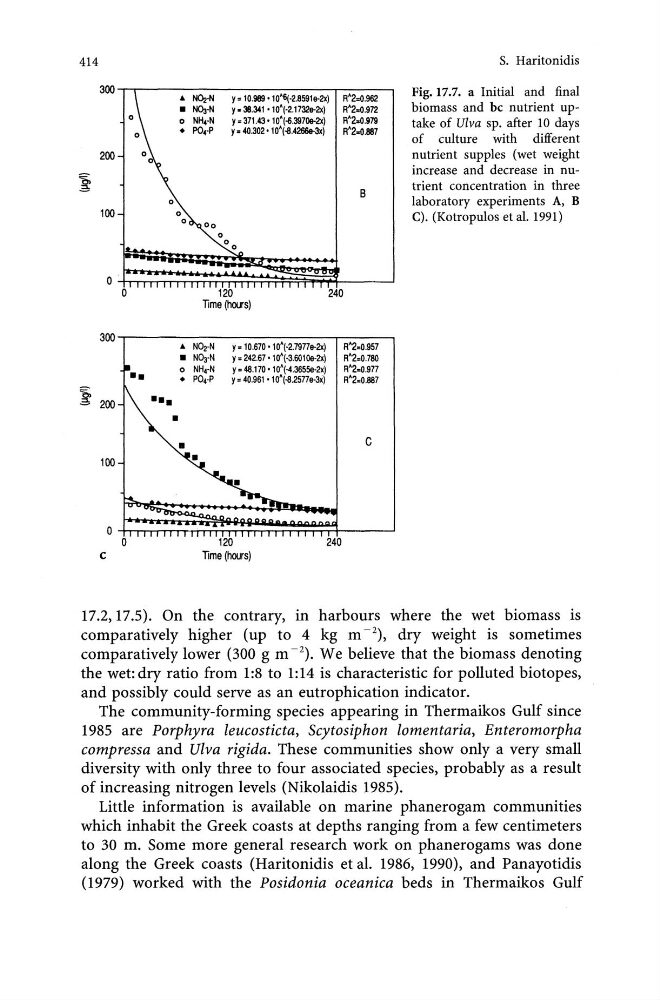
Fig. 17.7. a Initial and final
RA2-O.962
R A 2.o.972
biomass and bc nutrient upR A 2.0.979
take of Ulva sp. after 10 days
R A 2.o.887
of culture with different
nutrient supples (wet weight
increase and decrease in nuB
trient concentration in three
laboratory experiments A, B
C). (Kotropulos et al. 1991)
17.2,17.5). On the contrary, in harbours where the wet biomass is
comparatively higher (up to 4 kg m- 2 ), dry weight is sometimes
comparatively lower (300 g m -2). We believe that the biomass denoting
the wet: dry ratio from 1:8 to 1:14 is characteristic for polluted biotopes,
and possibly could serve as an eutrophication indicator.
The community-forming species appearing in Thermaikos Gulf since
1985 are Porphyra leucosticta, Scytosiphon lomentaria, Enteromorpha
compressa and Ulva rigida. These communities show only a very small
diversity with only three to four associated species, probably as a result
of increasing nitrogen levels (Nikolaidis 1985).
Little information is available on marine phanerogam communities
which inhabit the Greek coasts at depths ranging from a few centimeters
to 30 m. Some more general research work on phanerogams was done
along the Greek coasts (Haritonidis et al. 1986, 1990), and Panayotidis
(1979) worked with the Posidonia oceanica beds in Thermaikos Gulf
300
200
i
100
o
c
• NO:!-N
y .10.989 ·10"'6(·2.8591e-2x)
• NO:!·N y .38.341 ·10 A (-2.1732e-2x)
o N!4-N y.371.43·10 A (-6.39708-2x)
• PO.-p
y_ 40.302 '10 A (-6.4266e-3x)
120
Time (hours)
240
S. Haritonidis
Fig. 17.7. a Initial and final
RA2-O.962
R A 2.o.972
biomass and bc nutrient upR A 2.0.979
take of Ulva sp. after 10 days
R A 2.o.887
of culture with different
nutrient supples (wet weight
increase and decrease in nuB
trient concentration in three
laboratory experiments A, B
C). (Kotropulos et al. 1991)
17.2,17.5). On the contrary, in harbours where the wet biomass is
comparatively higher (up to 4 kg m- 2 ), dry weight is sometimes
comparatively lower (300 g m -2). We believe that the biomass denoting
the wet: dry ratio from 1:8 to 1:14 is characteristic for polluted biotopes,
and possibly could serve as an eutrophication indicator.
The community-forming species appearing in Thermaikos Gulf since
1985 are Porphyra leucosticta, Scytosiphon lomentaria, Enteromorpha
compressa and Ulva rigida. These communities show only a very small
diversity with only three to four associated species, probably as a result
of increasing nitrogen levels (Nikolaidis 1985).
Little information is available on marine phanerogam communities
which inhabit the Greek coasts at depths ranging from a few centimeters
to 30 m. Some more general research work on phanerogams was done
along the Greek coasts (Haritonidis et al. 1986, 1990), and Panayotidis
(1979) worked with the Posidonia oceanica beds in Thermaikos Gulf