

416
THESSALONIKI
~ Cymodocea nodosa
!nIl Zoslera nollil
S. Haritonidis
~ Posidonia oceanica 100% I
t!J
60%1
~
40%1
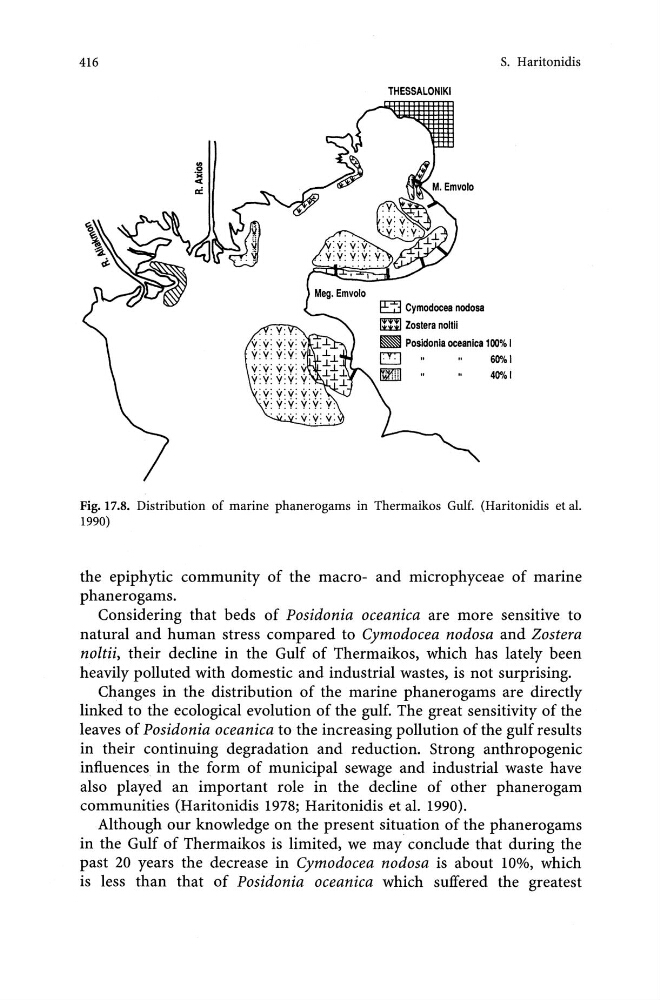
Fig. 17.8. Distribution of marine phanerogams in Thermaikos Gulf. (Haritonidis et aI.
1990)
the epiphytic community of the macro- and microphyceae of marine
phanerogams.
Considering that beds of Posidonia oceanica are more sensitive to
natural and human stress compared to Cymodocea nodosa and Zostera
noltii, their decline in the Gulf of Thermaikos, which has lately been
heavily polluted with domestic and industrial wastes, is not surprising.
Changes in the distribution of the marine phanerogams are directly
linked to the ecological evolution of the gulf. The great sensitivity of the
leaves of Posidonia oceanica to the increasing pollution of the gulf results
in their continuing degradation and reduction. Strong anthropogenic
influences in the form of municipal sewage and industrial waste have
also played an important role in the decline of other phanerogam
communities (Haritonidis 1978; Haritonidis et aI. 1990).
Although our knowledge on the present situation of the phanerogams
in the Gulf of Thermaikos is limited, we may conclude that during the
past 20 years the decrease in Cymodocea nodosa is about 10%, which
is less than that of Posidonia oceanica which suffered the greatest
THESSALONIKI
~ Cymodocea nodosa
!nIl Zoslera nollil
S. Haritonidis
~ Posidonia oceanica 100% I
t!J
60%1
~
40%1
Fig. 17.8. Distribution of marine phanerogams in Thermaikos Gulf. (Haritonidis et aI.
1990)
the epiphytic community of the macro- and microphyceae of marine
phanerogams.
Considering that beds of Posidonia oceanica are more sensitive to
natural and human stress compared to Cymodocea nodosa and Zostera
noltii, their decline in the Gulf of Thermaikos, which has lately been
heavily polluted with domestic and industrial wastes, is not surprising.
Changes in the distribution of the marine phanerogams are directly
linked to the ecological evolution of the gulf. The great sensitivity of the
leaves of Posidonia oceanica to the increasing pollution of the gulf results
in their continuing degradation and reduction. Strong anthropogenic
influences in the form of municipal sewage and industrial waste have
also played an important role in the decline of other phanerogam
communities (Haritonidis 1978; Haritonidis et aI. 1990).
Although our knowledge on the present situation of the phanerogams
in the Gulf of Thermaikos is limited, we may conclude that during the
past 20 years the decrease in Cymodocea nodosa is about 10%, which
is less than that of Posidonia oceanica which suffered the greatest