

Greece
407
17.3 The Gulf of Thessaloniki
The Gulf of Thessaloniki has some specific features which constitute its
peculiar environment: the shallow depth, the narrow opening to the
northern Aegean, and the rivers which discharge thousands of tons of
wastewaters daily (annual average flow 150 m 3 S-I), enriched with
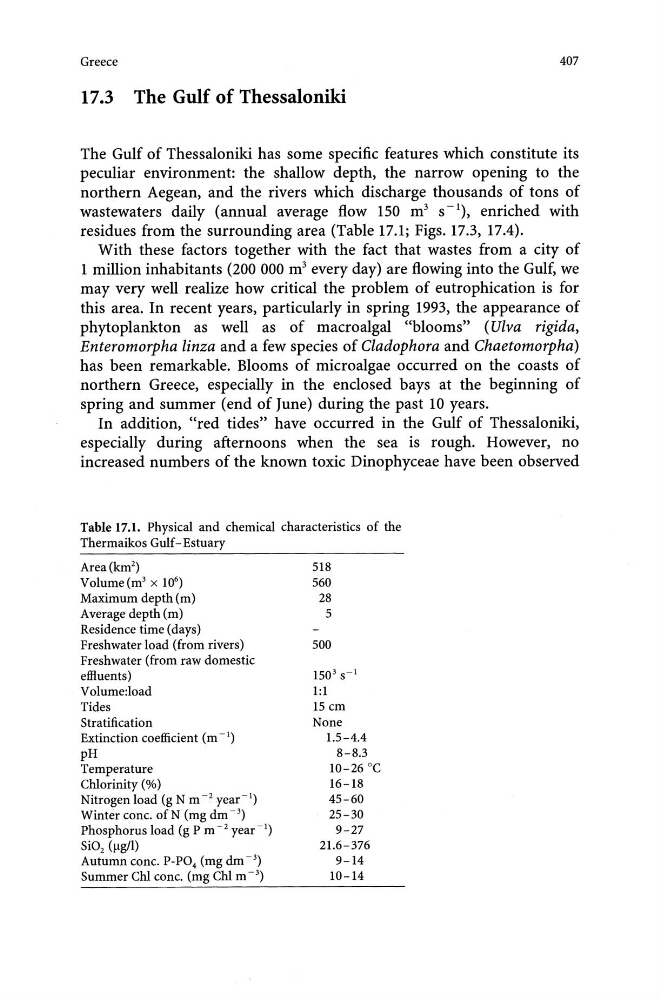
residues from the surrounding area (Table 17.1; Figs. 17.3, 17.4).
With these factors together with the fact that wastes from a city of
1 million inhabitants (200 000 m 3 every day) are flowing into the Gulf, we
may very well realize how critical the problem of eutrophication is for
this area. In recent years, particularly in spring 1993, the appearance of
phytoplankton as well as of macro algal "blooms" (Ulva rigida,
Enteromorpha linza and a few species of Cladophora and Chaetomorpha)
has been remarkable. Blooms of microalgae occurred on the coasts of
northern Greece, especially in the enclosed bays at the beginning of
spring and summer (end of June) during the past 10 years.
In addition, "red tides" have occurred in the Gulf of Thessaloniki,
especially during afternoons when the sea is rough. However, no
increased numbers of the known toxic Dinophyceae have been observed
Table 17.1. Physical and chemical characteristics of the
Thermaikos Gulf-Estuary
Area (km 2 )
Volume (m 3 x 10 6 )
Maximum depth (m)
Average depth(m)
Residence time (days)
Freshwater load (from rivers)
Freshwater (from raw domestic
effluents)
Volume:load
Tides
Stratification
Extinction coefficient (m -I)
pH
Temperature
Chlorinity (%)
Nitrogen load (g N m -2 year-I)
Winter conc. ofN (mg dm -3)
Phosphorus load (g P m -2 year-I)
Si0 2 (llg/l)
Autumn conc. P-P0 4 (mg dm- 3 )
Summer ChI conc. (mg ChI m -3)
518
560
28
5
500
15 cm
None
1.5-4.4
8-8.3
1O-26°C
16-18
45-60
25-30
9-27
21.6-376
9-14
10-14
407
17.3 The Gulf of Thessaloniki
The Gulf of Thessaloniki has some specific features which constitute its
peculiar environment: the shallow depth, the narrow opening to the
northern Aegean, and the rivers which discharge thousands of tons of
wastewaters daily (annual average flow 150 m 3 S-I), enriched with
residues from the surrounding area (Table 17.1; Figs. 17.3, 17.4).
With these factors together with the fact that wastes from a city of
1 million inhabitants (200 000 m 3 every day) are flowing into the Gulf, we
may very well realize how critical the problem of eutrophication is for
this area. In recent years, particularly in spring 1993, the appearance of
phytoplankton as well as of macro algal "blooms" (Ulva rigida,
Enteromorpha linza and a few species of Cladophora and Chaetomorpha)
has been remarkable. Blooms of microalgae occurred on the coasts of
northern Greece, especially in the enclosed bays at the beginning of
spring and summer (end of June) during the past 10 years.
In addition, "red tides" have occurred in the Gulf of Thessaloniki,
especially during afternoons when the sea is rough. However, no
increased numbers of the known toxic Dinophyceae have been observed
Table 17.1. Physical and chemical characteristics of the
Thermaikos Gulf-Estuary
Area (km 2 )
Volume (m 3 x 10 6 )
Maximum depth (m)
Average depth(m)
Residence time (days)
Freshwater load (from rivers)
Freshwater (from raw domestic
effluents)
Volume:load
Tides
Stratification
Extinction coefficient (m -I)
pH
Temperature
Chlorinity (%)
Nitrogen load (g N m -2 year-I)
Winter conc. ofN (mg dm -3)
Phosphorus load (g P m -2 year-I)
Si0 2 (llg/l)
Autumn conc. P-P0 4 (mg dm- 3 )
Summer ChI conc. (mg ChI m -3)
518
560
28
5
500
15 cm
None
1.5-4.4
8-8.3
1O-26°C
16-18
45-60
25-30
9-27
21.6-376
9-14
10-14