

408
2~
~ nautical miles
THESSALONIKI
29
.
N
I
S. Haritonidis
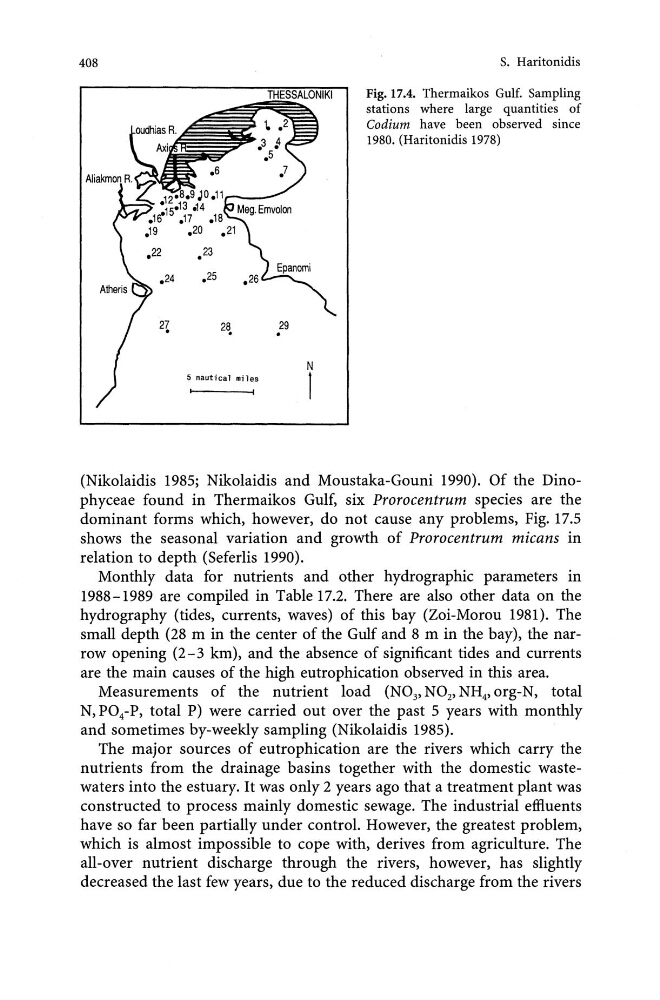
Fig. 17.4. Thermaikos Gulf. Sampling
stations where large quantities of
Codium have been observed since
1980. (Haritonidis 1978)
(Nikolaidis 1985; Nikolaidis and Moustaka-Gouni 1990). Of the Dinophyceae found in Thermaikos Gulf, six Prorocentrum species are the
dominant forms which, however, do not cause any problems, Fig. 17.5
shows the seasonal variation and growth of Prorocentrum micans in
relation to depth (Seferlis 1990).
Monthly data for nutrients and other hydrographic parameters in
1988-1989 are compiled in Table 17.2. There are also other data on the
hydrography (tides, currents, waves) of this bay (Zoi-Morou 1981). The
small depth (28 m in the center of the Gulf and 8 m in the bay), the narrow opening (2-3 km), and the absence of significant tides and currents
are the main causes of the high eutrophication observed in this area.
Measurements of the nutrient load (N0 3 , N0 2 , NH 4 , org-N, total
N, P0 4 -P, total P) were carried out over the past 5 years with monthly
and sometimes by-weekly sampling (Nikolaidis 1985).
The major sources of eutrophication are the rivers which carry the
nutrients from the drainage basins together with the domestic wastewaters into the estuary. It was only 2 years ago that a treatment plant was
constructed to process mainly domestic sewage. The industrial effluents
have so far been partially under control. However, the greatest problem,
which is almost impossible to cope with, derives from agriculture. The
all-over nutrient discharge through the rivers, however, has slightly
decreased the last few years, due to the reduced discharge from the rivers
2~
~ nautical miles
THESSALONIKI
29
.
N
I
S. Haritonidis
Fig. 17.4. Thermaikos Gulf. Sampling
stations where large quantities of
Codium have been observed since
1980. (Haritonidis 1978)
(Nikolaidis 1985; Nikolaidis and Moustaka-Gouni 1990). Of the Dinophyceae found in Thermaikos Gulf, six Prorocentrum species are the
dominant forms which, however, do not cause any problems, Fig. 17.5
shows the seasonal variation and growth of Prorocentrum micans in
relation to depth (Seferlis 1990).
Monthly data for nutrients and other hydrographic parameters in
1988-1989 are compiled in Table 17.2. There are also other data on the
hydrography (tides, currents, waves) of this bay (Zoi-Morou 1981). The
small depth (28 m in the center of the Gulf and 8 m in the bay), the narrow opening (2-3 km), and the absence of significant tides and currents
are the main causes of the high eutrophication observed in this area.
Measurements of the nutrient load (N0 3 , N0 2 , NH 4 , org-N, total
N, P0 4 -P, total P) were carried out over the past 5 years with monthly
and sometimes by-weekly sampling (Nikolaidis 1985).
The major sources of eutrophication are the rivers which carry the
nutrients from the drainage basins together with the domestic wastewaters into the estuary. It was only 2 years ago that a treatment plant was
constructed to process mainly domestic sewage. The industrial effluents
have so far been partially under control. However, the greatest problem,
which is almost impossible to cope with, derives from agriculture. The
all-over nutrient discharge through the rivers, however, has slightly
decreased the last few years, due to the reduced discharge from the rivers