

406
S. Haritonidis
Meg. Emvolo
SCALE
1 :250.000
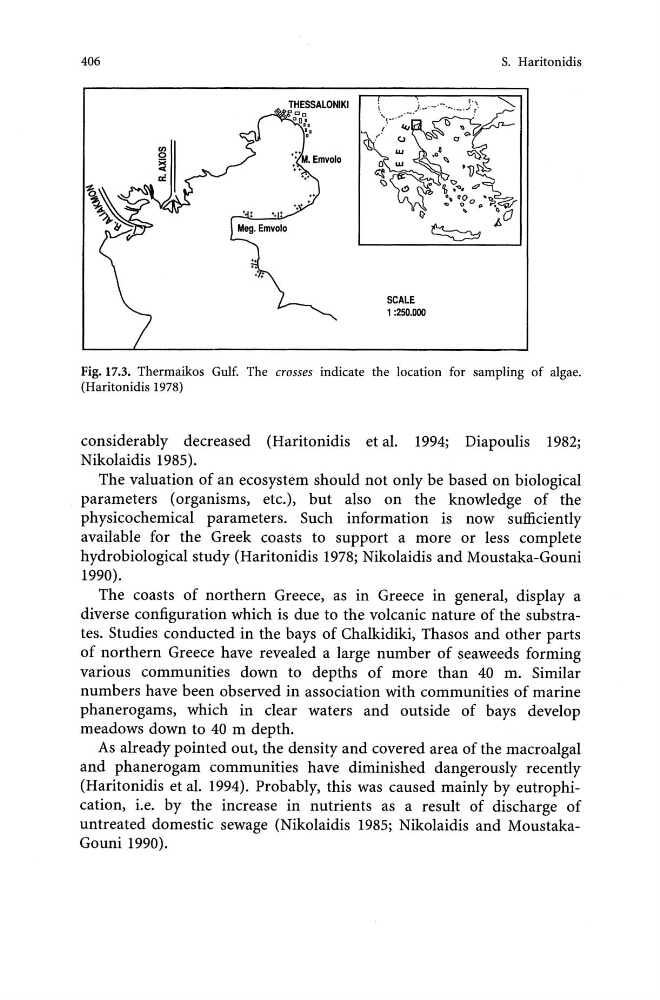
Fig. 17.3. Thermaikos Gulf. The crosses indicate the location for sampling of algae.
(Haritonidis 1978)
considerably decreased (Haritonidis et al. 1994; Diapoulis 1982;
Nikolaidis 1985).
The valuation of an ecosystem should not only be based on biological
parameters (organisms, etc.), but also on the knowledge of the
physicochemical parameters. Such information is now sufficiently
available for the Greek coasts to support a more or less complete
hydrobiological study (Haritonidis 1978; Nikolaidis and Moustaka-Gouni
1990).
The coasts of northern Greece, as in Greece in general, display a
diverse configuration which is due to the volcanic nature of the substrates. Studies conducted in the bays of Chalkidiki, Thasos and other parts
of northern Greece have revealed a large number of seaweeds forming
various communities down to depths of more than 40 m. Similar
numbers have been observed in association with communities of marine
phanerogams, which in clear waters and outside of bays develop
meadows down to 40 m depth.
As already pointed out, the density and covered area of the macro algal
and phanerogam communities have diminished dangerously recently
(Haritonidis et al. 1994). Probably, this was caused mainly by eutrophication, i.e. by the increase in nutrients as a result of discharge of
untreated domestic sewage (Nikolaidis 1985; Nikolaidis and MoustakaGouni 1990).
S. Haritonidis
Meg. Emvolo
SCALE
1 :250.000
Fig. 17.3. Thermaikos Gulf. The crosses indicate the location for sampling of algae.
(Haritonidis 1978)
considerably decreased (Haritonidis et al. 1994; Diapoulis 1982;
Nikolaidis 1985).
The valuation of an ecosystem should not only be based on biological
parameters (organisms, etc.), but also on the knowledge of the
physicochemical parameters. Such information is now sufficiently
available for the Greek coasts to support a more or less complete
hydrobiological study (Haritonidis 1978; Nikolaidis and Moustaka-Gouni
1990).
The coasts of northern Greece, as in Greece in general, display a
diverse configuration which is due to the volcanic nature of the substrates. Studies conducted in the bays of Chalkidiki, Thasos and other parts
of northern Greece have revealed a large number of seaweeds forming
various communities down to depths of more than 40 m. Similar
numbers have been observed in association with communities of marine
phanerogams, which in clear waters and outside of bays develop
meadows down to 40 m depth.
As already pointed out, the density and covered area of the macro algal
and phanerogam communities have diminished dangerously recently
(Haritonidis et al. 1994). Probably, this was caused mainly by eutrophication, i.e. by the increase in nutrients as a result of discharge of
untreated domestic sewage (Nikolaidis 1985; Nikolaidis and MoustakaGouni 1990).