

Greece
405
Cosmopolitan
J F M
J A 5
0 N 0
Sryopsis hypnoides
Chaetomorpha linum
Enteromorpha compresse
Enteromorpha linza
Ulva rigida
Oictyopteris membranacea
DictyoIa dichotoma
Feldmannia inegularis
Giffordia mitchellae
5cytosiphon tomentaria
Bangia fuscopurpurea
Pterothamnion plumula
Girtina teedii
Gracilaria bursa-pastoris
Gracilaria verrucosa
Jania rubens
Laurencia obtuse
---_.-------.Laurencia pinnatifida
- - , - - - - - - ' - -
Porphyra teucostica
-... ~----~Spyridia filamentosa
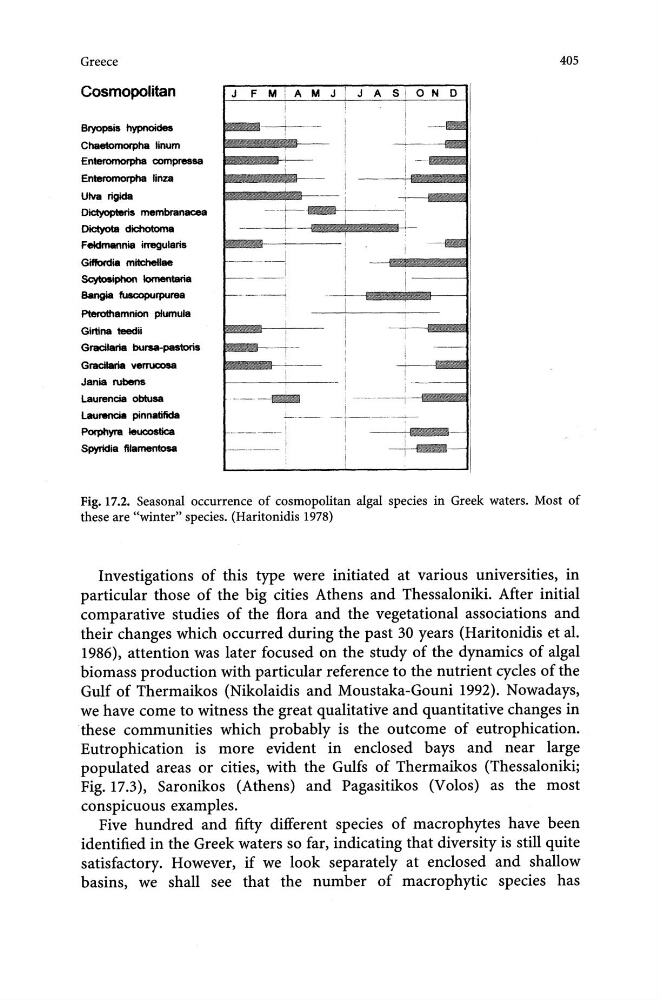
Fig. 17.2. Seasonal occurrence of cosmopolitan algal species in Greek waters. Most of
these are "winter" species. (Haritonidis 1978)
Investigations of this type were initiated at various universities, in
particular those of the big cities Athens and Thessaloniki. After initial
comparative studies of the flora and the vegetational associations and
their changes which occurred during the past 30 years (Haritonidis et al.
1986), attention was later focused on the study of the dynamics of algal
biomass production with particular reference to the nutrient cycles of the
Gulf of Thermaikos (Nikolaidis and Moustaka-Gouni 1992). Nowadays,
we have come to witness the great qualitative and quantitative changes in
these communities which probably is the outcome of eutrophication.
Eutrophication is more evident in enclosed bays and near large
populated areas or cities, with the Gulfs of Thermaikos (Thessaloniki;
Fig. 17.3), Saronikos (Athens) and Pagasitikos (Volos) as the most
conspicuous examples.
Five hundred and fifty different species of macrophytes have been
identified in the Greek waters so far, indicating that diversity is still quite
satisfactory. However, if we look separately at enclosed and shallow
basins, we shall see that the number of macrophytic species has
405
Cosmopolitan
J F M
J A 5
0 N 0
Sryopsis hypnoides
Chaetomorpha linum
Enteromorpha compresse
Enteromorpha linza
Ulva rigida
Oictyopteris membranacea
DictyoIa dichotoma
Feldmannia inegularis
Giffordia mitchellae
5cytosiphon tomentaria
Bangia fuscopurpurea
Pterothamnion plumula
Girtina teedii
Gracilaria bursa-pastoris
Gracilaria verrucosa
Jania rubens
Laurencia obtuse
---_.-------.Laurencia pinnatifida
- - , - - - - - - ' - -
Porphyra teucostica
-... ~----~Spyridia filamentosa
Fig. 17.2. Seasonal occurrence of cosmopolitan algal species in Greek waters. Most of
these are "winter" species. (Haritonidis 1978)
Investigations of this type were initiated at various universities, in
particular those of the big cities Athens and Thessaloniki. After initial
comparative studies of the flora and the vegetational associations and
their changes which occurred during the past 30 years (Haritonidis et al.
1986), attention was later focused on the study of the dynamics of algal
biomass production with particular reference to the nutrient cycles of the
Gulf of Thermaikos (Nikolaidis and Moustaka-Gouni 1992). Nowadays,
we have come to witness the great qualitative and quantitative changes in
these communities which probably is the outcome of eutrophication.
Eutrophication is more evident in enclosed bays and near large
populated areas or cities, with the Gulfs of Thermaikos (Thessaloniki;
Fig. 17.3), Saronikos (Athens) and Pagasitikos (Volos) as the most
conspicuous examples.
Five hundred and fifty different species of macrophytes have been
identified in the Greek waters so far, indicating that diversity is still quite
satisfactory. However, if we look separately at enclosed and shallow
basins, we shall see that the number of macrophytic species has