

362
350
300
250
200
150
100
~
A. Sfriso and A. Marcomini
TINIRP ATOMIC RATIO IN WATER
COLUMN
I!!
\ i
\
\J\
II \
50 ""~
a
19·Feb
~
~
"'-.
29·May
OS·Sep
15·0ec
25·Mar
TOTAL NIP ATOMIC RATIO IN SURFACE
SEDIMENT
03·Jul
14r------------------------------------------13
12+-------~---------------------------------11
7~=_~----~--_hd_~~~--~~------~~---S +-~E_ ______ ~ _________________ ~~~~-----5+-------~------~--------+_------~------~
19·Feb
29·May
OS.Sep
15·0ec
25·Mar
03·Jul
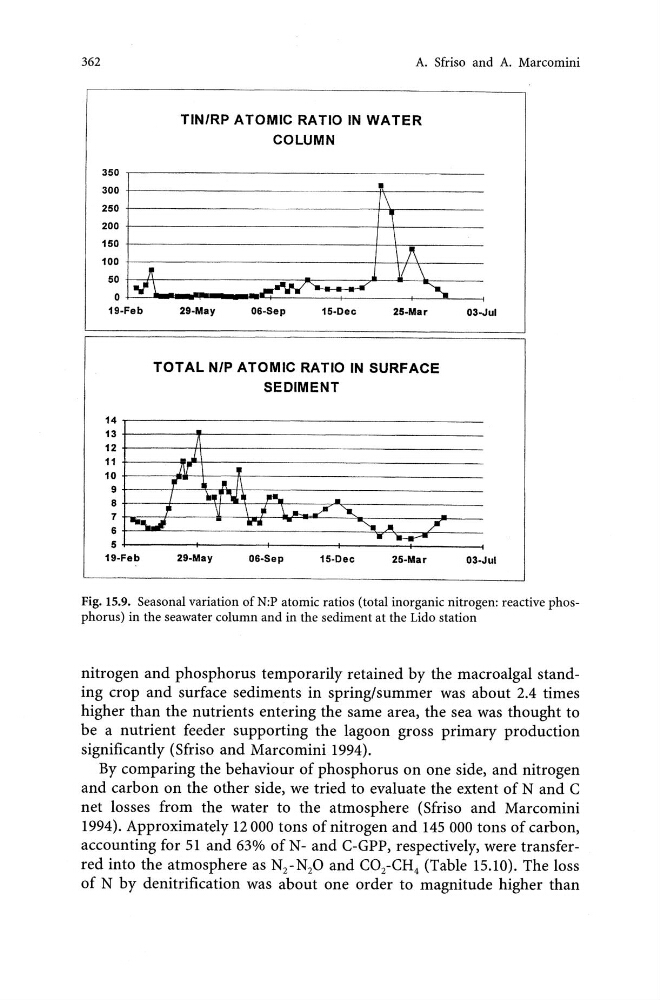
Fig. 15.9. Seasonal variation of N:P atomic ratios (total inorganic nitrogen: reactive phosphorus) in the seawater column and in the sediment at the Lido station
nitrogen and phosphorus temporarily retained by the macro algal standing crop and surface sediments in spring/summer was about 2.4 times
higher than the nutrients entering the same area, the sea was thought to
be a nutrient feeder supporting the lagoon gross primary production
significantly (Sfriso and Marcomini 1994).
By comparing the behaviour of phosphorus on one side, and nitrogen
and carbon on the other side, we tried to evaluate the extent of Nand C
net losses from the water to the atmosphere (Sfriso and Marcomini
1994). Approximately 12000 tons of nitrogen and 145 000 tons of carbon,
accounting for 51 and 63% of N- and C-GPP, respectively, were transferred into the atmosphere as N 2 -N 2 0 and CO 2 -CH 4 (Table 15.10). The loss
of N by denitrification was about one order to magnitude higher than
350
300
250
200
150
100
~
A. Sfriso and A. Marcomini
TINIRP ATOMIC RATIO IN WATER
COLUMN
I!!
\ i
\
\J\
II \
50 ""~
a
19·Feb
~
~
"'-.
29·May
OS·Sep
15·0ec
25·Mar
TOTAL NIP ATOMIC RATIO IN SURFACE
SEDIMENT
03·Jul
14r------------------------------------------13
12+-------~---------------------------------11
7~=_~----~--_hd_~~~--~~------~~---S +-~E_ ______ ~ _________________ ~~~~-----5+-------~------~--------+_------~------~
19·Feb
29·May
OS.Sep
15·0ec
25·Mar
03·Jul
Fig. 15.9. Seasonal variation of N:P atomic ratios (total inorganic nitrogen: reactive phosphorus) in the seawater column and in the sediment at the Lido station
nitrogen and phosphorus temporarily retained by the macro algal standing crop and surface sediments in spring/summer was about 2.4 times
higher than the nutrients entering the same area, the sea was thought to
be a nutrient feeder supporting the lagoon gross primary production
significantly (Sfriso and Marcomini 1994).
By comparing the behaviour of phosphorus on one side, and nitrogen
and carbon on the other side, we tried to evaluate the extent of Nand C
net losses from the water to the atmosphere (Sfriso and Marcomini
1994). Approximately 12000 tons of nitrogen and 145 000 tons of carbon,
accounting for 51 and 63% of N- and C-GPP, respectively, were transferred into the atmosphere as N 2 -N 2 0 and CO 2 -CH 4 (Table 15.10). The loss
of N by denitrification was about one order to magnitude higher than