

Italy - The Lagoon of Venice
363
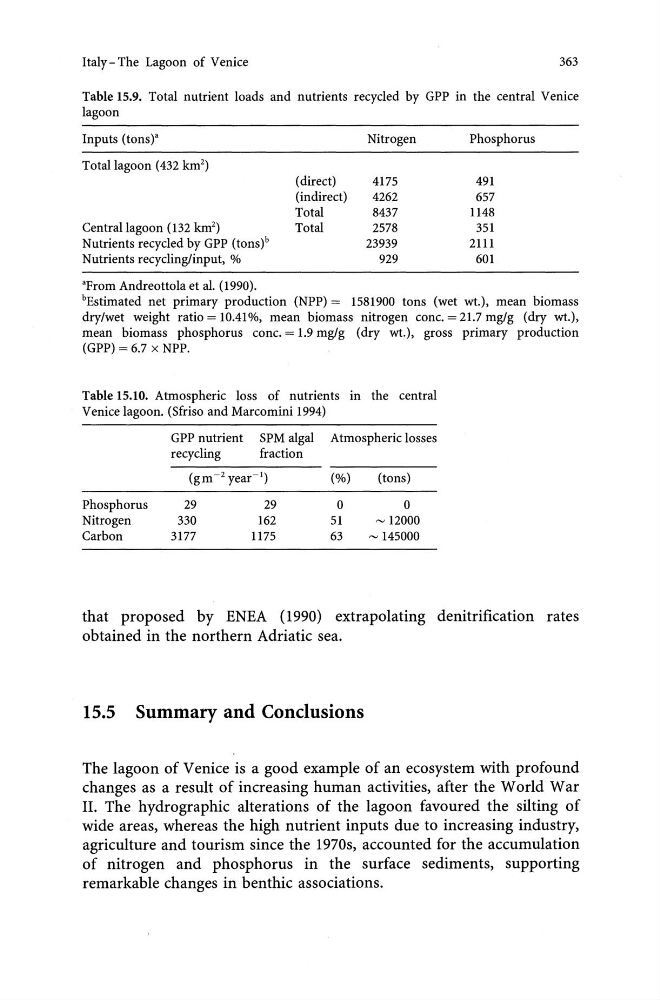
Table 15.9. Total nutrient loads and nutrients recycled by GPP in the central Venice
lagoon
Inputs (tons)'
Nitrogen
Phosphorus
Total lagoon (432 km 2 )
(direct)
4175
491
(indirect)
4262
657
Total
8437
1148
Central lagoon (132 km 2 )
Total
2578
351
Nutrients recycled by GPP (tons)b
23939
2111
Nutrients recycling/input, %
929
601
'From Andreottola et al. (1990).
bEstimated net primary production (NPP) = 1581900 tons (wet wt.), mean biomass
dry/wet weight ratio = 10.41%, mean biomass nitrogen conc. = 21.7 mg/g (dry wt.),
mean biomass phosphorus conc. = 1.9 mg/g (dry wt.), gross primary production
(GPP) = 6.7 x NPP.
Table 15.10. Atmospheric loss of nutrients in the central
Venice lagoon. (Sfriso and Marcomini 1994)
GPP nutrient SPM algal Atmospheric losses
recycling
fraction
(gm- 2 year-I)
(%)
(tons)
Phosphorus
29
29
0
0
Nitrogen
330
162
51
~ 12000
Carbon
3177
1175
63
~ 145000
that proposed by ENEA (1990) extrapolating denitrification rates
obtained in the northern Adriatic sea.
15.5 Summary and Conclusions
The lagoon of Venice is a good example of an ecosystem with profound
changes as a result of increasing human activities, after the Wodd War
II. The hydrographic alterations of the lagoon favoured the silting of
wide areas, whereas the high nutrient inputs due to increasing industry,
agriculture and tourism since the 1970s, accounted for the accumulation
of nitrogen and phosphorus in the surface sediments, supporting
remarkable changes in benthic associations.
363
Table 15.9. Total nutrient loads and nutrients recycled by GPP in the central Venice
lagoon
Inputs (tons)'
Nitrogen
Phosphorus
Total lagoon (432 km 2 )
(direct)
4175
491
(indirect)
4262
657
Total
8437
1148
Central lagoon (132 km 2 )
Total
2578
351
Nutrients recycled by GPP (tons)b
23939
2111
Nutrients recycling/input, %
929
601
'From Andreottola et al. (1990).
bEstimated net primary production (NPP) = 1581900 tons (wet wt.), mean biomass
dry/wet weight ratio = 10.41%, mean biomass nitrogen conc. = 21.7 mg/g (dry wt.),
mean biomass phosphorus conc. = 1.9 mg/g (dry wt.), gross primary production
(GPP) = 6.7 x NPP.
Table 15.10. Atmospheric loss of nutrients in the central
Venice lagoon. (Sfriso and Marcomini 1994)
GPP nutrient SPM algal Atmospheric losses
recycling
fraction
(gm- 2 year-I)
(%)
(tons)
Phosphorus
29
29
0
0
Nitrogen
330
162
51
~ 12000
Carbon
3177
1175
63
~ 145000
that proposed by ENEA (1990) extrapolating denitrification rates
obtained in the northern Adriatic sea.
15.5 Summary and Conclusions
The lagoon of Venice is a good example of an ecosystem with profound
changes as a result of increasing human activities, after the Wodd War
II. The hydrographic alterations of the lagoon favoured the silting of
wide areas, whereas the high nutrient inputs due to increasing industry,
agriculture and tourism since the 1970s, accounted for the accumulation
of nitrogen and phosphorus in the surface sediments, supporting
remarkable changes in benthic associations.