

318
.Cliffs
[::::::1 Seaweeds
~ Recently exploited area
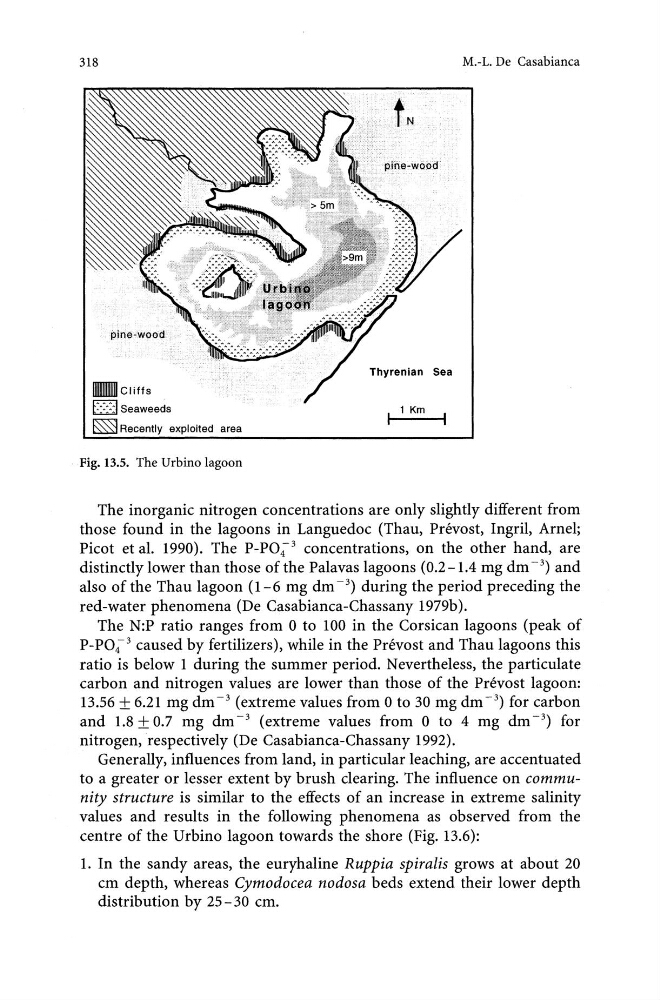
Fig. 13.5. The Urbino lagoon
M.-L. De Casabianca
Thyrenlan Sea
I 1 Km
The inorganic nitrogen concentrations are only slightly different from
those found in the lagoons in Languedoc (Thau, Prevost, Ingril, Arnel;
Picot et al. 1990). The P_PO;3 concentrations, on the other hand, are
distinctly lower than those of the Palavas lagoons (0.2 -1.4 mg dm -3) and
also of the Thau lagoon (1- 6 mg dm - 3) during the period preceding the
red-water phenomena (De Casabianca-Chassany 1979b).
The N:P ratio ranges from 0 to 100 in the Corsican lagoons (peak of
P-P0 4 - 3 caused by fertilizers), while in the Prevost and Thau lagoons this
ratio is below 1 during the summer period. Nevertheless, the particulate
carbon and nitrogen values are lower than those of the Prevost lagoon:
13.56 ± 6.21 mg dm -3 (extreme values from 0 to 30 mg dm -3) for carbon
and 1.8 ± 0.7 mg dm -3 (extreme values from 0 to 4 mg dm -3) for
nitrogen, respectively (De Casabianca-Chassany 1992).
Generally, influences from land, in particular leaching, are accentuated
to a greater or lesser extent by brush clearing. The influence on community structure is similar to the effects of an increase in extreme salinity
values and results in the following phenomena as observed from the
centre of the Urbino lagoon towards the shore (Fig. 13.6):
1. In the sandy areas, the euryhaline Ruppia spiralis grows at about 20
cm depth, whereas Cymodocea nodosa beds extend their lower depth
distribution by 25 - 30 cm.
.Cliffs
[::::::1 Seaweeds
~ Recently exploited area
Fig. 13.5. The Urbino lagoon
M.-L. De Casabianca
Thyrenlan Sea
I 1 Km
The inorganic nitrogen concentrations are only slightly different from
those found in the lagoons in Languedoc (Thau, Prevost, Ingril, Arnel;
Picot et al. 1990). The P_PO;3 concentrations, on the other hand, are
distinctly lower than those of the Palavas lagoons (0.2 -1.4 mg dm -3) and
also of the Thau lagoon (1- 6 mg dm - 3) during the period preceding the
red-water phenomena (De Casabianca-Chassany 1979b).
The N:P ratio ranges from 0 to 100 in the Corsican lagoons (peak of
P-P0 4 - 3 caused by fertilizers), while in the Prevost and Thau lagoons this
ratio is below 1 during the summer period. Nevertheless, the particulate
carbon and nitrogen values are lower than those of the Prevost lagoon:
13.56 ± 6.21 mg dm -3 (extreme values from 0 to 30 mg dm -3) for carbon
and 1.8 ± 0.7 mg dm -3 (extreme values from 0 to 4 mg dm -3) for
nitrogen, respectively (De Casabianca-Chassany 1992).
Generally, influences from land, in particular leaching, are accentuated
to a greater or lesser extent by brush clearing. The influence on community structure is similar to the effects of an increase in extreme salinity
values and results in the following phenomena as observed from the
centre of the Urbino lagoon towards the shore (Fig. 13.6):
1. In the sandy areas, the euryhaline Ruppia spiralis grows at about 20
cm depth, whereas Cymodocea nodosa beds extend their lower depth
distribution by 25 - 30 cm.