

The North Sea Coasts
•
•• large Zostera marina _-. small Z. marina
~
1 km
•• Z.noltii
199
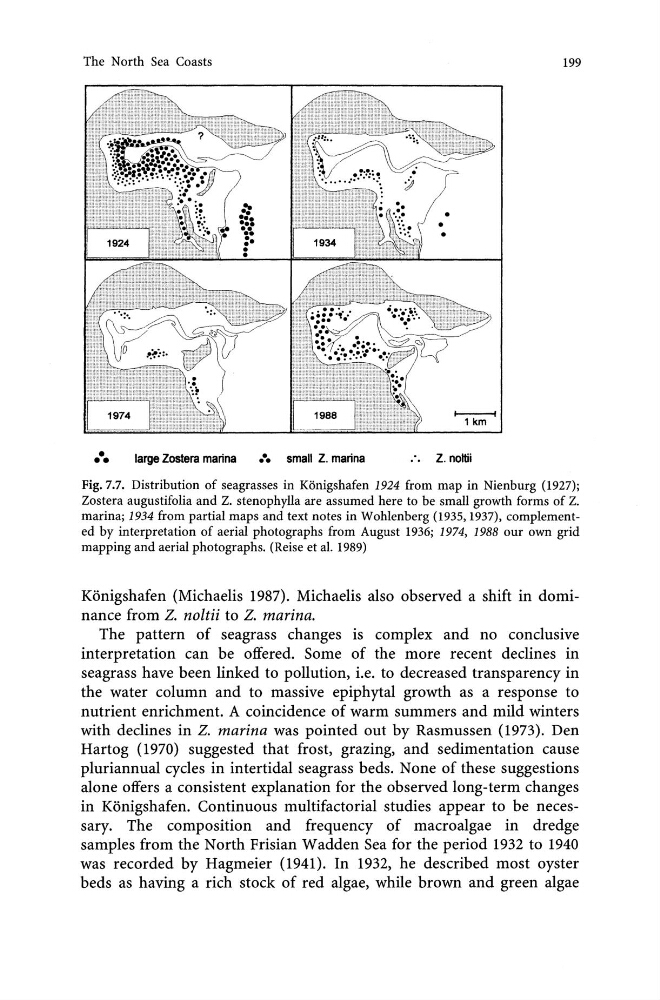
Fig.7.7. Distribution of seagrasses in Konigshafen 1924 from map in Nienburg (1927);
Zostera augustifolia and Z. stenophylla are assumed here to be small growth forms of Z.
marina; 1934 from partial maps and text notes in Wohlenberg (1935, 1937), complemented by interpretation of aerial photographs from August 1936; 1974, 1988 our own grid
mapping and aerial photographs. (Reise et al. 1989)
Konigshafen (Michaelis 1987). Michaelis also observed a shift in dominance from Z. noltii to Z. marina.
The pattern of seagrass changes is complex and no conclusive
interpretation can be offered. Some of the more recent declines in
seagrass have been linked to pollution, i.e. to decreased transparency in
the water column and to massive epiphytal growth as a response to
nutrient enrichment. A coincidence of warm summers and mild winters
with declines in Z. marina was pointed out by Rasmussen (1973). Den
Hartog (1970) suggested that frost, grazing, and sedimentation cause
pluriannual cycles in intertidal seagrass beds. None of these suggestions
alone offers a consistent explanation for the observed long-term changes
in Konigshafen. Continuous multifactorial studies appear to be necessary. The composition and frequency of macroalgae in dredge
samples from the North Frisian Wadden Sea for the period 1932 to 1940
was recorded by Hagmeier (1941). In 1932, he described most oyster
beds as having a rich stock of red algae, while brown and green algae
•
•• large Zostera marina _-. small Z. marina
~
1 km
•• Z.noltii
199
Fig.7.7. Distribution of seagrasses in Konigshafen 1924 from map in Nienburg (1927);
Zostera augustifolia and Z. stenophylla are assumed here to be small growth forms of Z.
marina; 1934 from partial maps and text notes in Wohlenberg (1935, 1937), complemented by interpretation of aerial photographs from August 1936; 1974, 1988 our own grid
mapping and aerial photographs. (Reise et al. 1989)
Konigshafen (Michaelis 1987). Michaelis also observed a shift in dominance from Z. noltii to Z. marina.
The pattern of seagrass changes is complex and no conclusive
interpretation can be offered. Some of the more recent declines in
seagrass have been linked to pollution, i.e. to decreased transparency in
the water column and to massive epiphytal growth as a response to
nutrient enrichment. A coincidence of warm summers and mild winters
with declines in Z. marina was pointed out by Rasmussen (1973). Den
Hartog (1970) suggested that frost, grazing, and sedimentation cause
pluriannual cycles in intertidal seagrass beds. None of these suggestions
alone offers a consistent explanation for the observed long-term changes
in Konigshafen. Continuous multifactorial studies appear to be necessary. The composition and frequency of macroalgae in dredge
samples from the North Frisian Wadden Sea for the period 1932 to 1940
was recorded by Hagmeier (1941). In 1932, he described most oyster
beds as having a rich stock of red algae, while brown and green algae