

200
P.H. Nienhuis
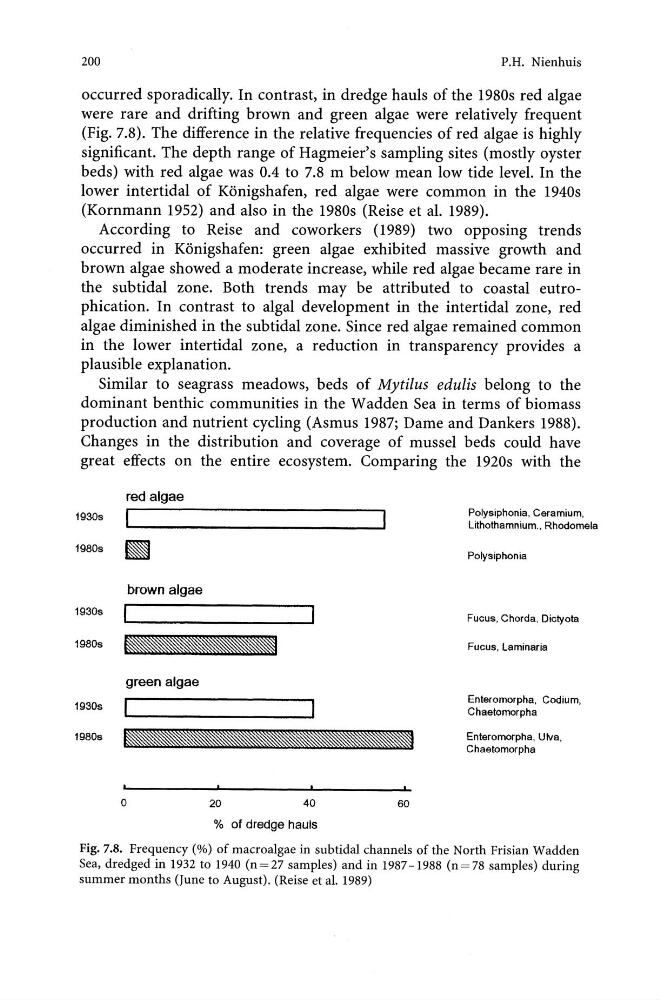
occurred sporadically. In contrast, in dredge hauls of the 1980s red algae
were rare and drifting brown and green algae were relatively frequent
(Fig. 7.8). The difference in the relative frequencies of red algae is highly
significant. The depth range of Hagmeier's sampling sites (mostly oyster
beds) with red algae was 0.4 to 7.8 m below mean low tide level. In the
lower intertidal of Konigshafen, red algae were common in the 1940s
(Kornmann 1952) and also in the 1980s (Reise et al. 1989).
According to Reise and coworkers (1989) two opposing trends
occurred in Konigshafen: green algae exhibited massive growth and
brown algae showed a moderate increase, while red algae became rare in
the subtidal zone. Both trends may be attributed to coastal eutrophication. In contrast to algal development in the intertidal zone, red
algae diminished in the subtidal zone. Since red algae remained common
in the lower intertidal zone, a reduction in transparency provides a
plausible explanation.
Similar to seagrass meadows, beds of Mytilus edulis belong to the
dominant benthic communities in the Wadden Sea in terms of biomass
production and nutrient cycling (Asmus 1987; Dame and Dankers 1988).
Changes in the distribution and coverage of mussel beds could have
great effects on the entire ecosystem. Comparing the 1920s with the
red algae
1930s
1 ... ______________ -'
1980s
~
brown algae
1930s1 ... _ _ _ _ _ _ _ _ _ _ ..J
1980s
~
green algae
1930s
1 9 8 0 S _
o
20
40
60
% of dredge hauls
Polysiphonia, Ceramium,
Lithothamnium., Rhodomela
Polysiphonia
Fucus, Chorda, Dictyota
Fucus, laminaria
Enteromorpha, Codium,
Chaetomorpha
Enteromorpha, Ulva,
Chaetomorpha
Fig.7.S. Frequency ('Yo) of macroalgae in subtidal channels of the North Frisian Wadden
Sea, dredged in 1932 to 1940 (n = 27 samples) and in 1987 -1988 (n = 78 samples) during
summer months (June to August). (Reise et a1. 1989)
P.H. Nienhuis
occurred sporadically. In contrast, in dredge hauls of the 1980s red algae
were rare and drifting brown and green algae were relatively frequent
(Fig. 7.8). The difference in the relative frequencies of red algae is highly
significant. The depth range of Hagmeier's sampling sites (mostly oyster
beds) with red algae was 0.4 to 7.8 m below mean low tide level. In the
lower intertidal of Konigshafen, red algae were common in the 1940s
(Kornmann 1952) and also in the 1980s (Reise et al. 1989).
According to Reise and coworkers (1989) two opposing trends
occurred in Konigshafen: green algae exhibited massive growth and
brown algae showed a moderate increase, while red algae became rare in
the subtidal zone. Both trends may be attributed to coastal eutrophication. In contrast to algal development in the intertidal zone, red
algae diminished in the subtidal zone. Since red algae remained common
in the lower intertidal zone, a reduction in transparency provides a
plausible explanation.
Similar to seagrass meadows, beds of Mytilus edulis belong to the
dominant benthic communities in the Wadden Sea in terms of biomass
production and nutrient cycling (Asmus 1987; Dame and Dankers 1988).
Changes in the distribution and coverage of mussel beds could have
great effects on the entire ecosystem. Comparing the 1920s with the
red algae
1930s
1 ... ______________ -'
1980s
~
brown algae
1930s1 ... _ _ _ _ _ _ _ _ _ _ ..J
1980s
~
green algae
1930s
1 9 8 0 S _
o
20
40
60
% of dredge hauls
Polysiphonia, Ceramium,
Lithothamnium., Rhodomela
Polysiphonia
Fucus, Chorda, Dictyota
Fucus, laminaria
Enteromorpha, Codium,
Chaetomorpha
Enteromorpha, Ulva,
Chaetomorpha
Fig.7.S. Frequency ('Yo) of macroalgae in subtidal channels of the North Frisian Wadden
Sea, dredged in 1932 to 1940 (n = 27 samples) and in 1987 -1988 (n = 78 samples) during
summer months (June to August). (Reise et a1. 1989)