

The North Sea Coasts
1()3t Total N
1200 ~------------,
A
1000
...
. ..
.. _-----_. -.------------------------- ._--------_ ... _-----.0.
. ..
"
0 . . . . . .
.. ... .. ..
400
600
• • ·~l~Jr:;~li:::
~-------------..... ~- .... - .. -.~.~ ..
800
200 r--... -- -. -.... - .. -....... ......... . ... .
1980 81 82 83 84 85 86 87 88 89 90
o RhineJMeuse Ems
189
1()3 t Total P
80r-------------------~
60 ·11,;, ~r""8
4O.1l~.I . .
B
~
20 ..... -- .. -.... ---.-- .. -.. - -.-.---~ .. -
1980 81 82 83 84 85 88 87 88 89 90
Weser
o Elba
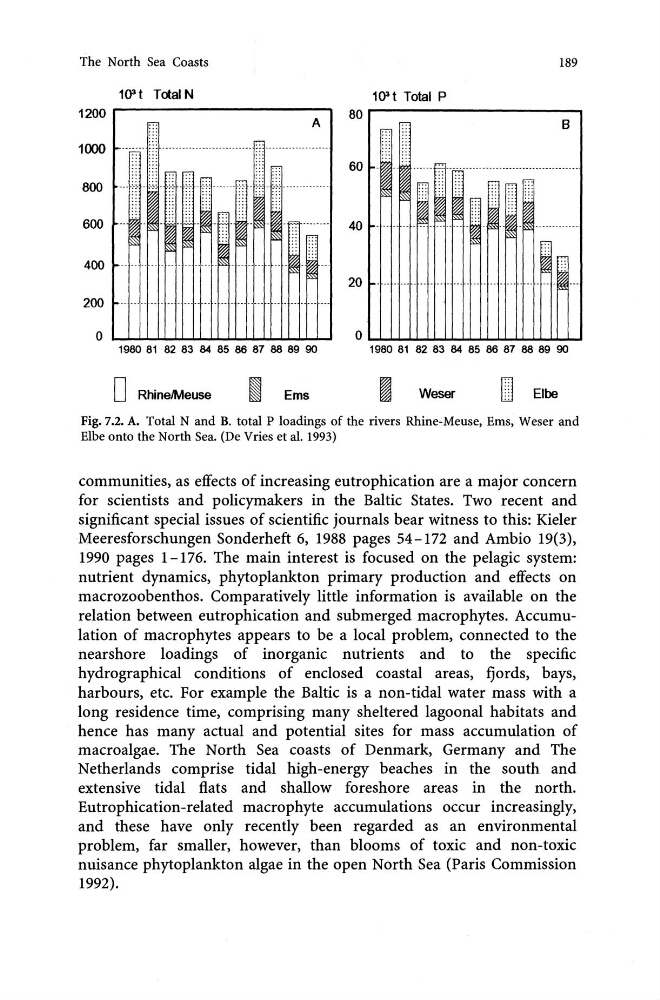
Fig. 7.2. A. Total N and B. total P loadings of the rivers Rhine-Meuse, Ems, Weser and
Elbe onto the North Sea. (De Vries et al. 1993)
communities, as effects of increasing eutrophication are a major concern
for scientists and policymakers in the Baltic States. Two recent and
significant special issues of scientific journals bear witness to this: Kieler
Meeresforschungen Sonderheft 6, 1988 pages 54-172 and Ambio 19(3),
1990 pages 1-176. The main interest is focused on the pelagic system:
nutrient dynamics, phytoplankton primary production and effects on
macrozoobenthos. Comparatively little information is available on the
relation between eutrophication and submerged macrophytes. Accumulation of macrophytes appears to be a local problem, connected to the
nearshore loadings of inorganic nutrients and to the specific
hydrographical conditions of enclosed coastal areas, fjords, bays,
harbours, etc. For example the Baltic is a non-tidal water mass with a
long residence time, comprising many sheltered lagoonal habitats and
hence has many actual and potential sites for mass accumulation of
macroalgae. The North Sea coasts of Denmark, Germany and The
Netherlands comprise tidal high-energy beaches in the south and
extensive tidal fiats and shallow foreshore areas in the north.
Eutrophication-related macrophyte accumulations occur increasingly,
and these have only recently been regarded as an environmental
problem, far smaller, however, than blooms of toxic and non-toxic
nuisance phytoplankton algae in the open North Sea (Paris Commission
1992).
1()3t Total N
1200 ~------------,
A
1000
...
. ..
.. _-----_. -.------------------------- ._--------_ ... _-----.0.
. ..
"
0 . . . . . .
.. ... .. ..
400
600
• • ·~l~Jr:;~li:::
~-------------..... ~- .... - .. -.~.~ ..
800
200 r--... -- -. -.... - .. -....... ......... . ... .
1980 81 82 83 84 85 86 87 88 89 90
o RhineJMeuse Ems
189
1()3 t Total P
80r-------------------~
60 ·11,;, ~r""8
4O.1l~.I . .
B
~
20 ..... -- .. -.... ---.-- .. -.. - -.-.---~ .. -
1980 81 82 83 84 85 88 87 88 89 90
Weser
o Elba
Fig. 7.2. A. Total N and B. total P loadings of the rivers Rhine-Meuse, Ems, Weser and
Elbe onto the North Sea. (De Vries et al. 1993)
communities, as effects of increasing eutrophication are a major concern
for scientists and policymakers in the Baltic States. Two recent and
significant special issues of scientific journals bear witness to this: Kieler
Meeresforschungen Sonderheft 6, 1988 pages 54-172 and Ambio 19(3),
1990 pages 1-176. The main interest is focused on the pelagic system:
nutrient dynamics, phytoplankton primary production and effects on
macrozoobenthos. Comparatively little information is available on the
relation between eutrophication and submerged macrophytes. Accumulation of macrophytes appears to be a local problem, connected to the
nearshore loadings of inorganic nutrients and to the specific
hydrographical conditions of enclosed coastal areas, fjords, bays,
harbours, etc. For example the Baltic is a non-tidal water mass with a
long residence time, comprising many sheltered lagoonal habitats and
hence has many actual and potential sites for mass accumulation of
macroalgae. The North Sea coasts of Denmark, Germany and The
Netherlands comprise tidal high-energy beaches in the south and
extensive tidal fiats and shallow foreshore areas in the north.
Eutrophication-related macrophyte accumulations occur increasingly,
and these have only recently been regarded as an environmental
problem, far smaller, however, than blooms of toxic and non-toxic
nuisance phytoplankton algae in the open North Sea (Paris Commission
1992).