

188
NORTH SEA
P.H. Nienhuis
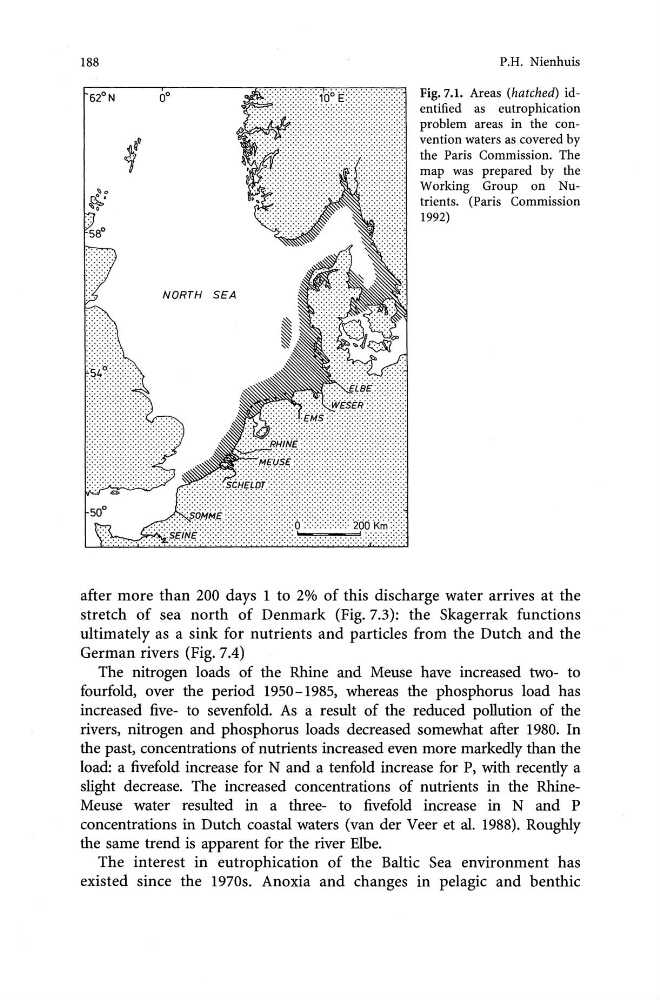
Fig.7.1. Areas (hatched) identified as eutrophication
problem areas in the convention waters as covered by
the Paris Commission. The
map was prepared by the
Working Group on Nutrients. (Paris Commission
1992)
after more than 200 days 1 to 2% of this discharge water arrives at the
stretch of sea north of Denmark (Fig. 7.3): the Skagerrak functions
ultimately as a sink for nutrients and particles from the Dutch and the
German rivers (Fig. 7.4)
The nitrogen loads of the Rhine and Meuse have increased two- to
fourfold, over the period 1950-1985, whereas the phosphorus load has
increased five- to sevenfold. As a result of the reduced pollution of the
rivers, nitrogen and phosphorus loads decreased somewhat after 1980. In
the past, concentrations of nutrients increased even more markedly than the
load: a fivefold increase for N and a tenfold increase for P, with recently a
slight decrease. The increased concentrations of nutrients in the RhineMeuse water resulted in a three- to fivefold increase in N and P
concentrations in Dutch coastal waters (van der Veer et al. 1988). Roughly
the same trend is apparent for the river Elbe.
The interest in eutrophication of the Baltic Sea environment has
existed since the 1970s. Anoxia and changes in pelagic and benthic
NORTH SEA
P.H. Nienhuis
Fig.7.1. Areas (hatched) identified as eutrophication
problem areas in the convention waters as covered by
the Paris Commission. The
map was prepared by the
Working Group on Nutrients. (Paris Commission
1992)
after more than 200 days 1 to 2% of this discharge water arrives at the
stretch of sea north of Denmark (Fig. 7.3): the Skagerrak functions
ultimately as a sink for nutrients and particles from the Dutch and the
German rivers (Fig. 7.4)
The nitrogen loads of the Rhine and Meuse have increased two- to
fourfold, over the period 1950-1985, whereas the phosphorus load has
increased five- to sevenfold. As a result of the reduced pollution of the
rivers, nitrogen and phosphorus loads decreased somewhat after 1980. In
the past, concentrations of nutrients increased even more markedly than the
load: a fivefold increase for N and a tenfold increase for P, with recently a
slight decrease. The increased concentrations of nutrients in the RhineMeuse water resulted in a three- to fivefold increase in N and P
concentrations in Dutch coastal waters (van der Veer et al. 1988). Roughly
the same trend is apparent for the river Elbe.
The interest in eutrophication of the Baltic Sea environment has
existed since the 1970s. Anoxia and changes in pelagic and benthic