

The Baltic Sea and Its Transition Zones
157
disturbances of community metabolism is an approach, which has been
used to study the effects of increased nutrient levels on the functional
efficiency of seaweed or seagrass communities in enclosure systems
(Schramm and Booth 1981).
Similarly, the effects of pollutants (antifouling paint containing
tributyltin TBT; chlorate) on gas and nutrient exchange of various Fucus
communities along the Swedish east and west coast were studied employing in situ flow-through enclosure systems (Lindblad et al. 1986,
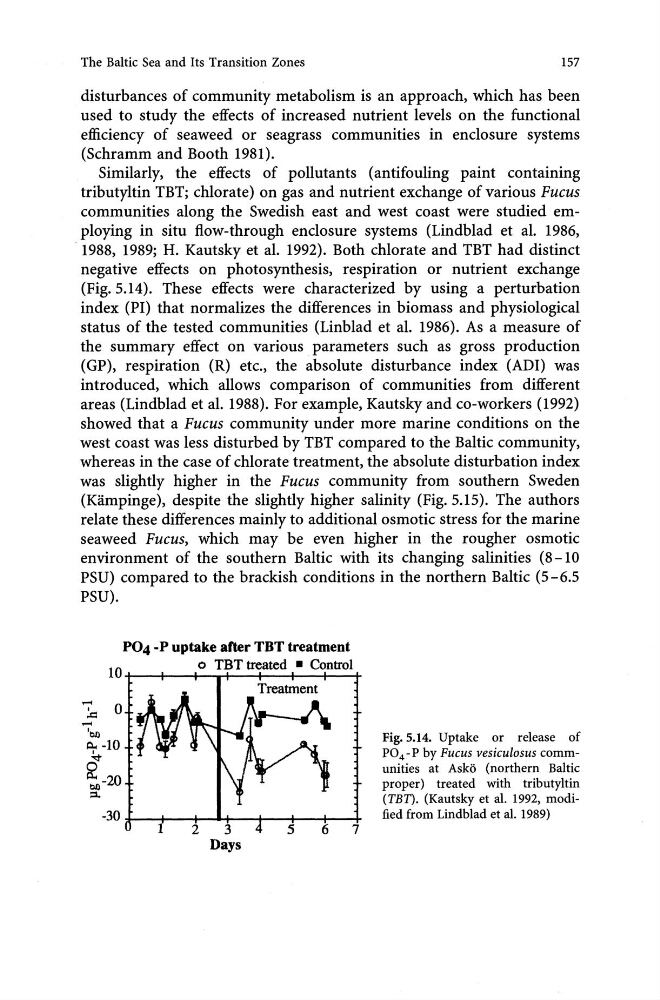
·1988, 1989; H. Kautsky et al. 1992). Both chlorate and TBT had distinct
negative effects on photosynthesis, respiration or nutrient exchange
(Fig. 5.14). These effects were characterized by using a perturbation
index (PI) that normalizes the differences in biomass and physiological
status of the tested communities (Linblad et al. 1986). As a measure of
the summary effect on various parameters such as gross production
(GP), respiration (R) etc., the absolute disturbance index (ADI) was
introduced, which allows comparison of communities from different
areas (Lindblad et al' 1988). For example, Kautsky and co-workers (1992)
showed that a Fucus community under more marine conditions on the
west coast was less disturbed by TBT compared to the Baltic community,
whereas in the case of chlorate treatment, the absolute disturbation index
was slightly higher in the Fucus community from southern Sweden
(Klimpinge), despite the slightly higher salinity (Fig. 5.15). The authors
relate these differences mainly to additional osmotic stress for the marine
seaweed Fucus, which may be even higher in the rougher osmotic
environment of the southern Baltic with its changing salinities (8-10
PSU) compared to the brackish conditions in the northern Baltic (5-6.5
PSU).
P04 -P uptake after TBT treatment
o TBT treated • Control
10+-~~-+-,+-~~-+ __ +--+
-30 :l--i--+----+--+-+---I--+
7
Fig. 5.14. Uptake or release of
P0 4 -P by Fucus vesiculosus communities at Asko (northern Baltic
proper) treated with tributyltin
(TBn, (Kautsky et al. 1992, modified from Lindblad et al. 1989)
157
disturbances of community metabolism is an approach, which has been
used to study the effects of increased nutrient levels on the functional
efficiency of seaweed or seagrass communities in enclosure systems
(Schramm and Booth 1981).
Similarly, the effects of pollutants (antifouling paint containing
tributyltin TBT; chlorate) on gas and nutrient exchange of various Fucus
communities along the Swedish east and west coast were studied employing in situ flow-through enclosure systems (Lindblad et al. 1986,
·1988, 1989; H. Kautsky et al. 1992). Both chlorate and TBT had distinct
negative effects on photosynthesis, respiration or nutrient exchange
(Fig. 5.14). These effects were characterized by using a perturbation
index (PI) that normalizes the differences in biomass and physiological
status of the tested communities (Linblad et al. 1986). As a measure of
the summary effect on various parameters such as gross production
(GP), respiration (R) etc., the absolute disturbance index (ADI) was
introduced, which allows comparison of communities from different
areas (Lindblad et al' 1988). For example, Kautsky and co-workers (1992)
showed that a Fucus community under more marine conditions on the
west coast was less disturbed by TBT compared to the Baltic community,
whereas in the case of chlorate treatment, the absolute disturbation index
was slightly higher in the Fucus community from southern Sweden
(Klimpinge), despite the slightly higher salinity (Fig. 5.15). The authors
relate these differences mainly to additional osmotic stress for the marine
seaweed Fucus, which may be even higher in the rougher osmotic
environment of the southern Baltic with its changing salinities (8-10
PSU) compared to the brackish conditions in the northern Baltic (5-6.5
PSU).
P04 -P uptake after TBT treatment
o TBT treated • Control
10+-~~-+-,+-~~-+ __ +--+
-30 :l--i--+----+--+-+---I--+
7
Fig. 5.14. Uptake or release of
P0 4 -P by Fucus vesiculosus communities at Asko (northern Baltic
proper) treated with tributyltin
(TBn, (Kautsky et al. 1992, modified from Lindblad et al. 1989)