

156
W. Schramm
latter being a dominant species in red algal communities replacing
Fucus) in relation to the seasonal nutrient pattern in their respective
habitats in Kiel Bight.
In situ inorganic nitrogen concentrations in all locations investigated
were high enough to support nutrient-saturated growth of Fucus
throughout the year, whereas Phycodrys appeared to be growth-limited
during the summer months (cf. Fig. 5.3). In situ phosphate concentrations were mostly below growth saturating levels, except for Fucus in
winter.
However, as seaweeds are capable of utilizing their internal nutrient
reserves, the tissue nutrient levels are probably more relevant for optimal
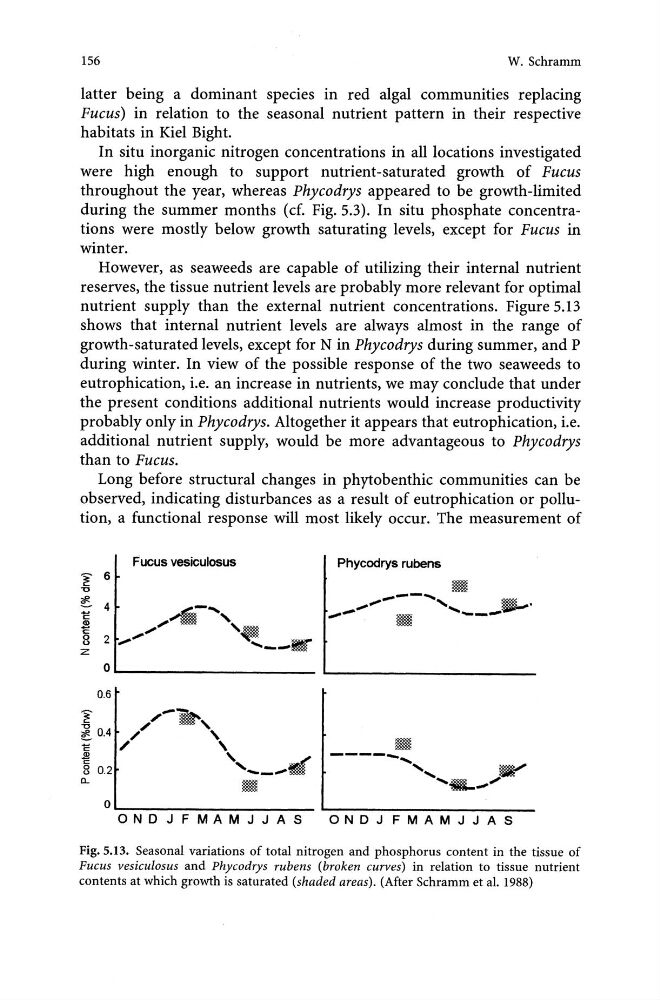
nutrient supply than the external nutrient concentrations. Figure 5.13
shows that internal nutrient levels are always almost in the range of
growth-saturated levels, except for N in Phycodrys during summer, and P
during winter. In view of the possible response of the two seaweeds to
eutrophication, i.e. an increase in nutrients, we may conclude that under
the present conditions additional nutrients would increase productivity
probably only in Phycodrys. Altogether it appears that eutrophication, i.e.
additional nutrient supply, would be more advantageous to Phycodrys
than to Fucus.
Long before structural changes in phytobenthic communities can be
observed, indicating disturbances as a result of eutrophication or pollution, a functional response will most likely occur. The measurement of
Fucus vesiculosus
Phycodrys rubens
o~ _____________________ ~ ______________________ __
0.6
'F
~O.4
e
~
8 0.2
IL
ill!
-----'"
.....
' .... -"
o~~~~~ ___________ ~ ____________________ __
ONDJFMAMJJAS
ONDJFMAMJJAS
Fig. 5.13. Seasonal variations of total nitrogen and phosphorus content in the tissue of
Fucus vesiculosus and Phycodrys rubens (broken curves) in relation to tissue nutrient
contents at which growth is saturated (shaded areas). (After Schramm et al. 1988)
W. Schramm
latter being a dominant species in red algal communities replacing
Fucus) in relation to the seasonal nutrient pattern in their respective
habitats in Kiel Bight.
In situ inorganic nitrogen concentrations in all locations investigated
were high enough to support nutrient-saturated growth of Fucus
throughout the year, whereas Phycodrys appeared to be growth-limited
during the summer months (cf. Fig. 5.3). In situ phosphate concentrations were mostly below growth saturating levels, except for Fucus in
winter.
However, as seaweeds are capable of utilizing their internal nutrient
reserves, the tissue nutrient levels are probably more relevant for optimal
nutrient supply than the external nutrient concentrations. Figure 5.13
shows that internal nutrient levels are always almost in the range of
growth-saturated levels, except for N in Phycodrys during summer, and P
during winter. In view of the possible response of the two seaweeds to
eutrophication, i.e. an increase in nutrients, we may conclude that under
the present conditions additional nutrients would increase productivity
probably only in Phycodrys. Altogether it appears that eutrophication, i.e.
additional nutrient supply, would be more advantageous to Phycodrys
than to Fucus.
Long before structural changes in phytobenthic communities can be
observed, indicating disturbances as a result of eutrophication or pollution, a functional response will most likely occur. The measurement of
Fucus vesiculosus
Phycodrys rubens
o~ _____________________ ~ ______________________ __
0.6
'F
~O.4
e
~
8 0.2
IL
ill!
-----'"
.....
' .... -"
o~~~~~ ___________ ~ ____________________ __
ONDJFMAMJJAS
ONDJFMAMJJAS
Fig. 5.13. Seasonal variations of total nitrogen and phosphorus content in the tissue of
Fucus vesiculosus and Phycodrys rubens (broken curves) in relation to tissue nutrient
contents at which growth is saturated (shaded areas). (After Schramm et al. 1988)