

122
J.E. Merrill
lO-day intervals. It has a very high protein (hence nitrogen) content, up to
45% by dry weight. The productivity and nitrogen uptake of this plant are
sufficiently great that it is an excellent choice for eutrophication abatement
where other conditions are suitable.
4.3.2 Kelp Species, e.g. Laminaria, Undaria
Laminaria ("kombu") and Undaria ("wakame") are kelps cultivated principally in Asian countries (Druehl 1988). These are used primarily in
preparing soups and as flavoring in other dishes (Arasaki and Arasaki
1983). They have markets that are almost as large as that for nori. These and
other kelp species may also have potential value for extraction of alginate,
although alginate is currently obtained entirely from harvests of wild
stocks.
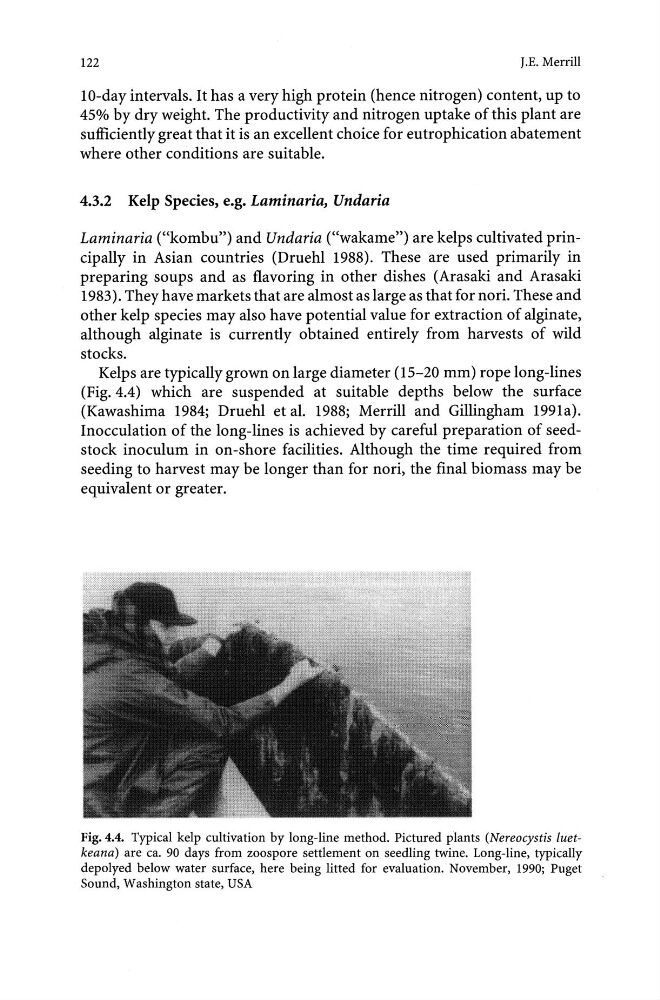
Kelps are typically grown on large diameter (15-20 mm) rope long-lines
(Fig. 4.4) which are suspended at suitable depths below the surface
(Kawashima 1984; Druehl et al. 1988; Merrill and Gillingham 1991a).
Inocculation of the long-lines is achieved by careful preparation of seedstock inoculum in on-shore facilities. Although the time required from
seeding to harvest may be longer than for nori, the final biomass may be
equivalent or greater.
Fig. 4.4. Typical kelp cultivation by long-line method. Pictured plants (Nereocystis luetkeana) are ca. 90 days from zoospore settlement on seedling twine. Long-line, typically
depolyed below water surface, here being litted for evaluation. November, 1990; Puget
Sound, Washington state, USA
J.E. Merrill
lO-day intervals. It has a very high protein (hence nitrogen) content, up to
45% by dry weight. The productivity and nitrogen uptake of this plant are
sufficiently great that it is an excellent choice for eutrophication abatement
where other conditions are suitable.
4.3.2 Kelp Species, e.g. Laminaria, Undaria
Laminaria ("kombu") and Undaria ("wakame") are kelps cultivated principally in Asian countries (Druehl 1988). These are used primarily in
preparing soups and as flavoring in other dishes (Arasaki and Arasaki
1983). They have markets that are almost as large as that for nori. These and
other kelp species may also have potential value for extraction of alginate,
although alginate is currently obtained entirely from harvests of wild
stocks.
Kelps are typically grown on large diameter (15-20 mm) rope long-lines
(Fig. 4.4) which are suspended at suitable depths below the surface
(Kawashima 1984; Druehl et al. 1988; Merrill and Gillingham 1991a).
Inocculation of the long-lines is achieved by careful preparation of seedstock inoculum in on-shore facilities. Although the time required from
seeding to harvest may be longer than for nori, the final biomass may be
equivalent or greater.
Fig. 4.4. Typical kelp cultivation by long-line method. Pictured plants (Nereocystis luetkeana) are ca. 90 days from zoospore settlement on seedling twine. Long-line, typically
depolyed below water surface, here being litted for evaluation. November, 1990; Puget
Sound, Washington state, USA