

Aquaculture Methods for Use in Managing Eutrophicated Waters
123
Protein content is lower in the kelps, typically in the range of 10 - 20% by
dry weight. Their value in pollution abatement is augmented by their value
as habitat for fish and shellfish (Merrill and Gillingham 1991b).
4.3.3 Gracilaria and Other Agarophytes
Gracilaria is one of the principal sources of agar and is consequently one
the most commercially important of all macro algae other than the main
food sources. Cultivation efforts in Chile and Taiwan are particularly
notable as examples of the technology applied (Santelices and Doty 1989).
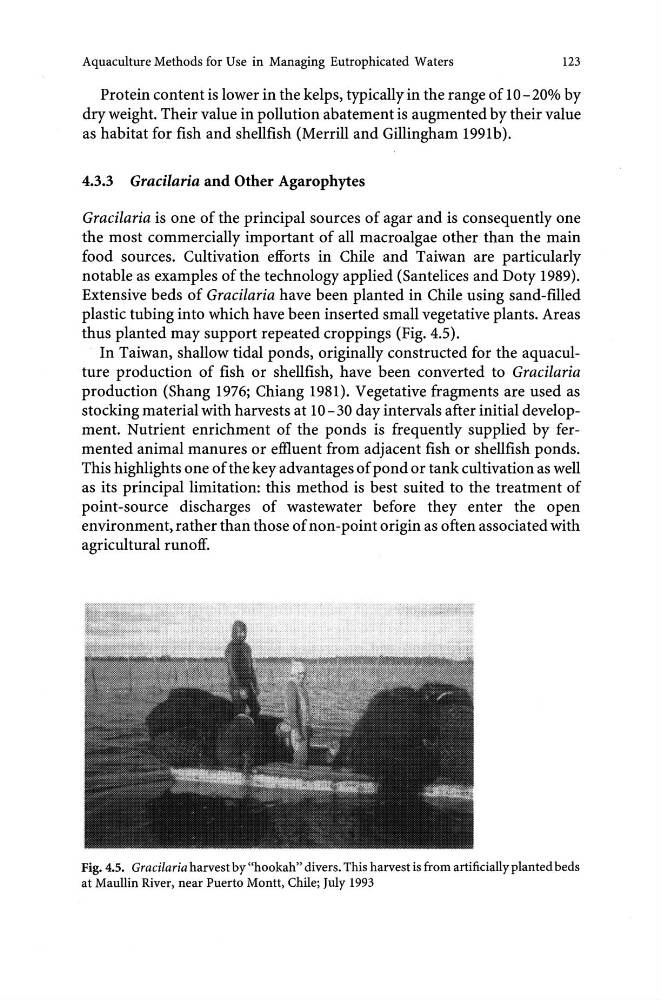
Extensive beds of Gracilaria have been planted in Chile using sand-filled
plastic tubing into which have been inserted small vegetative plants. Areas
thus planted may support repeated croppings (Fig. 4.5).
In Taiwan, shallow tidal ponds, originally constructed for the aquaculture production of fish or shellfish, have been converted to Gracilaria
production (Shang 1976; Chiang 1981). Vegetative fragments are used as
stocking material with harvests at 10 - 30 day intervals after initial development. Nutrient enrichment of the ponds is frequently supplied by fermented animal manures or effluent from adjacent fish or shellfish ponds.
This highlights one of the key advantages of pond or tank cultivation as well
as its principal limitation: this method is best suited to the treatment of
point-source discharges of wastewater before they enter the open
environment, rather than those of non-point origin as often associated with
agricultural runoff.
Fig. 4.5. Gracilaria harvest by "hookah" divers. This harvest is from artificially planted beds
at Maullin River, near Puerto Montt, Chile; July 1993
123
Protein content is lower in the kelps, typically in the range of 10 - 20% by
dry weight. Their value in pollution abatement is augmented by their value
as habitat for fish and shellfish (Merrill and Gillingham 1991b).
4.3.3 Gracilaria and Other Agarophytes
Gracilaria is one of the principal sources of agar and is consequently one
the most commercially important of all macro algae other than the main
food sources. Cultivation efforts in Chile and Taiwan are particularly
notable as examples of the technology applied (Santelices and Doty 1989).
Extensive beds of Gracilaria have been planted in Chile using sand-filled
plastic tubing into which have been inserted small vegetative plants. Areas
thus planted may support repeated croppings (Fig. 4.5).
In Taiwan, shallow tidal ponds, originally constructed for the aquaculture production of fish or shellfish, have been converted to Gracilaria
production (Shang 1976; Chiang 1981). Vegetative fragments are used as
stocking material with harvests at 10 - 30 day intervals after initial development. Nutrient enrichment of the ponds is frequently supplied by fermented animal manures or effluent from adjacent fish or shellfish ponds.
This highlights one of the key advantages of pond or tank cultivation as well
as its principal limitation: this method is best suited to the treatment of
point-source discharges of wastewater before they enter the open
environment, rather than those of non-point origin as often associated with
agricultural runoff.
Fig. 4.5. Gracilaria harvest by "hookah" divers. This harvest is from artificially planted beds
at Maullin River, near Puerto Montt, Chile; July 1993