

Aquaculture Methods for Use in Managing Eutrophicated Waters
121
4.3.1 Porphyra ("nori") Cultivation
The most valuable cultivated seaweed on a worldwide basis is Porphyra
(Chapman and Chapman 1980; Perez et al. 1992; Merrill 1993). Selected
strains of P. yezoensis and P. tenera are farmed on a very large scale in Japan
as well as in Korea and China for the production of the edible product
"nori" (Miura 1975; Mumford and Miura 1988). Nori is a key ingredient in
the Japanese dish called "sushi", in which nori is used as a flavorful wrapper
around a filling of vinegared rice and various vegetables or fish (Arasaki
and Arasaki 1983).
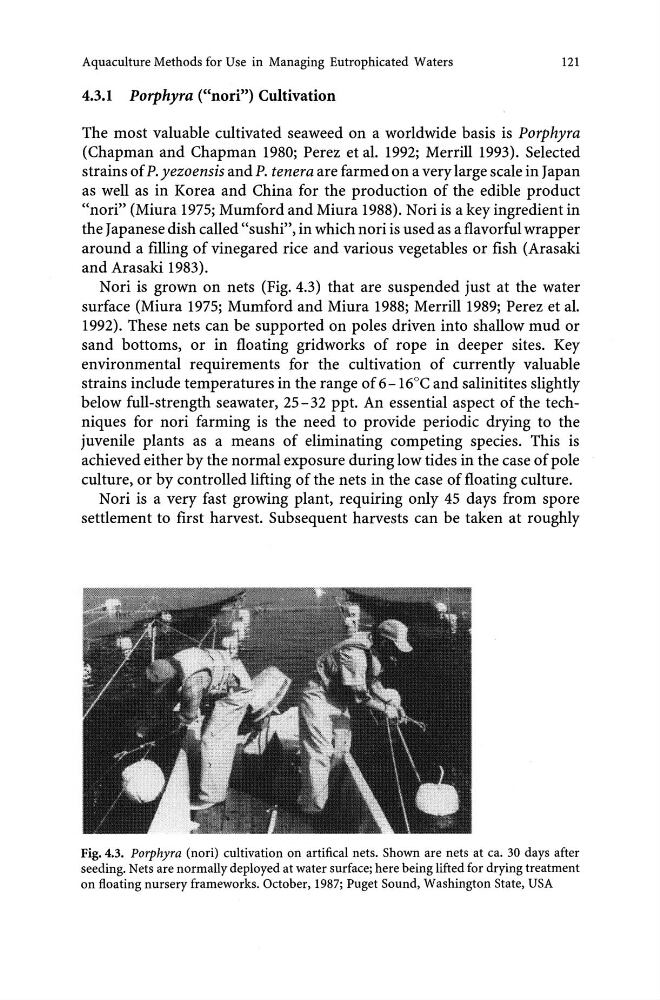
Nori is grown on nets (Fig. 4.3) that are suspended just at the water
surface (Miura 1975; Mumford and Miura 1988; Merrill 1989; Perez et al.
1992). These nets can be supported on poles driven into shallow mud or
sand bottoms, or in floating gridworks of rope in deeper sites. Key
environmental requirements for the cultivation of currently valuable
strains include temperatures in the range of 6-16°C and salinitites slightly
below full-strength seawater, 25-32 ppt. An essential aspect of the techniques for nori farming is the need to provide periodic drying to the
juvenile plants as a means of eliminating competing species. This is
achieved either by the normal exposure during low tides in the case of pole
culture, or by controlled lifting of the nets in the case of floating culture.
Nori is a very fast growing plant, requiring only 45 days from spore
settlement to first harvest. Subsequent harvests can be taken at roughly
Fig.4.3. Porphyra (nori) cultivation on artifical nets. Shown are nets at ca. 30 days after
seeding. Nets are normally deployed at water surface; here being lifted for drying treatment
on floating nursery frameworks. October, 1987; Puget Sound, Washington State, USA
121
4.3.1 Porphyra ("nori") Cultivation
The most valuable cultivated seaweed on a worldwide basis is Porphyra
(Chapman and Chapman 1980; Perez et al. 1992; Merrill 1993). Selected
strains of P. yezoensis and P. tenera are farmed on a very large scale in Japan
as well as in Korea and China for the production of the edible product
"nori" (Miura 1975; Mumford and Miura 1988). Nori is a key ingredient in
the Japanese dish called "sushi", in which nori is used as a flavorful wrapper
around a filling of vinegared rice and various vegetables or fish (Arasaki
and Arasaki 1983).
Nori is grown on nets (Fig. 4.3) that are suspended just at the water
surface (Miura 1975; Mumford and Miura 1988; Merrill 1989; Perez et al.
1992). These nets can be supported on poles driven into shallow mud or
sand bottoms, or in floating gridworks of rope in deeper sites. Key
environmental requirements for the cultivation of currently valuable
strains include temperatures in the range of 6-16°C and salinitites slightly
below full-strength seawater, 25-32 ppt. An essential aspect of the techniques for nori farming is the need to provide periodic drying to the
juvenile plants as a means of eliminating competing species. This is
achieved either by the normal exposure during low tides in the case of pole
culture, or by controlled lifting of the nets in the case of floating culture.
Nori is a very fast growing plant, requiring only 45 days from spore
settlement to first harvest. Subsequent harvests can be taken at roughly
Fig.4.3. Porphyra (nori) cultivation on artifical nets. Shown are nets at ca. 30 days after
seeding. Nets are normally deployed at water surface; here being lifted for drying treatment
on floating nursery frameworks. October, 1987; Puget Sound, Washington State, USA