

Coastal Eutrophication and Marine Benthic Vegetation
101
The value of the coefficient relating area to depth (a) was quantified as
the inverse value of the mean depth (lIz nean) according to Klepper
(1990).
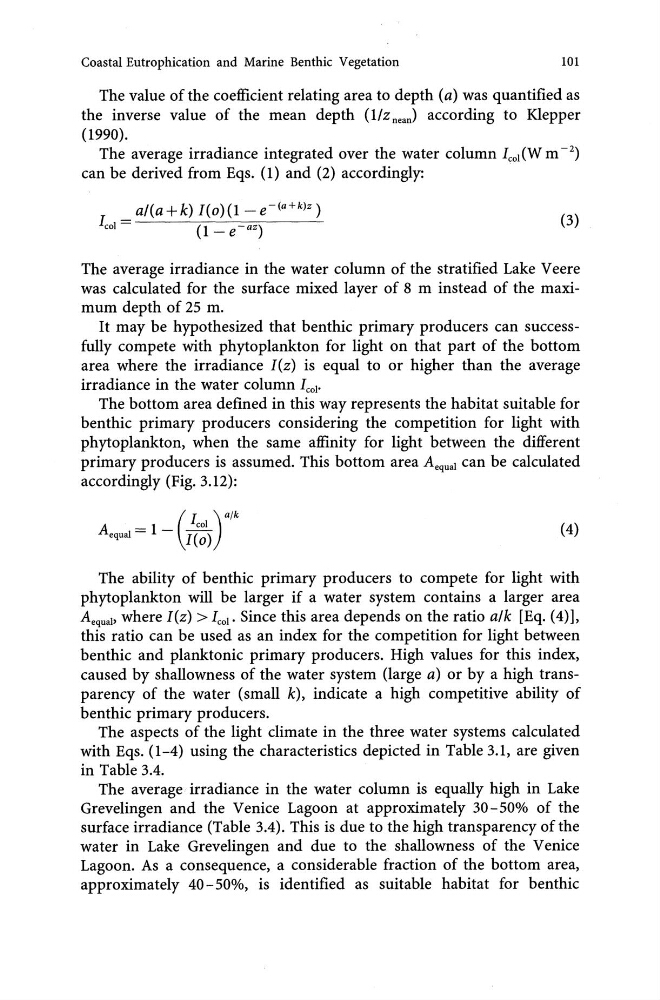
The average irradiance integrated over the water column Icol(W m -2)
can be derived from Eqs. (1) and (2) accordingly:
al(a+k) I(o)(l-e-(a+k)z)
Icol =
(1 _ e az)
(3)
The average irradiance in the water column of the stratified Lake Veere
was calculated for the surface mixed layer of 8 m instead of the maximum depth of 25 m.
It may be hypothesized that benthic primary producers can successfully compete with phytoplankton for light on that part of the bottom
area where the irradiance I(z) is equal to or higher than the average
irradiance in the water column I col '
The bottom area defined in this way represents the habitat suitable for
benthic primary producers considering the competition for light with
phytoplankton, when the same affinity for light between the different
primary producers is assumed. This bottom area Aequal can be calculated
accordingly (Fig. 3.12):
(
I )a/k
A equal = 1 -
I t~l)
(4)
The ability of benthic primary producers to compete for light with
phytoplankton will be larger if a water system contains a larger area
Aequal' where I(z) > Icol ' Since this area depends on the ratio alk [Eq. (4)],
this ratio can be used as an index for the competition for light between
benthic and planktonic primary producers. High values for this index,
caused by shallowness of the water system (large a) or by a high transparency of the water (small k), indicate a high competitive ability of
benthic primary producers.
The aspects of the light climate in the three water systems calculated
with Eqs. (1-4) using the characteristics depicted in Table 3.1, are given
in Table 3.4.
The average irradiance in the water column is equally high in Lake
Grevelingen and the Venice Lagoon at approximately 30 - 50% of the
surface irradiance (Table 3.4). This is due to the high transparency of the
water in Lake Grevelingen and due to the shallowness of the Venice
Lagoon. As a consequence, a considerable fraction of the bottom area,
approximately 40 - 50%, is identified as suitable habitat for benthic
101
The value of the coefficient relating area to depth (a) was quantified as
the inverse value of the mean depth (lIz nean) according to Klepper
(1990).
The average irradiance integrated over the water column Icol(W m -2)
can be derived from Eqs. (1) and (2) accordingly:
al(a+k) I(o)(l-e-(a+k)z)
Icol =
(1 _ e az)
(3)
The average irradiance in the water column of the stratified Lake Veere
was calculated for the surface mixed layer of 8 m instead of the maximum depth of 25 m.
It may be hypothesized that benthic primary producers can successfully compete with phytoplankton for light on that part of the bottom
area where the irradiance I(z) is equal to or higher than the average
irradiance in the water column I col '
The bottom area defined in this way represents the habitat suitable for
benthic primary producers considering the competition for light with
phytoplankton, when the same affinity for light between the different
primary producers is assumed. This bottom area Aequal can be calculated
accordingly (Fig. 3.12):
(
I )a/k
A equal = 1 -
I t~l)
(4)
The ability of benthic primary producers to compete for light with
phytoplankton will be larger if a water system contains a larger area
Aequal' where I(z) > Icol ' Since this area depends on the ratio alk [Eq. (4)],
this ratio can be used as an index for the competition for light between
benthic and planktonic primary producers. High values for this index,
caused by shallowness of the water system (large a) or by a high transparency of the water (small k), indicate a high competitive ability of
benthic primary producers.
The aspects of the light climate in the three water systems calculated
with Eqs. (1-4) using the characteristics depicted in Table 3.1, are given
in Table 3.4.
The average irradiance in the water column is equally high in Lake
Grevelingen and the Venice Lagoon at approximately 30 - 50% of the
surface irradiance (Table 3.4). This is due to the high transparency of the
water in Lake Grevelingen and due to the shallowness of the Venice
Lagoon. As a consequence, a considerable fraction of the bottom area,
approximately 40 - 50%, is identified as suitable habitat for benthic