

100
1. De Vries et al.
3.4.1 Light Climate
Primary producers occupy different positions in the water column.
Microphytobenthos and macrophytes have a flxed position in the
eutrophic zone, being more or less attached to the bottom surface.
Phytoplankton is permanently mixed over the entire water column, as
long as no stratiflcation occurs and enough turbulence is present to
prevent buoyancy control. The ability of the different primary producers
to compete for light is therefore determined by the light extinction in the
water column and the morphological and hydrographic characteristics of
the system.
These aspects of the light climate can be quantifled with the following
equations (see also Fig. 3.12). The light extinction in the water column
can be described according to the law of Lambert-Beer:
I(z) = I(o)e- kZ
where 1(0) = surface irradiance (Wm -2)
I(z) = irradiance at depth z(Wm -2)
k = light extinction coefficient (m -1)
z = depth (m).
(1)
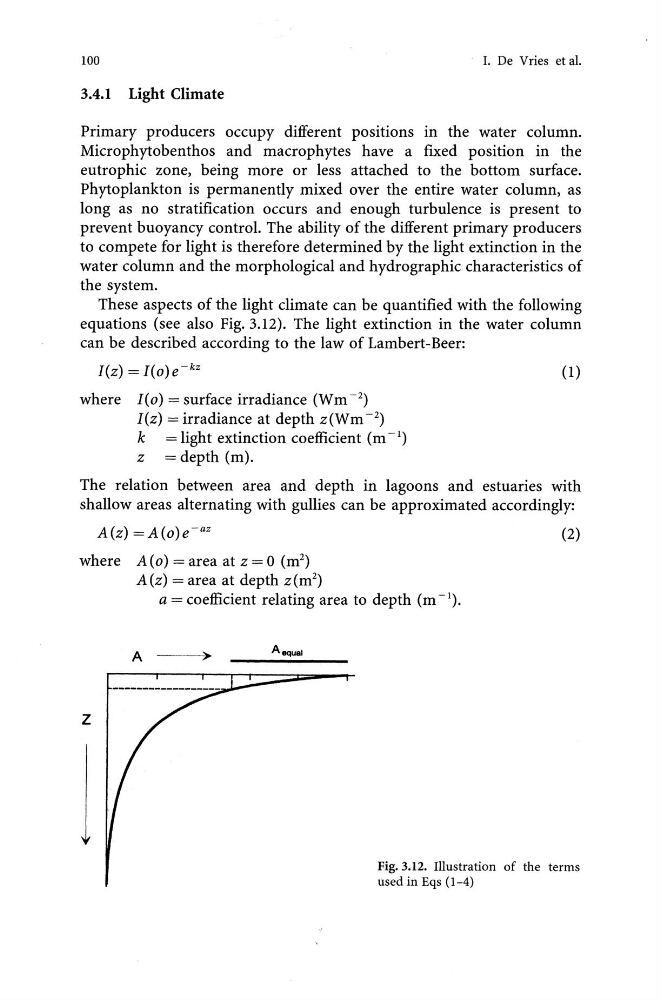
The relation between area and depth in lagoons and estuaries with
shallow areas alternating with gullies can be approximated accordingly:
A(z) =A(o)e- az
where A(o) = area at z = 0 (m 2 )
A(z) = area at depth z(m 2 )
(2)
a = coefficient relating area to depth (m -1).
z
Fig. 3.12. Illustration of the terms
used in Eqs (1-4)
1. De Vries et al.
3.4.1 Light Climate
Primary producers occupy different positions in the water column.
Microphytobenthos and macrophytes have a flxed position in the
eutrophic zone, being more or less attached to the bottom surface.
Phytoplankton is permanently mixed over the entire water column, as
long as no stratiflcation occurs and enough turbulence is present to
prevent buoyancy control. The ability of the different primary producers
to compete for light is therefore determined by the light extinction in the
water column and the morphological and hydrographic characteristics of
the system.
These aspects of the light climate can be quantifled with the following
equations (see also Fig. 3.12). The light extinction in the water column
can be described according to the law of Lambert-Beer:
I(z) = I(o)e- kZ
where 1(0) = surface irradiance (Wm -2)
I(z) = irradiance at depth z(Wm -2)
k = light extinction coefficient (m -1)
z = depth (m).
(1)
The relation between area and depth in lagoons and estuaries with
shallow areas alternating with gullies can be approximated accordingly:
A(z) =A(o)e- az
where A(o) = area at z = 0 (m 2 )
A(z) = area at depth z(m 2 )
(2)
a = coefficient relating area to depth (m -1).
z
Fig. 3.12. Illustration of the terms
used in Eqs (1-4)