

102
1. De Vries et al.
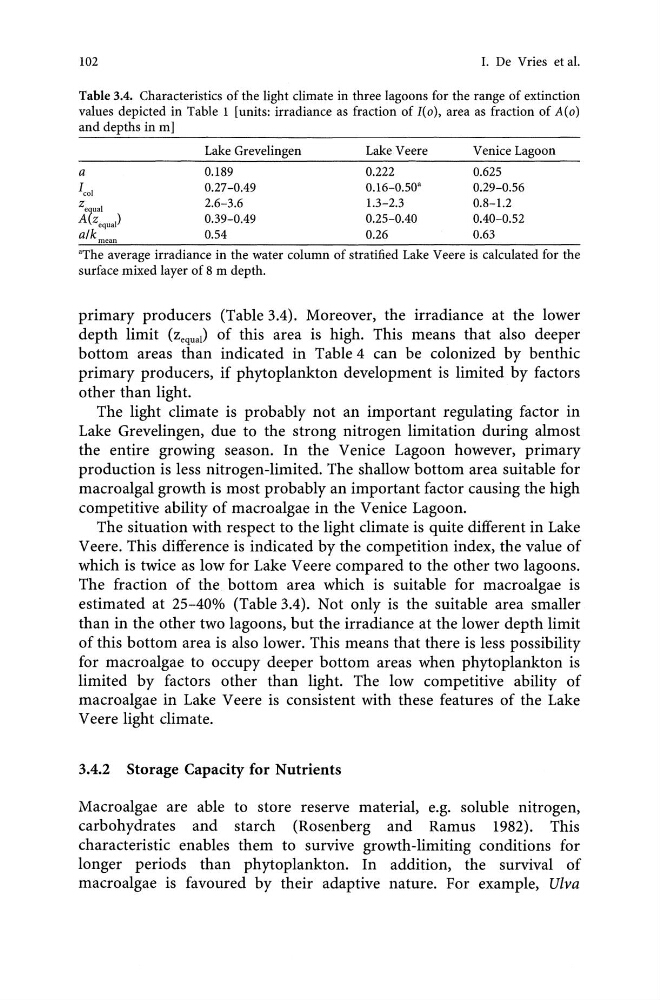
Table 3.4. Characteristics of the light climate in three lagoons for the range of extinction
values depicted in Table 1 [units: irradiance as fraction of l(o), area as fraction of A(o)
and depths in ml
Lake Grevelingen
Lake Veere
Venice Lagoon
a
0.189
0.222
0.625
lcol
0.27-0.49
0.16-0.50'
0.29-0.56
Zer'l
2.6-3.6
1.3-2.3
0.8-1.2
A Zequat)
0.39-0.49
0.25-0.40
0.40-0.52
alk mean
0.54
0.26
0.63
'The average irradiance in the water column of stratified Lake Veere is calculated for the
surface mixed layer of 8 m depth.
primary producers (Table 3.4). Moreover, the irradiance at the lower
depth limit (zequal) of this area is high. This means that also deeper
bottom areas than indicated in Table 4 can be colonized by benthic
primary producers, if phytoplankton development is limited by factors
other than light.
The light climate is probably not an important regulating factor in
Lake Grevelingen, due to the strong nitrogen limitation during almost
the entire growing season. In the Venice Lagoon however, primary
production is less nitrogen-limited. The shallow bottom area suitable for
macroalgal growth is most probably an important factor causing the high
competitive ability of macroalgae in the Venice Lagoon.
The situation with respect to the light climate is quite different in Lake
Veere. This difference is indicated by the competition index, the value of
which is twice as low for Lake Veere compared to the other two lagoons.
The fraction of the. bottom area which is suitable for macroalgae is
estimated at 25-40% (Table 3.4). Not only is the suitable area smaller
than in the other two lagoons, but the irradiance at the lower depth limit
of this bottom area is also lower. This means that there is less possibility
for macroalgae to occupy deeper bottom areas when phytoplankton is
limited by factors other than light. The low competitive ability of
macro algae in Lake Veere is consistent with these features of the Lake
Veere light climate.
3.4.2 Storage Capacity for Nutrients
Macroalgae are able to store reserve material, e.g. soluble nitrogen,
carbohydrates and starch (Rosenberg and Ramus 1982). This
characteristic enables them to survive growth-limiting conditions for
longer periods than phytoplankton. In addition, the survival of
macro algae is favoured by their adaptive nature. For example, Ulva
1. De Vries et al.
Table 3.4. Characteristics of the light climate in three lagoons for the range of extinction
values depicted in Table 1 [units: irradiance as fraction of l(o), area as fraction of A(o)
and depths in ml
Lake Grevelingen
Lake Veere
Venice Lagoon
a
0.189
0.222
0.625
lcol
0.27-0.49
0.16-0.50'
0.29-0.56
Zer'l
2.6-3.6
1.3-2.3
0.8-1.2
A Zequat)
0.39-0.49
0.25-0.40
0.40-0.52
alk mean
0.54
0.26
0.63
'The average irradiance in the water column of stratified Lake Veere is calculated for the
surface mixed layer of 8 m depth.
primary producers (Table 3.4). Moreover, the irradiance at the lower
depth limit (zequal) of this area is high. This means that also deeper
bottom areas than indicated in Table 4 can be colonized by benthic
primary producers, if phytoplankton development is limited by factors
other than light.
The light climate is probably not an important regulating factor in
Lake Grevelingen, due to the strong nitrogen limitation during almost
the entire growing season. In the Venice Lagoon however, primary
production is less nitrogen-limited. The shallow bottom area suitable for
macroalgal growth is most probably an important factor causing the high
competitive ability of macroalgae in the Venice Lagoon.
The situation with respect to the light climate is quite different in Lake
Veere. This difference is indicated by the competition index, the value of
which is twice as low for Lake Veere compared to the other two lagoons.
The fraction of the. bottom area which is suitable for macroalgae is
estimated at 25-40% (Table 3.4). Not only is the suitable area smaller
than in the other two lagoons, but the irradiance at the lower depth limit
of this bottom area is also lower. This means that there is less possibility
for macroalgae to occupy deeper bottom areas when phytoplankton is
limited by factors other than light. The low competitive ability of
macro algae in Lake Veere is consistent with these features of the Lake
Veere light climate.
3.4.2 Storage Capacity for Nutrients
Macroalgae are able to store reserve material, e.g. soluble nitrogen,
carbohydrates and starch (Rosenberg and Ramus 1982). This
characteristic enables them to survive growth-limiting conditions for
longer periods than phytoplankton. In addition, the survival of
macro algae is favoured by their adaptive nature. For example, Ulva