

there are two opposing schools of thought. For some, LUCA
is the organism (i.e. the cell) from which evolutionary
lineages that are at the origin of the three domains of today’s
living world diverged (Archaea, Bacteria and Eucarya). It is
a genealogical vision of evolution, based on the research of
ancestor-to-descendant relationships between organisms.
Accordingly, LUCA was a single cell from which all
existing cells descend (Fig. 4.3a). The other school of
thought includes, in addition to the genealogy of organisms,
the evolutionary history of all their constituents (i.e. genes).
Because of the exchange of genetic material between
organisms (horizontal gene transfer*, HGTs), there
would not be a ‘single’ LUCA but as many LUCAs as
there are genes (Fig. 4.3b), each with its own evolutionary
history that may differ from that of the other genes. For the
purposes of this chapter, the term LUCA designates the
common cellular ancestor of all extant cells (Fig. 4.3a).
4.1.2 When and Where Did LUCA Live
To try and describe LUCA, especially its physiology and
metabolism, it is essential to understand its habitat and
therefore at what time it could have lived. Palaeontological
data suggest that from 3.2 to 3.5 Ga, there was an already
diverse cellular life involving complex interactions between
different populations, all of which are of the prokaryotic type
(Westall 2011). However, the presence of diverse cellular
life does not indicate whether these organisms were
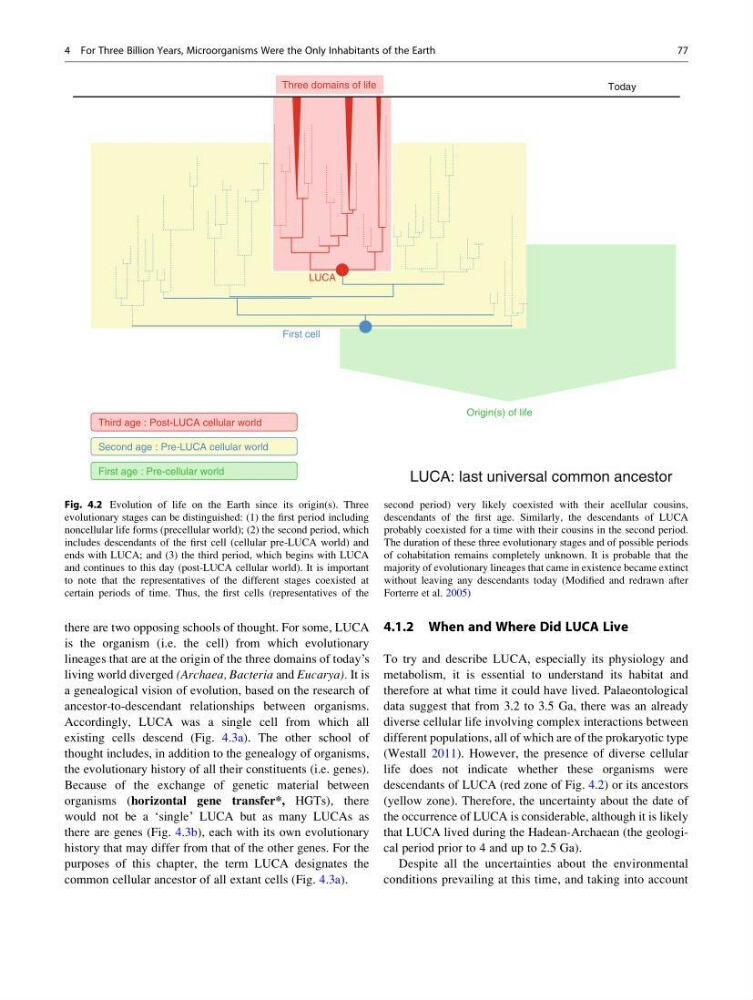
descendants of LUCA (red zone of Fig. 4.2) or its ancestors
(yellow zone). Therefore, the uncertainty about the date of
the occurrence of LUCA is considerable, although it is likely
that LUCA lived during the Hadean-Archaean (the geological period prior to 4 and up to 2.5 Ga).
Despite all the uncertainties about the environmental
conditions prevailing at this time, and taking into account
Three domains of life
LUCA
First cell
Today
First age : Pre-cellular world
Second age : Pre-LUCA cellular world
Third age : Post-LUCA cellular world
Origin(s) of life
LUCA: last universal common ancestor
Fig. 4.2 Evolution of life on the Earth since its origin(s). Three
evolutionary stages can be distinguished: (1) the first period including
noncellular life forms (precellular world); (2) the second period, which
includes descendants of the first cell (cellular pre-LUCA world) and
ends with LUCA; and (3) the third period, which begins with LUCA
and continues to this day (post-LUCA cellular world). It is important
to note that the representatives of the different stages coexisted at
certain periods of time. Thus, the first cells (representatives of the
second period) very likely coexisted with their acellular cousins,
descendants of the first age. Similarly, the descendants of LUCA
probably coexisted for a time with their cousins in the second period.
The duration of these three evolutionary stages and of possible periods
of cohabitation remains completely unknown. It is probable that the
majority of evolutionary lineages that came in existence became extinct
without leaving any descendants today (Modified and redrawn after
Forterre et al. 2005)
4 For Three Billion Years, Microorganisms Were the Only Inhabitants of the Earth
77
is the organism (i.e. the cell) from which evolutionary
lineages that are at the origin of the three domains of today’s
living world diverged (Archaea, Bacteria and Eucarya). It is
a genealogical vision of evolution, based on the research of
ancestor-to-descendant relationships between organisms.
Accordingly, LUCA was a single cell from which all
existing cells descend (Fig. 4.3a). The other school of
thought includes, in addition to the genealogy of organisms,
the evolutionary history of all their constituents (i.e. genes).
Because of the exchange of genetic material between
organisms (horizontal gene transfer*, HGTs), there
would not be a ‘single’ LUCA but as many LUCAs as
there are genes (Fig. 4.3b), each with its own evolutionary
history that may differ from that of the other genes. For the
purposes of this chapter, the term LUCA designates the
common cellular ancestor of all extant cells (Fig. 4.3a).
4.1.2 When and Where Did LUCA Live
To try and describe LUCA, especially its physiology and
metabolism, it is essential to understand its habitat and
therefore at what time it could have lived. Palaeontological
data suggest that from 3.2 to 3.5 Ga, there was an already
diverse cellular life involving complex interactions between
different populations, all of which are of the prokaryotic type
(Westall 2011). However, the presence of diverse cellular
life does not indicate whether these organisms were
descendants of LUCA (red zone of Fig. 4.2) or its ancestors
(yellow zone). Therefore, the uncertainty about the date of
the occurrence of LUCA is considerable, although it is likely
that LUCA lived during the Hadean-Archaean (the geological period prior to 4 and up to 2.5 Ga).
Despite all the uncertainties about the environmental
conditions prevailing at this time, and taking into account
Three domains of life
LUCA
First cell
Today
First age : Pre-cellular world
Second age : Pre-LUCA cellular world
Third age : Post-LUCA cellular world
Origin(s) of life
LUCA: last universal common ancestor
Fig. 4.2 Evolution of life on the Earth since its origin(s). Three
evolutionary stages can be distinguished: (1) the first period including
noncellular life forms (precellular world); (2) the second period, which
includes descendants of the first cell (cellular pre-LUCA world) and
ends with LUCA; and (3) the third period, which begins with LUCA
and continues to this day (post-LUCA cellular world). It is important
to note that the representatives of the different stages coexisted at
certain periods of time. Thus, the first cells (representatives of the
second period) very likely coexisted with their acellular cousins,
descendants of the first age. Similarly, the descendants of LUCA
probably coexisted for a time with their cousins in the second period.
The duration of these three evolutionary stages and of possible periods
of cohabitation remains completely unknown. It is probable that the
majority of evolutionary lineages that came in existence became extinct
without leaving any descendants today (Modified and redrawn after
Forterre et al. 2005)
4 For Three Billion Years, Microorganisms Were the Only Inhabitants of the Earth
77