

formation of the Earth) (see review in Westall 2011). The
oldest traces indicative of possible biological activity
(Box 4.1) (derived from the value of the
12 C/
13 C ratio)
were detected in rocks collected from the Isua site in West
Greenland dating back to 3.7 billion years (Rosing 1999).
However, given the state of preservation of these rocks, the
exact date of the appearance of the first traces of life is still
the subject of intense controversy.
In the history of the evolution of life, there is consensus
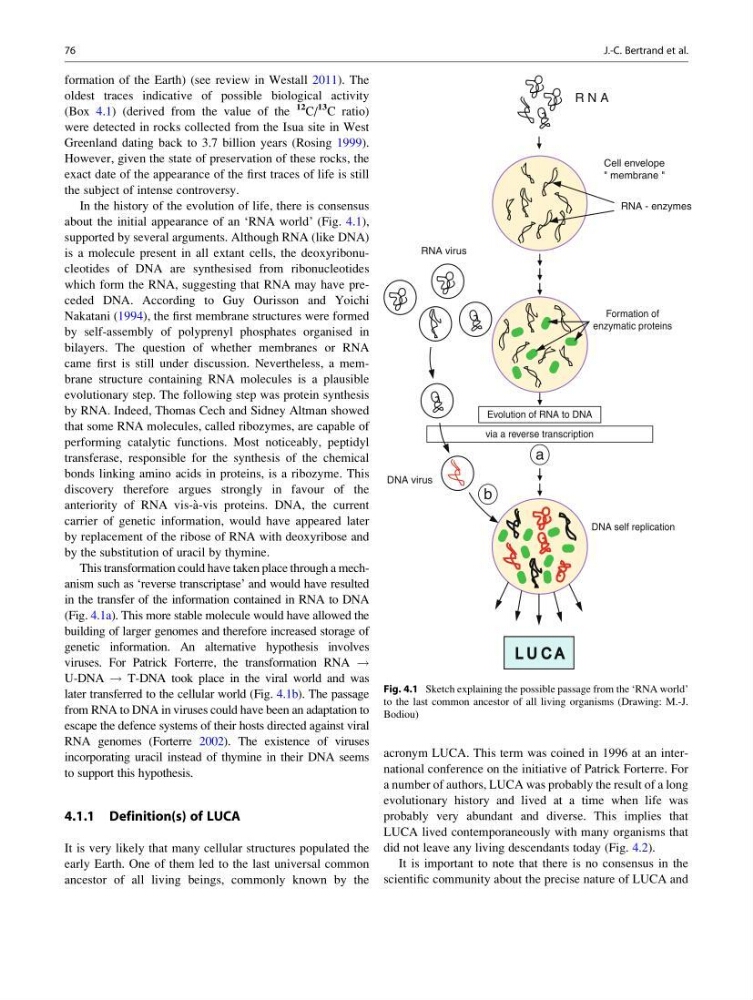
about the initial appearance of an ‘RNA world’ (Fig. 4.1),
supported by several arguments. Although RNA (like DNA)
is a molecule present in all extant cells, the deoxyribonucleotides of DNA are synthesised from ribonucleotides
which form the RNA, suggesting that RNA may have preceded DNA. According to Guy Ourisson and Yoichi
Nakatani (1994), the first membrane structures were formed
by self-assembly of polyprenyl phosphates organised in
bilayers. The question of whether membranes or RNA
came first is still under discussion. Nevertheless, a membrane structure containing RNA molecules is a plausible
evolutionary step. The following step was protein synthesis
by RNA. Indeed, Thomas Cech and Sidney Altman showed
that some RNA molecules, called ribozymes, are capable of
performing catalytic functions. Most noticeably, peptidyl
transferase, responsible for the synthesis of the chemical
bonds linking amino acids in proteins, is a ribozyme. This
discovery therefore argues strongly in favour of the
anteriority of RNA vis-a `-vis proteins. DNA, the current
carrier of genetic information, would have appeared later
by replacement of the ribose of RNA with deoxyribose and
by the substitution of uracil by thymine.
This transformation could have taken place through a mechanism such as ‘reverse transcriptase’ and would have resulted
in the transfer of the information contained in RNA to DNA
(Fig. 4.1a). This more stable molecule would have allowed the
building of larger genomes and therefore increased storage of
genetic information. An alternative hypothesis involves
viruses. For Patrick Forterre, the transformation RNA !
U-DNA ! T-DNA took place in the viral world and was
later transferred to the cellular world (Fig. 4.1b). The passage
from RNA to DNA in viruses could have been an adaptation to
escape the defence systems of their hosts directed against viral
RNA genomes (Forterre 2002). The existence of viruses
incorporating uracil instead of thymine in their DNA seems
to support this hypothesis.
4.1.1 Definition(s) of LUCA
It is very likely that many cellular structures populated the
early Earth. One of them led to the last universal common
ancestor of all living beings, commonly known by the
acronym LUCA. This term was coined in 1996 at an international conference on the initiative of Patrick Forterre. For
a number of authors, LUCA was probably the result of a long
evolutionary history and lived at a time when life was
probably very abundant and diverse. This implies that
LUCA lived contemporaneously with many organisms that
did not leave any living descendants today (Fig. 4.2).
It is important to note that there is no consensus in the
scientific community about the precise nature of LUCA and
R N A
RNA virus
Formation of
enzymatic proteins
Cell envelope
" membrane "
RNA - enzymes
DNA virus
a
b
Evolution of RNA to DNA
DNA self replication
via a reverse transcription
Fig. 4.1 Sketch explaining the possible passage from the ‘RNA world’
to the last common ancestor of all living organisms (Drawing: M.-J.
Bodiou)
76
J.-C. Bertrand et al.
oldest traces indicative of possible biological activity
(Box 4.1) (derived from the value of the
12 C/
13 C ratio)
were detected in rocks collected from the Isua site in West
Greenland dating back to 3.7 billion years (Rosing 1999).
However, given the state of preservation of these rocks, the
exact date of the appearance of the first traces of life is still
the subject of intense controversy.
In the history of the evolution of life, there is consensus
about the initial appearance of an ‘RNA world’ (Fig. 4.1),
supported by several arguments. Although RNA (like DNA)
is a molecule present in all extant cells, the deoxyribonucleotides of DNA are synthesised from ribonucleotides
which form the RNA, suggesting that RNA may have preceded DNA. According to Guy Ourisson and Yoichi
Nakatani (1994), the first membrane structures were formed
by self-assembly of polyprenyl phosphates organised in
bilayers. The question of whether membranes or RNA
came first is still under discussion. Nevertheless, a membrane structure containing RNA molecules is a plausible
evolutionary step. The following step was protein synthesis
by RNA. Indeed, Thomas Cech and Sidney Altman showed
that some RNA molecules, called ribozymes, are capable of
performing catalytic functions. Most noticeably, peptidyl
transferase, responsible for the synthesis of the chemical
bonds linking amino acids in proteins, is a ribozyme. This
discovery therefore argues strongly in favour of the
anteriority of RNA vis-a `-vis proteins. DNA, the current
carrier of genetic information, would have appeared later
by replacement of the ribose of RNA with deoxyribose and
by the substitution of uracil by thymine.
This transformation could have taken place through a mechanism such as ‘reverse transcriptase’ and would have resulted
in the transfer of the information contained in RNA to DNA
(Fig. 4.1a). This more stable molecule would have allowed the
building of larger genomes and therefore increased storage of
genetic information. An alternative hypothesis involves
viruses. For Patrick Forterre, the transformation RNA !
U-DNA ! T-DNA took place in the viral world and was
later transferred to the cellular world (Fig. 4.1b). The passage
from RNA to DNA in viruses could have been an adaptation to
escape the defence systems of their hosts directed against viral
RNA genomes (Forterre 2002). The existence of viruses
incorporating uracil instead of thymine in their DNA seems
to support this hypothesis.
4.1.1 Definition(s) of LUCA
It is very likely that many cellular structures populated the
early Earth. One of them led to the last universal common
ancestor of all living beings, commonly known by the
acronym LUCA. This term was coined in 1996 at an international conference on the initiative of Patrick Forterre. For
a number of authors, LUCA was probably the result of a long
evolutionary history and lived at a time when life was
probably very abundant and diverse. This implies that
LUCA lived contemporaneously with many organisms that
did not leave any living descendants today (Fig. 4.2).
It is important to note that there is no consensus in the
scientific community about the precise nature of LUCA and
R N A
RNA virus
Formation of
enzymatic proteins
Cell envelope
" membrane "
RNA - enzymes
DNA virus
a
b
Evolution of RNA to DNA
DNA self replication
via a reverse transcription
Fig. 4.1 Sketch explaining the possible passage from the ‘RNA world’
to the last common ancestor of all living organisms (Drawing: M.-J.
Bodiou)
76
J.-C. Bertrand et al.