

Another source of oxaloacetate is the formation of
glyoxylate from isocitrate, which shortens the Krebs cycle
avoiding the step of ketoglutarate (Fig. 3.40). The shorter
Krebs cycle is called glyoxylate cycle.
The main monomers synthesized from different carbon
skeletons are used to build macromolecules (Table 3.16).
3.4.4 Assimilation of Nitrogen, Sulfur,
and Essential Elements
3.4.4.1 Assimilation of Nitrogen Compounds
The most abundant nitrogen sources for microorganisms are
ammonia nitrogen, nitrate, and dinitrogen. Only ammonia
nitrogen is directly assimilated by the microorganisms.
Nitrate and dinitrogen must be reduced to ammonia to be
assimilated. Protozoa are dependent to organic nitrogen (cf.
Sect. 14.3.2).
Assimilatory Reduction of Nitrate
Nitrate is reduced to nitrite by assimilatory nitrate reductase
(Nas) whose properties are different from dissimilative
reductases previously described (Table 3.17) and used in
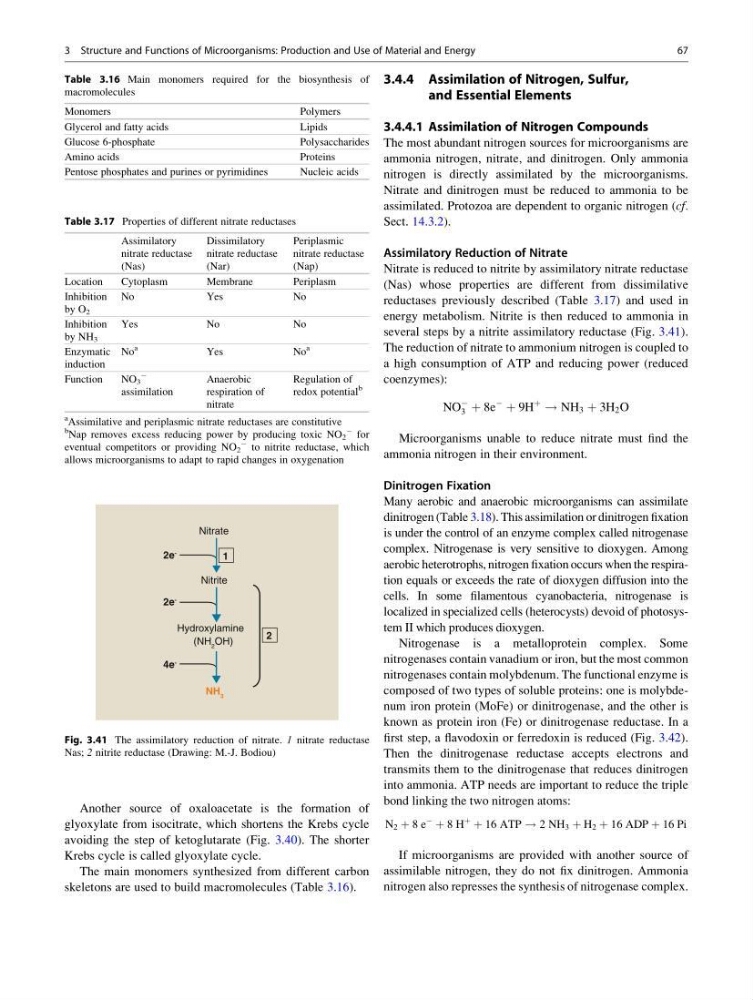
energy metabolism. Nitrite is then reduced to ammonia in
several steps by a nitrite assimilatory reductase (Fig. 3.41).
The reduction of nitrate to ammonium nitrogen is coupled to
a high consumption of ATP and reducing power (reduced
coenzymes):
NO
À
3 þ 8e
À
þ 9H
þ
! NH 3 þ 3H 2 O
Microorganisms unable to reduce nitrate must find the
ammonia nitrogen in their environment.
Dinitrogen Fixation
Many aerobic and anaerobic microorganisms can assimilate
dinitrogen (Table 3.18). This assimilation or dinitrogen fixation
is under the control of an enzyme complex called nitrogenase
complex. Nitrogenase is very sensitive to dioxygen. Among
aerobic heterotrophs, nitrogen fixation occurs when the respiration equals or exceeds the rate of dioxygen diffusion into the
cells. In some filamentous cyanobacteria, nitrogenase is
localized in specialized cells (heterocysts) devoid of photosystem II which produces dioxygen.
Nitrogenase is a metalloprotein complex. Some
nitrogenases contain vanadium or iron, but the most common
nitrogenases contain molybdenum. The functional enzyme is
composed of two types of soluble proteins: one is molybdenum iron protein (MoFe) or dinitrogenase, and the other is
known as protein iron (Fe) or dinitrogenase reductase. In a
first step, a flavodoxin or ferredoxin is reduced (Fig. 3.42).
Then the dinitrogenase reductase accepts electrons and
transmits them to the dinitrogenase that reduces dinitrogen
into ammonia. ATP needs are important to reduce the triple
bond linking the two nitrogen atoms:
N 2 þ 8 e
À þ 8 H
þ þ 16 ATP ! 2 NH 3 þ H 2 þ 16 ADP þ 16 Pi
If microorganisms are provided with another source of
assimilable nitrogen, they do not fix dinitrogen. Ammonia
nitrogen also represses the synthesis of nitrogenase complex.
Table 3.17 Properties of different nitrate reductases
Assimilatory
nitrate reductase
(Nas)
Dissimilatory
nitrate reductase
(Nar)
Periplasmic
nitrate reductase
(Nap)
Location
Cytoplasm
Membrane
Periplasm
Inhibition
by O 2
No
Yes
No
Inhibition
by NH 3
Yes
No
No
Enzymatic
induction
No
a
Yes
No
a
Function
NO 3
À
assimilation
Anaerobic
respiration of
nitrate
Regulation of
redox potential
b
a
Assimilative and periplasmic nitrate reductases are constitutive
b
Nap removes excess reducing power by producing toxic NO 2
À for
eventual competitors or providing NO 2
À to nitrite reductase, which
allows microorganisms to adapt to rapid changes in oxygenation
Nitrate
Nitrite
Hydroxylamine
(NH 2 OH)
NH 3
1
2
2e
-
2e
-
4e
-
Fig. 3.41 The assimilatory reduction of nitrate. 1 nitrate reductase
Nas; 2 nitrite reductase (Drawing: M.-J. Bodiou)
Table 3.16 Main monomers required for the biosynthesis of
macromolecules
Monomers
Polymers
Glycerol and fatty acids
Lipids
Glucose 6-phosphate
Polysaccharides
Amino acids
Proteins
Pentose phosphates and purines or pyrimidines
Nucleic acids
3 Structure and Functions of Microorganisms: Production and Use of Material and Energy
67
glyoxylate from isocitrate, which shortens the Krebs cycle
avoiding the step of ketoglutarate (Fig. 3.40). The shorter
Krebs cycle is called glyoxylate cycle.
The main monomers synthesized from different carbon
skeletons are used to build macromolecules (Table 3.16).
3.4.4 Assimilation of Nitrogen, Sulfur,
and Essential Elements
3.4.4.1 Assimilation of Nitrogen Compounds
The most abundant nitrogen sources for microorganisms are
ammonia nitrogen, nitrate, and dinitrogen. Only ammonia
nitrogen is directly assimilated by the microorganisms.
Nitrate and dinitrogen must be reduced to ammonia to be
assimilated. Protozoa are dependent to organic nitrogen (cf.
Sect. 14.3.2).
Assimilatory Reduction of Nitrate
Nitrate is reduced to nitrite by assimilatory nitrate reductase
(Nas) whose properties are different from dissimilative
reductases previously described (Table 3.17) and used in
energy metabolism. Nitrite is then reduced to ammonia in
several steps by a nitrite assimilatory reductase (Fig. 3.41).
The reduction of nitrate to ammonium nitrogen is coupled to
a high consumption of ATP and reducing power (reduced
coenzymes):
NO
À
3 þ 8e
À
þ 9H
þ
! NH 3 þ 3H 2 O
Microorganisms unable to reduce nitrate must find the
ammonia nitrogen in their environment.
Dinitrogen Fixation
Many aerobic and anaerobic microorganisms can assimilate
dinitrogen (Table 3.18). This assimilation or dinitrogen fixation
is under the control of an enzyme complex called nitrogenase
complex. Nitrogenase is very sensitive to dioxygen. Among
aerobic heterotrophs, nitrogen fixation occurs when the respiration equals or exceeds the rate of dioxygen diffusion into the
cells. In some filamentous cyanobacteria, nitrogenase is
localized in specialized cells (heterocysts) devoid of photosystem II which produces dioxygen.
Nitrogenase is a metalloprotein complex. Some
nitrogenases contain vanadium or iron, but the most common
nitrogenases contain molybdenum. The functional enzyme is
composed of two types of soluble proteins: one is molybdenum iron protein (MoFe) or dinitrogenase, and the other is
known as protein iron (Fe) or dinitrogenase reductase. In a
first step, a flavodoxin or ferredoxin is reduced (Fig. 3.42).
Then the dinitrogenase reductase accepts electrons and
transmits them to the dinitrogenase that reduces dinitrogen
into ammonia. ATP needs are important to reduce the triple
bond linking the two nitrogen atoms:
N 2 þ 8 e
À þ 8 H
þ þ 16 ATP ! 2 NH 3 þ H 2 þ 16 ADP þ 16 Pi
If microorganisms are provided with another source of
assimilable nitrogen, they do not fix dinitrogen. Ammonia
nitrogen also represses the synthesis of nitrogenase complex.
Table 3.17 Properties of different nitrate reductases
Assimilatory
nitrate reductase
(Nas)
Dissimilatory
nitrate reductase
(Nar)
Periplasmic
nitrate reductase
(Nap)
Location
Cytoplasm
Membrane
Periplasm
Inhibition
by O 2
No
Yes
No
Inhibition
by NH 3
Yes
No
No
Enzymatic
induction
No
a
Yes
No
a
Function
NO 3
À
assimilation
Anaerobic
respiration of
nitrate
Regulation of
redox potential
b
a
Assimilative and periplasmic nitrate reductases are constitutive
b
Nap removes excess reducing power by producing toxic NO 2
À for
eventual competitors or providing NO 2
À to nitrite reductase, which
allows microorganisms to adapt to rapid changes in oxygenation
Nitrate
Nitrite
Hydroxylamine
(NH 2 OH)
NH 3
1
2
2e
-
2e
-
4e
-
Fig. 3.41 The assimilatory reduction of nitrate. 1 nitrate reductase
Nas; 2 nitrite reductase (Drawing: M.-J. Bodiou)
Table 3.16 Main monomers required for the biosynthesis of
macromolecules
Monomers
Polymers
Glycerol and fatty acids
Lipids
Glucose 6-phosphate
Polysaccharides
Amino acids
Proteins
Pentose phosphates and purines or pyrimidines
Nucleic acids
3 Structure and Functions of Microorganisms: Production and Use of Material and Energy
67