

Thermoplasma, Sulfolobus), while an incomplete cycle was
often described in the anaerobic archaea (Pyrococcus,
Methanosarcina, Archaeoglobus) (Danson et al. 2007).
In some archaea, the whole of genes encoding enzymes
of the cycle has been identified (Halobacterium,
Thermoplasma, Picrophilus). In others, the cycle can run in
the direction of reduction (reverse cycle) for CO 2 fixation
during autotrophic growth (Hu and Holden 2006).
The oxaloacetate is required for operating the Krebs
cycle. The removal of this compound for biosyntheses
(neoglucogenesis, amino acid synthesis) must be
compensated for the cycle to continue to operate. Reactions
providing the compound or precursors are anaplerotic
sequences*. These reactions catalyzed by a carboxylase
(3.6) and a carboxykinase (3.7) produce oxaloacetate:
Pyruvate þ CO 2 þ ATP ! oxaloacetate þ ADP þ Pi ð3:6Þ
Phosphoenolpyruvate þ CO 2 þ GDP
$ oxaloacetate þ GTP
ð3:7Þ
Purines
Pyrimidines
Nucleotides
Histidine
Tryptophan
Phenylalanine
Tyrosine
Aspartate
Lysine
Methionine
Threonine
Isoleucine
Glucose 6 - P
TAC
Glucose
Pi
ATP
Pi
ATP
Fructose 6 - P
Fructose 1,6 - P
Triose - P
Glycerate 3 - P
Phosphoenolpyruvate
AMP
ATP
ATP
Pyruvate
Acetate
CO 2
GTP
CO 2
Oxaloacetate
Isocitrate
Malate
α-Ketoglutarate
Succinate
Glycerol
Serine
Glycine
Cysteine
Alanine
Valine
Leucine
Fatty acids
Glutamate
Proline
Ornithine
Arginine
PPC
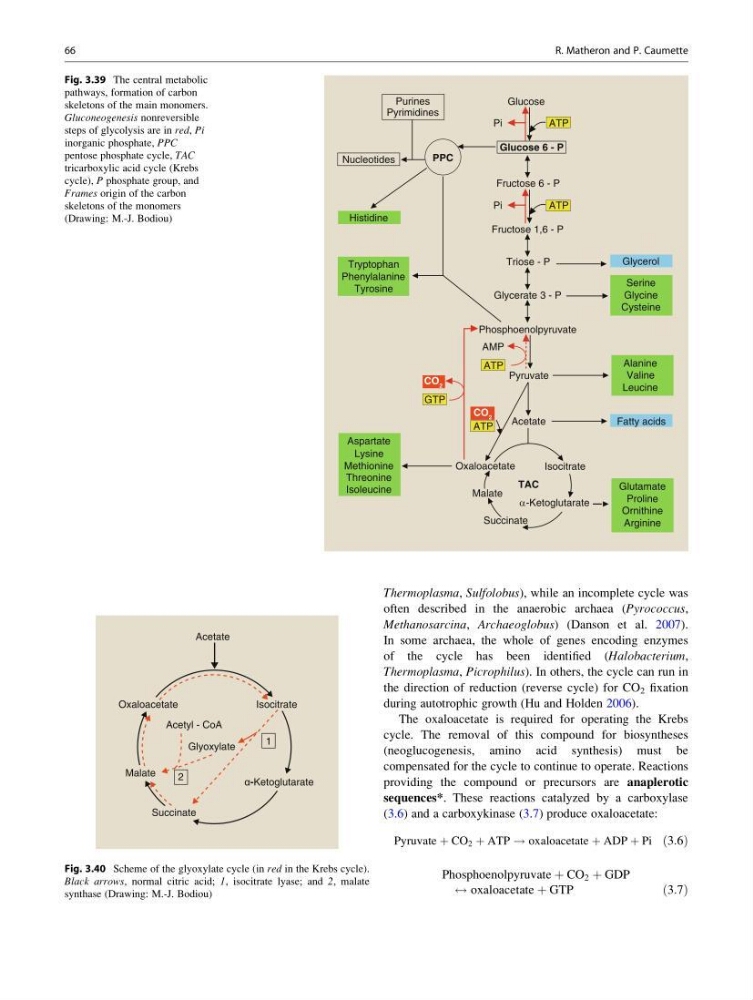
Fig. 3.39 The central metabolic
pathways, formation of carbon
skeletons of the main monomers.
Gluconeogenesis nonreversible
steps of glycolysis are in red, Pi
inorganic phosphate, PPC
pentose phosphate cycle, TAC
tricarboxylic acid cycle (Krebs
cycle), P phosphate group, and
Frames origin of the carbon
skeletons of the monomers
(Drawing: M.-J. Bodiou)
Acetate
Malate
Oxaloacetate
Succinate
α-Ketoglutarate
Isocitrate
Acetyl - CoA
Glyoxylate
1
2
Fig. 3.40 Scheme of the glyoxylate cycle (in red in the Krebs cycle).
Black arrows, normal citric acid; 1, isocitrate lyase; and 2, malate
synthase (Drawing: M.-J. Bodiou)
66
R. Matheron and P. Caumette
often described in the anaerobic archaea (Pyrococcus,
Methanosarcina, Archaeoglobus) (Danson et al. 2007).
In some archaea, the whole of genes encoding enzymes
of the cycle has been identified (Halobacterium,
Thermoplasma, Picrophilus). In others, the cycle can run in
the direction of reduction (reverse cycle) for CO 2 fixation
during autotrophic growth (Hu and Holden 2006).
The oxaloacetate is required for operating the Krebs
cycle. The removal of this compound for biosyntheses
(neoglucogenesis, amino acid synthesis) must be
compensated for the cycle to continue to operate. Reactions
providing the compound or precursors are anaplerotic
sequences*. These reactions catalyzed by a carboxylase
(3.6) and a carboxykinase (3.7) produce oxaloacetate:
Pyruvate þ CO 2 þ ATP ! oxaloacetate þ ADP þ Pi ð3:6Þ
Phosphoenolpyruvate þ CO 2 þ GDP
$ oxaloacetate þ GTP
ð3:7Þ
Purines
Pyrimidines
Nucleotides
Histidine
Tryptophan
Phenylalanine
Tyrosine
Aspartate
Lysine
Methionine
Threonine
Isoleucine
Glucose 6 - P
TAC
Glucose
Pi
ATP
Pi
ATP
Fructose 6 - P
Fructose 1,6 - P
Triose - P
Glycerate 3 - P
Phosphoenolpyruvate
AMP
ATP
ATP
Pyruvate
Acetate
CO 2
GTP
CO 2
Oxaloacetate
Isocitrate
Malate
α-Ketoglutarate
Succinate
Glycerol
Serine
Glycine
Cysteine
Alanine
Valine
Leucine
Fatty acids
Glutamate
Proline
Ornithine
Arginine
PPC
Fig. 3.39 The central metabolic
pathways, formation of carbon
skeletons of the main monomers.
Gluconeogenesis nonreversible
steps of glycolysis are in red, Pi
inorganic phosphate, PPC
pentose phosphate cycle, TAC
tricarboxylic acid cycle (Krebs
cycle), P phosphate group, and
Frames origin of the carbon
skeletons of the monomers
(Drawing: M.-J. Bodiou)
Acetate
Malate
Oxaloacetate
Succinate
α-Ketoglutarate
Isocitrate
Acetyl - CoA
Glyoxylate
1
2
Fig. 3.40 Scheme of the glyoxylate cycle (in red in the Krebs cycle).
Black arrows, normal citric acid; 1, isocitrate lyase; and 2, malate
synthase (Drawing: M.-J. Bodiou)
66
R. Matheron and P. Caumette