

condensation with a compound containing more than one
carbon atom and the production of a C3 molecule that feeds
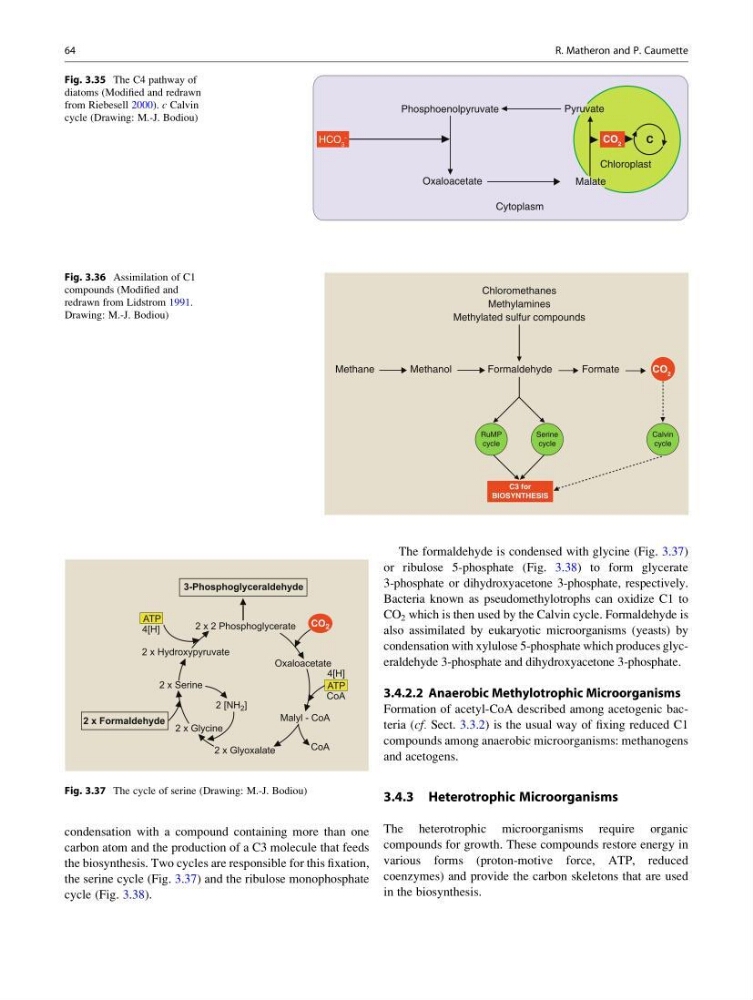
the biosynthesis. Two cycles are responsible for this fixation,
the serine cycle (Fig. 3.37) and the ribulose monophosphate
cycle (Fig. 3.38).
The formaldehyde is condensed with glycine (Fig. 3.37)
or ribulose 5-phosphate (Fig. 3.38) to form glycerate
3-phosphate or dihydroxyacetone 3-phosphate, respectively.
Bacteria known as pseudomethylotrophs can oxidize C1 to
CO 2 which is then used by the Calvin cycle. Formaldehyde is
also assimilated by eukaryotic microorganisms (yeasts) by
condensation with xylulose 5-phosphate which produces glyceraldehyde 3-phosphate and dihydroxyacetone 3-phosphate.
3.4.2.2 Anaerobic Methylotrophic Microorganisms
Formation of acetyl-CoA described among acetogenic bacteria (cf. Sect. 3.3.2) is the usual way of fixing reduced C1
compounds among anaerobic microorganisms: methanogens
and acetogens.
3.4.3 Heterotrophic Microorganisms
The heterotrophic microorganisms require organic
compounds for growth. These compounds restore energy in
various forms (proton-motive force, ATP, reduced
coenzymes) and provide the carbon skeletons that are used
in the biosynthesis.
Phosphoenolpyruvate
Pyruvate
HCO 3
-
Oxaloacetate
Cytoplasm
CO 2
C
Chloroplast
Malate
Fig. 3.35 The C4 pathway of
diatoms (Modified and redrawn
from Riebesell 2000). c Calvin
cycle (Drawing: M.-J. Bodiou)
Chloromethanes
Methylamines
Methylated sulfur compounds
Methane
Methanol
Formaldehyde
Formate
CO 2
RuMP
cycle
Serine
cycle
Calvin
cycle
C3 for
BIOSYNTHESIS
Fig. 3.36 Assimilation of C1
compounds (Modified and
redrawn from Lidstrom 1991.
Drawing: M.-J. Bodiou)
Fig. 3.37 The cycle of serine (Drawing: M.-J. Bodiou)
64
R. Matheron and P. Caumette
carbon atom and the production of a C3 molecule that feeds
the biosynthesis. Two cycles are responsible for this fixation,
the serine cycle (Fig. 3.37) and the ribulose monophosphate
cycle (Fig. 3.38).
The formaldehyde is condensed with glycine (Fig. 3.37)
or ribulose 5-phosphate (Fig. 3.38) to form glycerate
3-phosphate or dihydroxyacetone 3-phosphate, respectively.
Bacteria known as pseudomethylotrophs can oxidize C1 to
CO 2 which is then used by the Calvin cycle. Formaldehyde is
also assimilated by eukaryotic microorganisms (yeasts) by
condensation with xylulose 5-phosphate which produces glyceraldehyde 3-phosphate and dihydroxyacetone 3-phosphate.
3.4.2.2 Anaerobic Methylotrophic Microorganisms
Formation of acetyl-CoA described among acetogenic bacteria (cf. Sect. 3.3.2) is the usual way of fixing reduced C1
compounds among anaerobic microorganisms: methanogens
and acetogens.
3.4.3 Heterotrophic Microorganisms
The heterotrophic microorganisms require organic
compounds for growth. These compounds restore energy in
various forms (proton-motive force, ATP, reduced
coenzymes) and provide the carbon skeletons that are used
in the biosynthesis.
Phosphoenolpyruvate
Pyruvate
HCO 3
-
Oxaloacetate
Cytoplasm
CO 2
C
Chloroplast
Malate
Fig. 3.35 The C4 pathway of
diatoms (Modified and redrawn
from Riebesell 2000). c Calvin
cycle (Drawing: M.-J. Bodiou)
Chloromethanes
Methylamines
Methylated sulfur compounds
Methane
Methanol
Formaldehyde
Formate
CO 2
RuMP
cycle
Serine
cycle
Calvin
cycle
C3 for
BIOSYNTHESIS
Fig. 3.36 Assimilation of C1
compounds (Modified and
redrawn from Lidstrom 1991.
Drawing: M.-J. Bodiou)
Fig. 3.37 The cycle of serine (Drawing: M.-J. Bodiou)
64
R. Matheron and P. Caumette