

CO 2 fixation by most acetogenic bacteria, few sulfatereducing bacteria (Desulfobacterium), or archaea
(Archaeoglobus, methanogens).
3.4.1.4 The 3-Hydroxypropionate Cycle
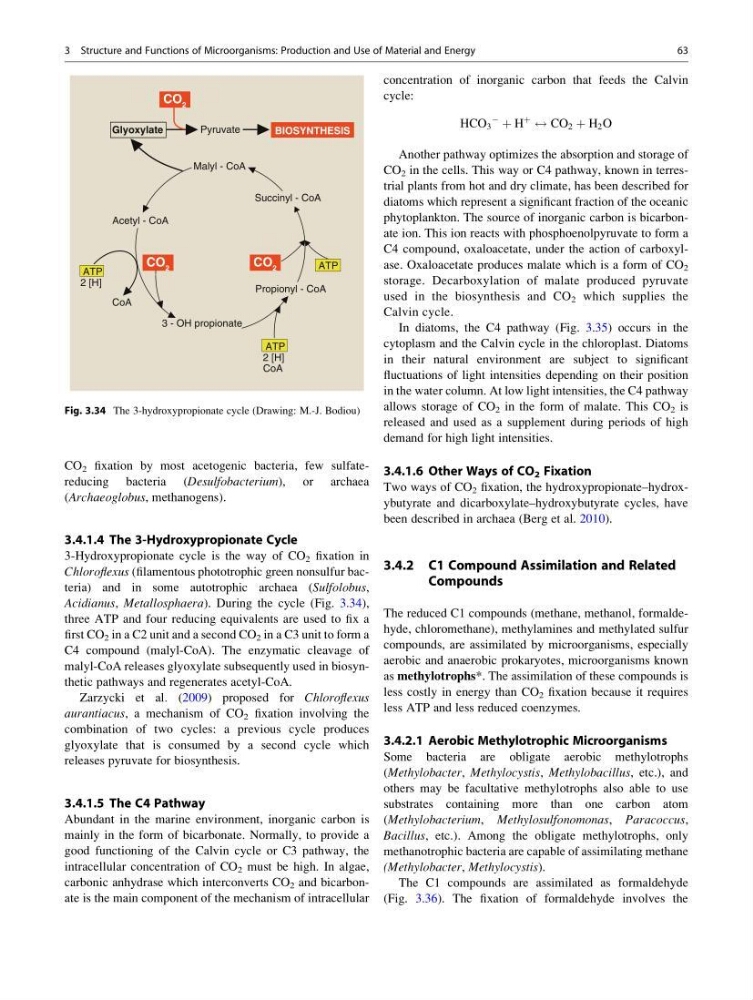
3-Hydroxypropionate cycle is the way of CO 2 fixation in
Chloroflexus (filamentous phototrophic green nonsulfur bacteria) and in some autotrophic archaea (Sulfolobus,
Acidianus, Metallosphaera). During the cycle (Fig. 3.34),
three ATP and four reducing equivalents are used to fix a
first CO 2 in a C2 unit and a second CO 2 in a C3 unit to form a
C4 compound (malyl-CoA). The enzymatic cleavage of
malyl-CoA releases glyoxylate subsequently used in biosynthetic pathways and regenerates acetyl-CoA.
Zarzycki et al. (2009) proposed for Chloroflexus
aurantiacus, a mechanism of CO 2 fixation involving the
combination of two cycles: a previous cycle produces
glyoxylate that is consumed by a second cycle which
releases pyruvate for biosynthesis.
3.4.1.5 The C4 Pathway
Abundant in the marine environment, inorganic carbon is
mainly in the form of bicarbonate. Normally, to provide a
good functioning of the Calvin cycle or C3 pathway, the
intracellular concentration of CO 2 must be high. In algae,
carbonic anhydrase which interconverts CO 2 and bicarbonate is the main component of the mechanism of intracellular
concentration of inorganic carbon that feeds the Calvin
cycle:
HCO 3
À
þ H
þ
$ CO 2 þ H 2 O
Another pathway optimizes the absorption and storage of
CO 2 in the cells. This way or C4 pathway, known in terrestrial plants from hot and dry climate, has been described for
diatoms which represent a significant fraction of the oceanic
phytoplankton. The source of inorganic carbon is bicarbonate ion. This ion reacts with phosphoenolpyruvate to form a
C4 compound, oxaloacetate, under the action of carboxylase. Oxaloacetate produces malate which is a form of CO 2
storage. Decarboxylation of malate produced pyruvate
used in the biosynthesis and CO 2 which supplies the
Calvin cycle.
In diatoms, the C4 pathway (Fig. 3.35) occurs in the
cytoplasm and the Calvin cycle in the chloroplast. Diatoms
in their natural environment are subject to significant
fluctuations of light intensities depending on their position
in the water column. At low light intensities, the C4 pathway
allows storage of CO 2 in the form of malate. This CO 2 is
released and used as a supplement during periods of high
demand for high light intensities.
3.4.1.6 Other Ways of CO 2 Fixation
Two ways of CO 2 fixation, the hydroxypropionate–hydroxybutyrate and dicarboxylate–hydroxybutyrate cycles, have
been described in archaea (Berg et al. 2010).
3.4.2 C1 Compound Assimilation and Related
Compounds
The reduced C1 compounds (methane, methanol, formaldehyde, chloromethane), methylamines and methylated sulfur
compounds, are assimilated by microorganisms, especially
aerobic and anaerobic prokaryotes, microorganisms known
as methylotrophs*. The assimilation of these compounds is
less costly in energy than CO 2 fixation because it requires
less ATP and less reduced coenzymes.
3.4.2.1 Aerobic Methylotrophic Microorganisms
Some bacteria are obligate aerobic methylotrophs
(Methylobacter, Methylocystis, Methylobacillus, etc.), and
others may be facultative methylotrophs also able to use
substrates containing more than one carbon atom
(Methylobacterium, Methylosulfonomonas, Paracoccus,
Bacillus, etc.). Among the obligate methylotrophs, only
methanotrophic bacteria are capable of assimilating methane
(Methylobacter, Methylocystis).
The C1 compounds are assimilated as formaldehyde
(Fig. 3.36). The fixation of formaldehyde involves the
ATP
ATP
2 [H]
CoA
ATP
2 [H]
CoA
Glyoxylate
BIOSYNTHESIS
CO 2
CO 2
CO 2
Malyl - CoA
Succinyl - CoA
Acetyl - CoA
Propionyl - CoA
Pyruvate
3 - OH propionate
Fig. 3.34 The 3-hydroxypropionate cycle (Drawing: M.-J. Bodiou)
3 Structure and Functions of Microorganisms: Production and Use of Material and Energy
63
(Archaeoglobus, methanogens).
3.4.1.4 The 3-Hydroxypropionate Cycle
3-Hydroxypropionate cycle is the way of CO 2 fixation in
Chloroflexus (filamentous phototrophic green nonsulfur bacteria) and in some autotrophic archaea (Sulfolobus,
Acidianus, Metallosphaera). During the cycle (Fig. 3.34),
three ATP and four reducing equivalents are used to fix a
first CO 2 in a C2 unit and a second CO 2 in a C3 unit to form a
C4 compound (malyl-CoA). The enzymatic cleavage of
malyl-CoA releases glyoxylate subsequently used in biosynthetic pathways and regenerates acetyl-CoA.
Zarzycki et al. (2009) proposed for Chloroflexus
aurantiacus, a mechanism of CO 2 fixation involving the
combination of two cycles: a previous cycle produces
glyoxylate that is consumed by a second cycle which
releases pyruvate for biosynthesis.
3.4.1.5 The C4 Pathway
Abundant in the marine environment, inorganic carbon is
mainly in the form of bicarbonate. Normally, to provide a
good functioning of the Calvin cycle or C3 pathway, the
intracellular concentration of CO 2 must be high. In algae,
carbonic anhydrase which interconverts CO 2 and bicarbonate is the main component of the mechanism of intracellular
concentration of inorganic carbon that feeds the Calvin
cycle:
HCO 3
À
þ H
þ
$ CO 2 þ H 2 O
Another pathway optimizes the absorption and storage of
CO 2 in the cells. This way or C4 pathway, known in terrestrial plants from hot and dry climate, has been described for
diatoms which represent a significant fraction of the oceanic
phytoplankton. The source of inorganic carbon is bicarbonate ion. This ion reacts with phosphoenolpyruvate to form a
C4 compound, oxaloacetate, under the action of carboxylase. Oxaloacetate produces malate which is a form of CO 2
storage. Decarboxylation of malate produced pyruvate
used in the biosynthesis and CO 2 which supplies the
Calvin cycle.
In diatoms, the C4 pathway (Fig. 3.35) occurs in the
cytoplasm and the Calvin cycle in the chloroplast. Diatoms
in their natural environment are subject to significant
fluctuations of light intensities depending on their position
in the water column. At low light intensities, the C4 pathway
allows storage of CO 2 in the form of malate. This CO 2 is
released and used as a supplement during periods of high
demand for high light intensities.
3.4.1.6 Other Ways of CO 2 Fixation
Two ways of CO 2 fixation, the hydroxypropionate–hydroxybutyrate and dicarboxylate–hydroxybutyrate cycles, have
been described in archaea (Berg et al. 2010).
3.4.2 C1 Compound Assimilation and Related
Compounds
The reduced C1 compounds (methane, methanol, formaldehyde, chloromethane), methylamines and methylated sulfur
compounds, are assimilated by microorganisms, especially
aerobic and anaerobic prokaryotes, microorganisms known
as methylotrophs*. The assimilation of these compounds is
less costly in energy than CO 2 fixation because it requires
less ATP and less reduced coenzymes.
3.4.2.1 Aerobic Methylotrophic Microorganisms
Some bacteria are obligate aerobic methylotrophs
(Methylobacter, Methylocystis, Methylobacillus, etc.), and
others may be facultative methylotrophs also able to use
substrates containing more than one carbon atom
(Methylobacterium, Methylosulfonomonas, Paracoccus,
Bacillus, etc.). Among the obligate methylotrophs, only
methanotrophic bacteria are capable of assimilating methane
(Methylobacter, Methylocystis).
The C1 compounds are assimilated as formaldehyde
(Fig. 3.36). The fixation of formaldehyde involves the
ATP
ATP
2 [H]
CoA
ATP
2 [H]
CoA
Glyoxylate
BIOSYNTHESIS
CO 2
CO 2
CO 2
Malyl - CoA
Succinyl - CoA
Acetyl - CoA
Propionyl - CoA
Pyruvate
3 - OH propionate
Fig. 3.34 The 3-hydroxypropionate cycle (Drawing: M.-J. Bodiou)
3 Structure and Functions of Microorganisms: Production and Use of Material and Energy
63