

reduced NAD
+
. Thus, the reduction of three moles of CO 2 to
form one mole of PGA requires 45 ATP or 75 ion-grams of
NO 2
À . In these circumstances, it is clearly conceivable that
these microorganisms oxidize a large amount of substrate
and growth based on the biosynthesis is slow.
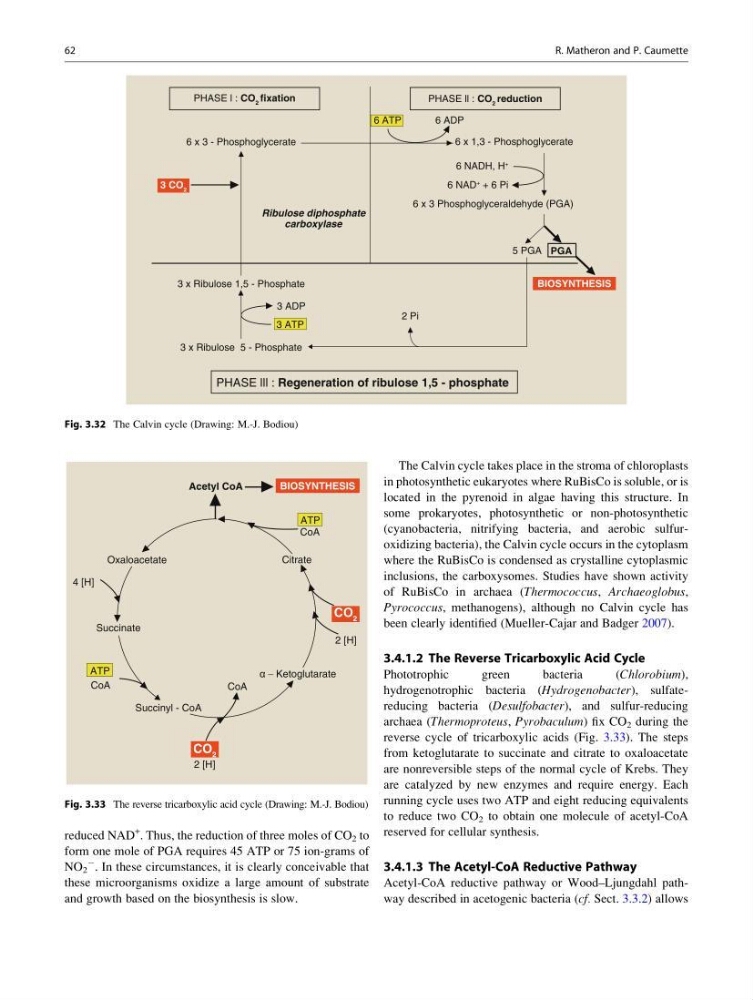
The Calvin cycle takes place in the stroma of chloroplasts
in photosynthetic eukaryotes where RuBisCo is soluble, or is
located in the pyrenoid in algae having this structure. In
some prokaryotes, photosynthetic or non-photosynthetic
(cyanobacteria, nitrifying bacteria, and aerobic sulfuroxidizing bacteria), the Calvin cycle occurs in the cytoplasm
where the RuBisCo is condensed as crystalline cytoplasmic
inclusions, the carboxysomes. Studies have shown activity
of RuBisCo in archaea (Thermococcus, Archaeoglobus,
Pyrococcus, methanogens), although no Calvin cycle has
been clearly identified (Mueller-Cajar and Badger 2007).
3.4.1.2 The Reverse Tricarboxylic Acid Cycle
Phototrophic
green
bacteria
(Chlorobium),
hydrogenotrophic bacteria (Hydrogenobacter), sulfatereducing bacteria (Desulfobacter), and sulfur-reducing
archaea (Thermoproteus, Pyrobaculum) fix CO 2 during the
reverse cycle of tricarboxylic acids (Fig. 3.33). The steps
from ketoglutarate to succinate and citrate to oxaloacetate
are nonreversible steps of the normal cycle of Krebs. They
are catalyzed by new enzymes and require energy. Each
running cycle uses two ATP and eight reducing equivalents
to reduce two CO 2 to obtain one molecule of acetyl-CoA
reserved for cellular synthesis.
3.4.1.3 The Acetyl-CoA Reductive Pathway
Acetyl-CoA reductive pathway or Wood–Ljungdahl pathway described in acetogenic bacteria (cf. Sect. 3.3.2) allows
PHASE l : CO 2 fixation
PHASE ll : CO 2 reduction
3 CO 2
PGA
BIOSYNTHESIS
PHASE lll : Regeneration of ribulose 1,5 - phosphate
Ribulose diphosphate
carboxylase
6 x 3 - Phosphoglycerate
6 x 3 Phosphoglyceraldehyde (PGA)
5 PGA
3 x Ribulose 1,5 - Phosphate
3 x Ribulose 5 - Phosphate
6 ATP
6 ADP
3 ATP
3 ADP
6 x 1,3 - Phosphoglycerate
6 NADH, H
+
6 NAD
+ + 6 Pi
2 Pi
Fig. 3.32 The Calvin cycle (Drawing: M.-J. Bodiou)
Oxaloacetate
CO 2
CO 2
Acetyl CoA
BIOSYNTHESIS
Citrate
Succinyl - CoA
2 [H]
2 [H]
4 [H]
CoA
α − Ketoglutarate
Succinate
ATP
CoA
ATP
CoA
Fig. 3.33 The reverse tricarboxylic acid cycle (Drawing: M.-J. Bodiou)
62
R. Matheron and P. Caumette
+
. Thus, the reduction of three moles of CO 2 to
form one mole of PGA requires 45 ATP or 75 ion-grams of
NO 2
À . In these circumstances, it is clearly conceivable that
these microorganisms oxidize a large amount of substrate
and growth based on the biosynthesis is slow.
The Calvin cycle takes place in the stroma of chloroplasts
in photosynthetic eukaryotes where RuBisCo is soluble, or is
located in the pyrenoid in algae having this structure. In
some prokaryotes, photosynthetic or non-photosynthetic
(cyanobacteria, nitrifying bacteria, and aerobic sulfuroxidizing bacteria), the Calvin cycle occurs in the cytoplasm
where the RuBisCo is condensed as crystalline cytoplasmic
inclusions, the carboxysomes. Studies have shown activity
of RuBisCo in archaea (Thermococcus, Archaeoglobus,
Pyrococcus, methanogens), although no Calvin cycle has
been clearly identified (Mueller-Cajar and Badger 2007).
3.4.1.2 The Reverse Tricarboxylic Acid Cycle
Phototrophic
green
bacteria
(Chlorobium),
hydrogenotrophic bacteria (Hydrogenobacter), sulfatereducing bacteria (Desulfobacter), and sulfur-reducing
archaea (Thermoproteus, Pyrobaculum) fix CO 2 during the
reverse cycle of tricarboxylic acids (Fig. 3.33). The steps
from ketoglutarate to succinate and citrate to oxaloacetate
are nonreversible steps of the normal cycle of Krebs. They
are catalyzed by new enzymes and require energy. Each
running cycle uses two ATP and eight reducing equivalents
to reduce two CO 2 to obtain one molecule of acetyl-CoA
reserved for cellular synthesis.
3.4.1.3 The Acetyl-CoA Reductive Pathway
Acetyl-CoA reductive pathway or Wood–Ljungdahl pathway described in acetogenic bacteria (cf. Sect. 3.3.2) allows
PHASE l : CO 2 fixation
PHASE ll : CO 2 reduction
3 CO 2
PGA
BIOSYNTHESIS
PHASE lll : Regeneration of ribulose 1,5 - phosphate
Ribulose diphosphate
carboxylase
6 x 3 - Phosphoglycerate
6 x 3 Phosphoglyceraldehyde (PGA)
5 PGA
3 x Ribulose 1,5 - Phosphate
3 x Ribulose 5 - Phosphate
6 ATP
6 ADP
3 ATP
3 ADP
6 x 1,3 - Phosphoglycerate
6 NADH, H
+
6 NAD
+ + 6 Pi
2 Pi
Fig. 3.32 The Calvin cycle (Drawing: M.-J. Bodiou)
Oxaloacetate
CO 2
CO 2
Acetyl CoA
BIOSYNTHESIS
Citrate
Succinyl - CoA
2 [H]
2 [H]
4 [H]
CoA
α − Ketoglutarate
Succinate
ATP
CoA
ATP
CoA
Fig. 3.33 The reverse tricarboxylic acid cycle (Drawing: M.-J. Bodiou)
62
R. Matheron and P. Caumette