

energy source for cells. Proteorhodopsin, a new rhodopsin
similar to bacteriorhodopsin of the archaea, is widely distributed in marine bacteria and functions as a proton pump light
dependent (Walter et al. 2007).
3.4
Production of Cellular Material
and Biosyntheses
An important part of the energy produced by the cells is used
to synthesize their cellular constituents (biosynthesis); this is
anabolism. From inorganic and/or simple organic
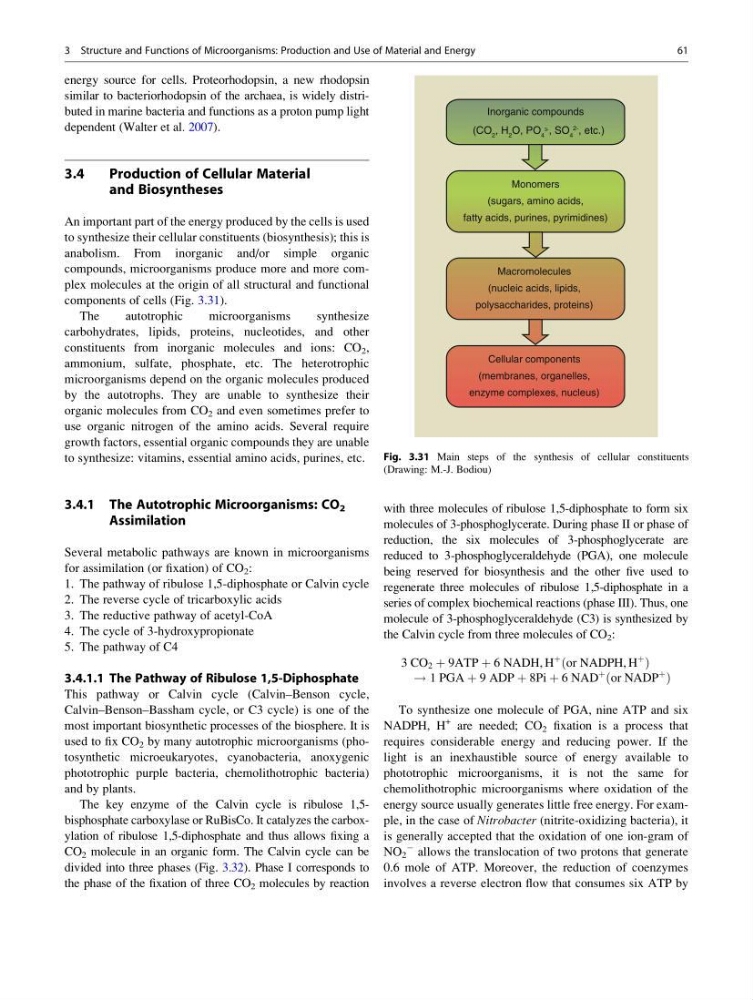
compounds, microorganisms produce more and more complex molecules at the origin of all structural and functional
components of cells (Fig. 3.31).
The
autotrophic
microorganisms
synthesize
carbohydrates, lipids, proteins, nucleotides, and other
constituents from inorganic molecules and ions: CO 2 ,
ammonium, sulfate, phosphate, etc. The heterotrophic
microorganisms depend on the organic molecules produced
by the autotrophs. They are unable to synthesize their
organic molecules from CO 2 and even sometimes prefer to
use organic nitrogen of the amino acids. Several require
growth factors, essential organic compounds they are unable
to synthesize: vitamins, essential amino acids, purines, etc.
3.4.1 The Autotrophic Microorganisms: CO 2
Assimilation
Several metabolic pathways are known in microorganisms
for assimilation (or fixation) of CO 2 :
1. The pathway of ribulose 1,5-diphosphate or Calvin cycle
2. The reverse cycle of tricarboxylic acids
3. The reductive pathway of acetyl-CoA
4. The cycle of 3-hydroxypropionate
5. The pathway of C4
3.4.1.1 The Pathway of Ribulose 1,5-Diphosphate
This pathway or Calvin cycle (Calvin–Benson cycle,
Calvin–Benson–Bassham cycle, or C3 cycle) is one of the
most important biosynthetic processes of the biosphere. It is
used to fix CO 2 by many autotrophic microorganisms (photosynthetic microeukaryotes, cyanobacteria, anoxygenic
phototrophic purple bacteria, chemolithotrophic bacteria)
and by plants.
The key enzyme of the Calvin cycle is ribulose 1,5bisphosphate carboxylase or RuBisCo. It catalyzes the carboxylation of ribulose 1,5-diphosphate and thus allows fixing a
CO 2 molecule in an organic form. The Calvin cycle can be
divided into three phases (Fig. 3.32). Phase I corresponds to
the phase of the fixation of three CO 2 molecules by reaction
with three molecules of ribulose 1,5-diphosphate to form six
molecules of 3-phosphoglycerate. During phase II or phase of
reduction, the six molecules of 3-phosphoglycerate are
reduced to 3-phosphoglyceraldehyde (PGA), one molecule
being reserved for biosynthesis and the other five used to
regenerate three molecules of ribulose 1,5-diphosphate in a
series of complex biochemical reactions (phase III). Thus, one
molecule of 3-phosphoglyceraldehyde (C3) is synthesized by
the Calvin cycle from three molecules of CO 2 :
3 CO 2 þ 9ATP þ 6 NADH, H
þ or NADPH, H
þ
ð
Þ
! 1 PGA þ 9 ADP þ 8Pi þ 6 NAD
þ or NADP
þ
ð
Þ
To synthesize one molecule of PGA, nine ATP and six
NADPH, H
+ are needed; CO 2 fixation is a process that
requires considerable energy and reducing power. If the
light is an inexhaustible source of energy available to
phototrophic microorganisms, it is not the same for
chemolithotrophic microorganisms where oxidation of the
energy source usually generates little free energy. For example, in the case of Nitrobacter (nitrite-oxidizing bacteria), it
is generally accepted that the oxidation of one ion-gram of
NO 2
À allows the translocation of two protons that generate
0.6 mole of ATP. Moreover, the reduction of coenzymes
involves a reverse electron flow that consumes six ATP by
(CO 2 , H 2 O, PO 4
3- , SO 4
2- , etc.)
Monomers
(sugars, amino acids,
fatty acids, purines, pyrimidines)
Macromolecules
(nucleic acids, lipids,
polysaccharides, proteins)
Cellular components
(membranes, organelles,
enzyme complexes, nucleus)
Inorganic compounds
Fig. 3.31 Main steps of the synthesis of cellular constituents
(Drawing: M.-J. Bodiou)
3 Structure and Functions of Microorganisms: Production and Use of Material and Energy
61
similar to bacteriorhodopsin of the archaea, is widely distributed in marine bacteria and functions as a proton pump light
dependent (Walter et al. 2007).
3.4
Production of Cellular Material
and Biosyntheses
An important part of the energy produced by the cells is used
to synthesize their cellular constituents (biosynthesis); this is
anabolism. From inorganic and/or simple organic
compounds, microorganisms produce more and more complex molecules at the origin of all structural and functional
components of cells (Fig. 3.31).
The
autotrophic
microorganisms
synthesize
carbohydrates, lipids, proteins, nucleotides, and other
constituents from inorganic molecules and ions: CO 2 ,
ammonium, sulfate, phosphate, etc. The heterotrophic
microorganisms depend on the organic molecules produced
by the autotrophs. They are unable to synthesize their
organic molecules from CO 2 and even sometimes prefer to
use organic nitrogen of the amino acids. Several require
growth factors, essential organic compounds they are unable
to synthesize: vitamins, essential amino acids, purines, etc.
3.4.1 The Autotrophic Microorganisms: CO 2
Assimilation
Several metabolic pathways are known in microorganisms
for assimilation (or fixation) of CO 2 :
1. The pathway of ribulose 1,5-diphosphate or Calvin cycle
2. The reverse cycle of tricarboxylic acids
3. The reductive pathway of acetyl-CoA
4. The cycle of 3-hydroxypropionate
5. The pathway of C4
3.4.1.1 The Pathway of Ribulose 1,5-Diphosphate
This pathway or Calvin cycle (Calvin–Benson cycle,
Calvin–Benson–Bassham cycle, or C3 cycle) is one of the
most important biosynthetic processes of the biosphere. It is
used to fix CO 2 by many autotrophic microorganisms (photosynthetic microeukaryotes, cyanobacteria, anoxygenic
phototrophic purple bacteria, chemolithotrophic bacteria)
and by plants.
The key enzyme of the Calvin cycle is ribulose 1,5bisphosphate carboxylase or RuBisCo. It catalyzes the carboxylation of ribulose 1,5-diphosphate and thus allows fixing a
CO 2 molecule in an organic form. The Calvin cycle can be
divided into three phases (Fig. 3.32). Phase I corresponds to
the phase of the fixation of three CO 2 molecules by reaction
with three molecules of ribulose 1,5-diphosphate to form six
molecules of 3-phosphoglycerate. During phase II or phase of
reduction, the six molecules of 3-phosphoglycerate are
reduced to 3-phosphoglyceraldehyde (PGA), one molecule
being reserved for biosynthesis and the other five used to
regenerate three molecules of ribulose 1,5-diphosphate in a
series of complex biochemical reactions (phase III). Thus, one
molecule of 3-phosphoglyceraldehyde (C3) is synthesized by
the Calvin cycle from three molecules of CO 2 :
3 CO 2 þ 9ATP þ 6 NADH, H
þ or NADPH, H
þ
ð
Þ
! 1 PGA þ 9 ADP þ 8Pi þ 6 NAD
þ or NADP
þ
ð
Þ
To synthesize one molecule of PGA, nine ATP and six
NADPH, H
+ are needed; CO 2 fixation is a process that
requires considerable energy and reducing power. If the
light is an inexhaustible source of energy available to
phototrophic microorganisms, it is not the same for
chemolithotrophic microorganisms where oxidation of the
energy source usually generates little free energy. For example, in the case of Nitrobacter (nitrite-oxidizing bacteria), it
is generally accepted that the oxidation of one ion-gram of
NO 2
À allows the translocation of two protons that generate
0.6 mole of ATP. Moreover, the reduction of coenzymes
involves a reverse electron flow that consumes six ATP by
(CO 2 , H 2 O, PO 4
3- , SO 4
2- , etc.)
Monomers
(sugars, amino acids,
fatty acids, purines, pyrimidines)
Macromolecules
(nucleic acids, lipids,
polysaccharides, proteins)
Cellular components
(membranes, organelles,
enzyme complexes, nucleus)
Inorganic compounds
Fig. 3.31 Main steps of the synthesis of cellular constituents
(Drawing: M.-J. Bodiou)
3 Structure and Functions of Microorganisms: Production and Use of Material and Energy
61