

realm has been much less studied than euphotic ocean certainly
because of difficulty in sampling (particularly maintaining high
pressure conditions) and the time and expenses involved.
17.2.3.1 From Adapted-to-Pressure
Microorganisms Discovery to
Physiological and Molecular Adaptation
Face to High-Pressure Condition
The Challenger Expedition (1873–1876) is commonly
credited as the historical beginning of deep-sea biology.
The finding of live specimens at great depths obliterated
the azoic-zone theory, below 600-m depth, that had been
suggested in the 1840s by Edward Forbes. A very good
summary of the controversial concept of the azoic zone is
provided in Jannasch and Taylor (1984). In 1884, Certes
(1884) examined sediment and water collected from depths
to 5,000 m and cultured bacteria from almost every sample.
In 1904, Portier used a sealed and autoclaved glass-tube
device as a bacteriological sampler and reported counts of
colonies from various depths and location (Jannasch and
Wirsen 1984). Research into the effects of high pressure on
the physiology of deep-sea bacteria was developed during
the last century. A synthesis of that work can be found in
ZoBell (1970), pioneer biologist in the study of the effects of
hydrostatic pressure on microbial activities (ZoBell and
Johnson 1949). ZoBell and Johnson (1949) began studies
of the effect of hydrostatic pressure on microbial activity
using pure cultures. “Barophilic” was the first term used to
define optimal growth at a pressure higher than 0.1 MPa, or
for a requirement for increased pressure for growth (ZoBell
and Johnson 1949), but was subsequently replaced by
Yayanos (1995), who suggested “piezophilic” (from the
Greek “piezo,” meaning pressure). Current terminology
(reviewed by Fang et al. 2010 and Kato 2011) defines
pressure-adapted microorganisms either as piezotolerant
(similar growth rate at atmospheric pressure and high pressure), piezophilic (more rapid growth at high pressure than
atmospheric pressure), or hyperpiezophilic (growth only at
high pressure), with pressure maxima increasing in rank
order (highest for hyperpiezophiles). Organisms that grow
best at atmospheric pressure, with little to no growth at
increased pressure, are termed piezosensitive.
Pressure-adapted microorganisms have been isolated from
many deep-sea sites by researchers around the world. Isolates
include representatives of the Archaea (both Euryarchaea and
Crenarchaea kingdoms) mainly from deep-sea hydrothermal
vents, and Bacteria from cold, deep-sea habitats. Most of the
bacterial piezophiles have been identified as belonging to
the genera Carnobacterium, Colwellia, Desulfovibrio,
Marinitoga, Moritella, Photobacterium, Psychromonas, and
Shewanella (reviewed by Bartlett et al. 2007). The membrane
properties of piezophiles have been described and other
characteristics of piezophiles, including motility, nutrient
transport, and DNA replication and translation under elevated
hydrostatic pressure, have been explored (Lauro et al. 2008).
Protein structural adaptation to high pressure has also been
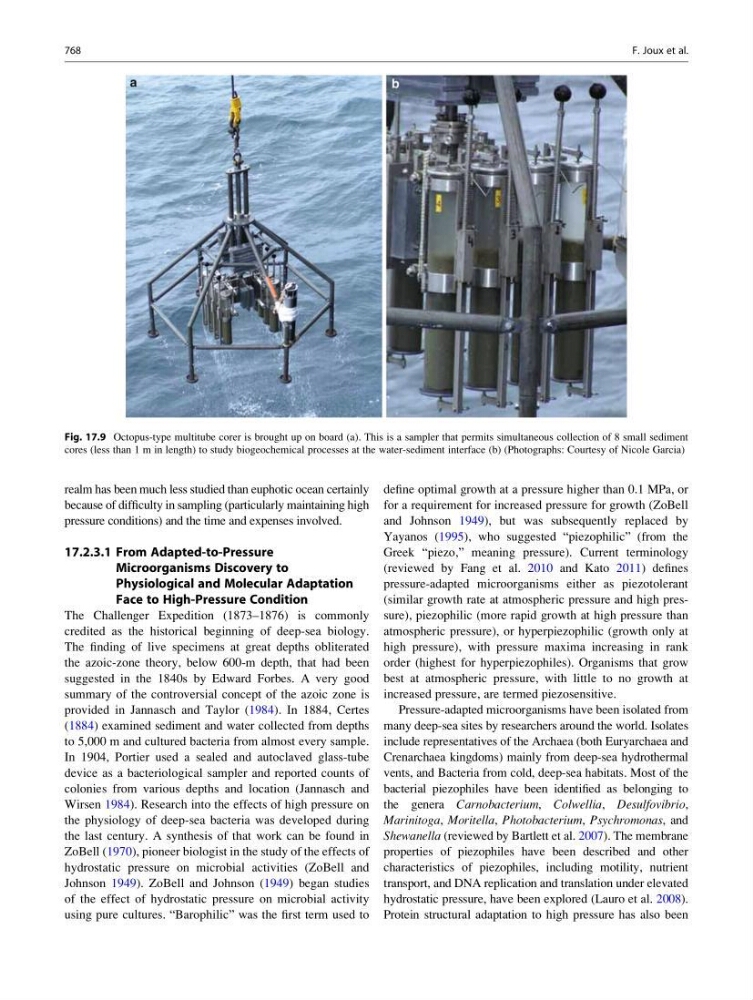
Fig. 17.9 Octopus-type multitube corer is brought up on board (a). This is a sampler that permits simultaneous collection of 8 small sediment
cores (less than 1 m in length) to study biogeochemical processes at the water-sediment interface (b) (Photographs: Courtesy of Nicole Garcia)
768
F. Joux et al.