

construction of the sediment trap array ensures a permanently
vertical position of the sampling tubes during deployment.
17.2.2.5 Sediment Sampling
The main problems posed by the study of marine sediment are
associated with its heterogeneity, both horizontal and vertical. In
addition, for many workers in the field of oceanography, it is
necessary to recover unmixed continuous sediment samples,
including sediment/water interfaces, that represent sediment
fractions and surface deposits that are as little disturbed as
possible. For large samples, bins or grabs that can recover up
to 1 m
3 of sediment are frequently used to study meio- and
macrobenthic communities, for instance. A grab is used to obtain
sediment samples from the seafloor. The grab is lowered to the
seabed on a steel cable with its “jaws” open. As soon as the jaws
touch the bottom, the valve that holds them open is released. As
the grab is pulled back up, the jaws close, scooping up sand and
sediment from the seabed. However, the use of bins or grabs is
not recommended for work on physiology at the water–sediment
interface, as these types of equipment permanently mix and
disturb sedimentary layers. To avoid mixing and disturbing the
materials sampled, it is preferable to use a coring technique.
In areas directly accessible by foot (e.g., in a low-tide zone)
or by diving, sampling of small volumes can easily be
performed “by hand” using simple tools such as hand corer
sediment samplers. In shallow waters, a sampler can be pushed
into sediment using the handles on the head. If the water depth
permits, extension handles of 4.5 m or 6 m can be used to
sample from boats or docks. In deeper water, the sampler can
be dropped by attaching a line to the clevis located on the head
assembly between the handles. A simple valve allows water to
flow through the sampler during descent and close tightly upon
removal, minimizing sample loss. A corer takes a 50-mmdiameter sample and measures 50 cm long. A box corer is a
marine geological sampling tool for use in soft sediments in
lakes or oceans. It is deployed from a research vessel with a
deep sea wire and is suitable for sampling at any water depth. It
is designed to minimize disturbance of the sediment surface by
bow wave effects, which is important for quantitative
investigations of the benthos micro- to macrofauna, geochemical processes, sampling of bottom water, and sedimentology.
To obtain more accurate and less disturbed samples, it is
preferable to use coring “tubes” recommended primarily for
sampling the water–sediment interface for biological and physiological studies. Coring tubes can obtain long cores but have
small cross sections. A coring tube is a long tube, typically made
of metal, with a sealing system at its base. The coring tube is
driven into the sediment to collect a truly undisturbed sediment
sample from the seabed, including the sediment–water interface
and overlying supernatant water. Many models have been
developed that differ primarily in their modes of penetration
(e.g., gravity, sinking, and vibration), shutter modes, and base
types (e.g., diaphragms and pneumatic valves).
Recent developments in coring technology have enabled the
use of an assembly of multiple corers for collecting several
cores simultaneously in a small area (Fig. 17.9). The Multicorer
is designed to obtain multiple samples of sediment from the
seabed at great depths. The Multicorer is used for sampling in
chemical, geochemical, and biological applications.
The Multicorer is used to obtain undisturbed sediment
samples from the surface of the seabed. It consists of a system
to which a series of tubes, measuring approximately 4 cm in
diameter, are attached. Above the system, a weight is mounted,
and this falls onto the assembly system when the Multicorer
touches the sediment. The falling weight drives the tubes into
the seabed so that when they are raised again, each of them
contains a drilling core with sediment from the seafloor.
17.2.3 Deep-Seawater Sampling
While the dark ocean, below 200 m depth, represents the largest
habitat, the largest reservoir of organic carbon, and the largest
pool of microbes in the biosphere (Whitman et al. 1998), this
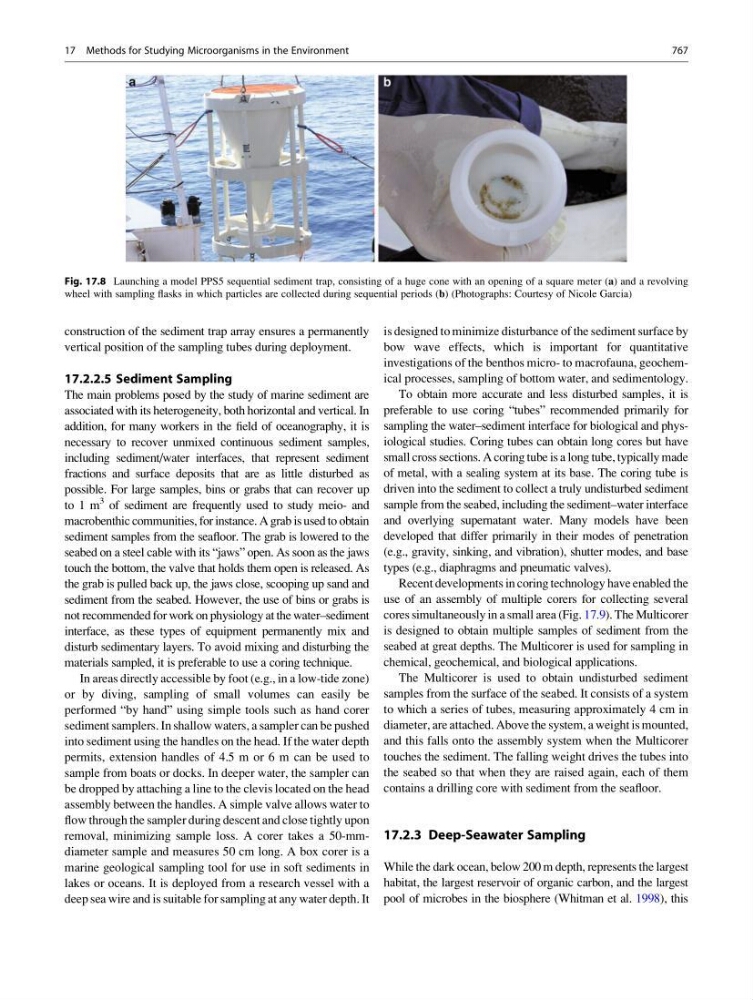
Fig. 17.8 Launching a model PPS5 sequential sediment trap, consisting of a huge cone with an opening of a square meter (a) and a revolving
wheel with sampling flasks in which particles are collected during sequential periods (b) (Photographs: Courtesy of Nicole Garcia)
17 Methods for Studying Microorganisms in the Environment
767