

measure the chemical composition of deep particles. Only in
situ pumps (ISP) are able to collect large amounts of particulate matter at depths below the water surface (Fig. 17.6). These
autonomous pumps, powered by batteries, are suspended
along a cable. Once at the selected depth, the pump is started
and filters several hundred to more than 1,000 l of water in a
few hours. On the same cable, between 5 and 12 pumps can be
deployed simultaneously at different depths. In situ pumps can
be submerged into ocean water for up to several hours at a
time. All of the water that the pump pulls in is passed through
filters, which catch the very fine particles. Several filters can be
stacked to achieve a size-fractionated filtration. When the
pumps are brought up to the surface after several hours, the
material captured on the filters can be analyzed.
17.2.2.3 How to Collect Living Organisms
in the Water Column?
The simplest and most commonly used device for collecting
living organisms (plankton) floating and drifting in the water
column is the plankton net. The amount of water filtered is
large and the gear is suitable for both qualitative and quantitative studies. The plankton nets are of various sizes and
types. The sampling success will largely depend on the
selection of suitable gear, the mesh size of the netting material, the time of collection, the water depth of the study area,
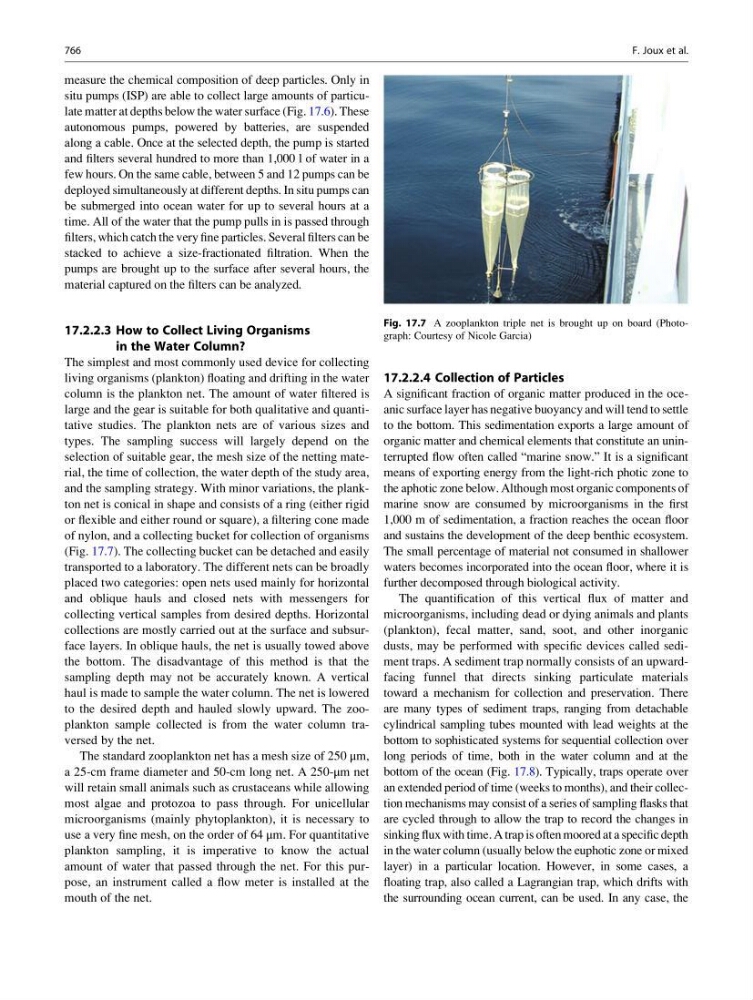
and the sampling strategy. With minor variations, the plankton net is conical in shape and consists of a ring (either rigid
or flexible and either round or square), a filtering cone made
of nylon, and a collecting bucket for collection of organisms
(Fig. 17.7). The collecting bucket can be detached and easily
transported to a laboratory. The different nets can be broadly
placed two categories: open nets used mainly for horizontal
and oblique hauls and closed nets with messengers for
collecting vertical samples from desired depths. Horizontal
collections are mostly carried out at the surface and subsurface layers. In oblique hauls, the net is usually towed above
the bottom. The disadvantage of this method is that the
sampling depth may not be accurately known. A vertical
haul is made to sample the water column. The net is lowered
to the desired depth and hauled slowly upward. The zooplankton sample collected is from the water column traversed by the net.
The standard zooplankton net has a mesh size of 250 μm,
a 25-cm frame diameter and 50-cm long net. A 250-μm net
will retain small animals such as crustaceans while allowing
most algae and protozoa to pass through. For unicellular
microorganisms (mainly phytoplankton), it is necessary to
use a very fine mesh, on the order of 64 μm. For quantitative
plankton sampling, it is imperative to know the actual
amount of water that passed through the net. For this purpose, an instrument called a flow meter is installed at the
mouth of the net.
17.2.2.4 Collection of Particles
A significant fraction of organic matter produced in the oceanic surface layer has negative buoyancy and will tend to settle
to the bottom. This sedimentation exports a large amount of
organic matter and chemical elements that constitute an uninterrupted flow often called “marine snow.” It is a significant
means of exporting energy from the light-rich photic zone to
the aphotic zone below. Although most organic components of
marine snow are consumed by microorganisms in the first
1,000 m of sedimentation, a fraction reaches the ocean floor
and sustains the development of the deep benthic ecosystem.
The small percentage of material not consumed in shallower
waters becomes incorporated into the ocean floor, where it is
further decomposed through biological activity.
The quantification of this vertical flux of matter and
microorganisms, including dead or dying animals and plants
(plankton), fecal matter, sand, soot, and other inorganic
dusts, may be performed with specific devices called sediment traps. A sediment trap normally consists of an upwardfacing funnel that directs sinking particulate materials
toward a mechanism for collection and preservation. There
are many types of sediment traps, ranging from detachable
cylindrical sampling tubes mounted with lead weights at the
bottom to sophisticated systems for sequential collection over
long periods of time, both in the water column and at the
bottom of the ocean (Fig. 17.8). Typically, traps operate over
an extended period of time (weeks to months), and their collection mechanisms may consist of a series of sampling flasks that
are cycled through to allow the trap to record the changes in
sinking flux with time. A trap is often moored at a specific depth
in the water column (usually below the euphotic zone or mixed
layer) in a particular location. However, in some cases, a
floating trap, also called a Lagrangian trap, which drifts with
the surrounding ocean current, can be used. In any case, the
Fig. 17.7 A zooplankton triple net is brought up on board (Photograph: Courtesy of Nicole Garcia)
766
F. Joux et al.