

Sampling with a Pump
Some analyses or experiments dealing with trace elements
(e.g., some metals or organic compounds) require water
collection and sampling without any contact with the air.
In these cases, a pumping system is better than hydrological
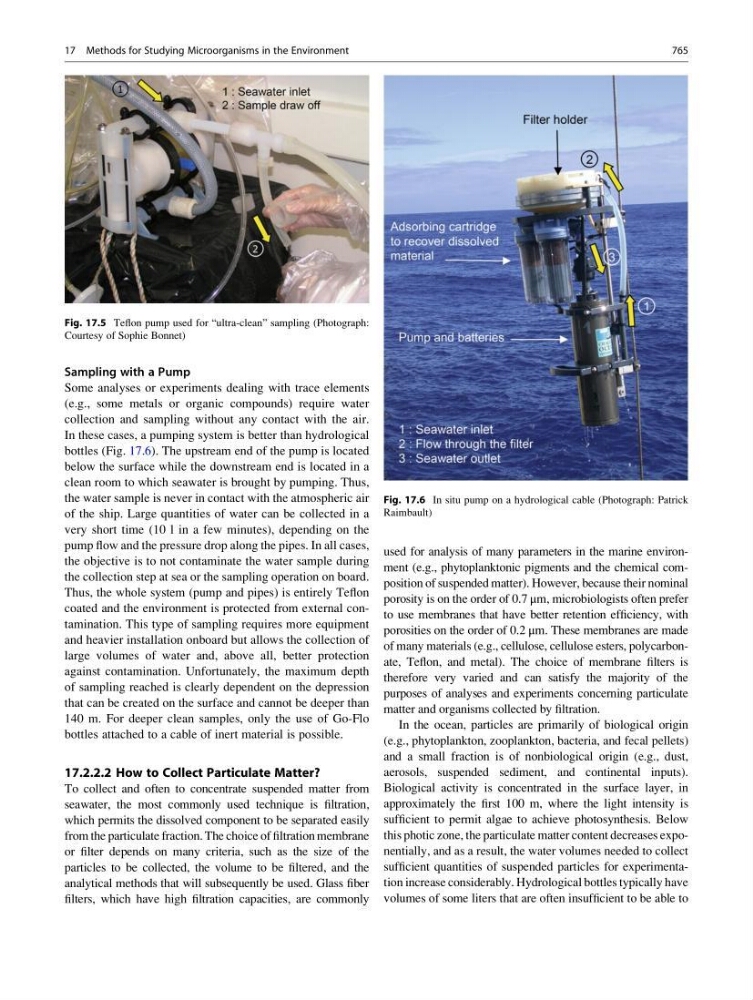
bottles (Fig. 17.6). The upstream end of the pump is located
below the surface while the downstream end is located in a
clean room to which seawater is brought by pumping. Thus,
the water sample is never in contact with the atmospheric air
of the ship. Large quantities of water can be collected in a
very short time (10 l in a few minutes), depending on the
pump flow and the pressure drop along the pipes. In all cases,
the objective is to not contaminate the water sample during
the collection step at sea or the sampling operation on board.
Thus, the whole system (pump and pipes) is entirely Teflon
coated and the environment is protected from external contamination. This type of sampling requires more equipment
and heavier installation onboard but allows the collection of
large volumes of water and, above all, better protection
against contamination. Unfortunately, the maximum depth
of sampling reached is clearly dependent on the depression
that can be created on the surface and cannot be deeper than
140 m. For deeper clean samples, only the use of Go-Flo
bottles attached to a cable of inert material is possible.
17.2.2.2 How to Collect Particulate Matter?
To collect and often to concentrate suspended matter from
seawater, the most commonly used technique is filtration,
which permits the dissolved component to be separated easily
from the particulate fraction. The choice of filtration membrane
or filter depends on many criteria, such as the size of the
particles to be collected, the volume to be filtered, and the
analytical methods that will subsequently be used. Glass fiber
filters, which have high filtration capacities, are commonly
used for analysis of many parameters in the marine environment (e.g., phytoplanktonic pigments and the chemical composition of suspended matter). However, because their nominal
porosity is on the order of 0.7 μm, microbiologists often prefer
to use membranes that have better retention efficiency, with
porosities on the order of 0.2 μm. These membranes are made
of many materials (e.g., cellulose, cellulose esters, polycarbonate, Teflon, and metal). The choice of membrane filters is
therefore very varied and can satisfy the majority of the
purposes of analyses and experiments concerning particulate
matter and organisms collected by filtration.
In the ocean, particles are primarily of biological origin
(e.g., phytoplankton, zooplankton, bacteria, and fecal pellets)
and a small fraction is of nonbiological origin (e.g., dust,
aerosols, suspended sediment, and continental inputs).
Biological activity is concentrated in the surface layer, in
approximately the first 100 m, where the light intensity is
sufficient to permit algae to achieve photosynthesis. Below
this photic zone, the particulate matter content decreases exponentially, and as a result, the water volumes needed to collect
sufficient quantities of suspended particles for experimentation increase considerably. Hydrological bottles typically have
volumes of some liters that are often insufficient to be able to
Fig. 17.5 Teflon pump used for “ultra-clean” sampling (Photograph:
Courtesy of Sophie Bonnet)
Fig. 17.6 In situ pump on a hydrological cable (Photograph: Patrick
Raimbault)
17 Methods for Studying Microorganisms in the Environment
765