

described in comparative studies of piezophilic and
piezosensitive microorganisms (Kato et al. 2008). Recent
studies have also highlighted that hydrostatic pressure
influences not only the unsaturation ratio of membrane fatty
acids but also the unsaturation ratio of intracellular wax esters
(storage lipids) which accumulated in the cells of a
piezotolerant hydrocarbonoclastic bacterium under the form
of individual lipid bodies (Grossi et al. 2010). Finally,
piezophilic bioluminescent bacteria shall produce more light
under high pressure than at atmospheric pressure conditions
conferring them an ecological advantage (Martini et al. 2013).
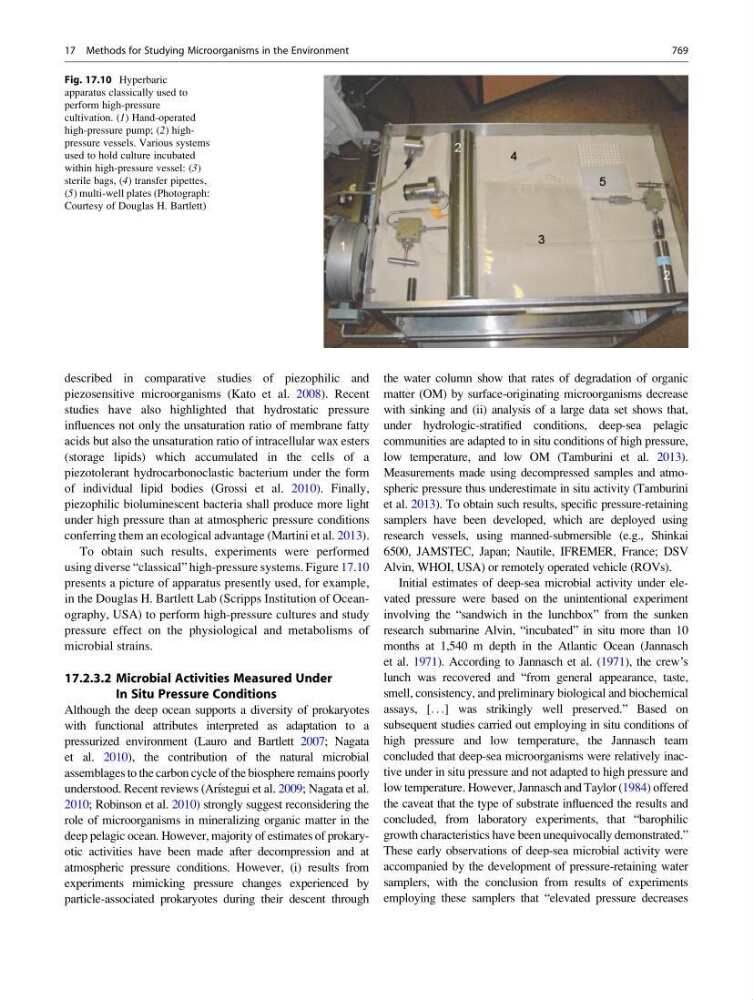
To obtain such results, experiments were performed
using diverse “classical” high-pressure systems. Figure 17.10
presents a picture of apparatus presently used, for example,
in the Douglas H. Bartlett Lab (Scripps Institution of Oceanography, USA) to perform high-pressure cultures and study
pressure effect on the physiological and metabolisms of
microbial strains.
17.2.3.2 Microbial Activities Measured Under
In Situ Pressure Conditions
Although the deep ocean supports a diversity of prokaryotes
with functional attributes interpreted as adaptation to a
pressurized environment (Lauro and Bartlett 2007; Nagata
et al. 2010), the contribution of the natural microbial
assemblages to the carbon cycle of the biosphere remains poorly
understood. Recent reviews (Arı ´stegui et al. 2009; Nagata et al.
2010; Robinson et al. 2010) strongly suggest reconsidering the
role of microorganisms in mineralizing organic matter in the
deep pelagic ocean. However, majority of estimates of prokaryotic activities have been made after decompression and at
atmospheric pressure conditions. However, (i) results from
experiments mimicking pressure changes experienced by
particle-associated prokaryotes during their descent through
the water column show that rates of degradation of organic
matter (OM) by surface-originating microorganisms decrease
with sinking and (ii) analysis of a large data set shows that,
under hydrologic-stratified conditions, deep-sea pelagic
communities are adapted to in situ conditions of high pressure,
low temperature, and low OM (Tamburini et al. 2013).
Measurements made using decompressed samples and atmospheric pressure thus underestimate in situ activity (Tamburini
et al. 2013). To obtain such results, specific pressure-retaining
samplers have been developed, which are deployed using
research vessels, using manned-submersible (e.g., Shinkai
6500, JAMSTEC, Japan; Nautile, IFREMER, France; DSV
Alvin, WHOI, USA) or remotely operated vehicle (ROVs).
Initial estimates of deep-sea microbial activity under elevated pressure were based on the unintentional experiment
involving the “sandwich in the lunchbox” from the sunken
research submarine Alvin, “incubated” in situ more than 10
months at 1,540 m depth in the Atlantic Ocean (Jannasch
et al. 1971). According to Jannasch et al. (1971), the crew’s
lunch was recovered and “from general appearance, taste,
smell, consistency, and preliminary biological and biochemical
assays, [. . .] was strikingly well preserved.” Based on
subsequent studies carried out employing in situ conditions of
high pressure and low temperature, the Jannasch team
concluded that deep-sea microorganisms were relatively inactive under in situ pressure and not adapted to high pressure and
low temperature. However, Jannasch and Taylor (1984) offered
the caveat that the type of substrate influenced the results and
concluded, from laboratory experiments, that “barophilic
growth characteristics have been unequivocally demonstrated.”
These early observations of deep-sea microbial activity were
accompanied by the development of pressure-retaining water
samplers, with the conclusion from results of experiments
employing these samplers that “elevated pressure decreases
Fig. 17.10 Hyperbaric
apparatus classically used to
perform high-pressure
cultivation. (1) Hand-operated
high-pressure pump; (2) highpressure vessels. Various systems
used to hold culture incubated
within high-pressure vessel: (3)
sterile bags, (4) transfer pipettes,
(5) multi-well plates (Photograph:
Courtesy of Douglas H. Bartlett)
17 Methods for Studying Microorganisms in the Environment
769