

Once the required depth has been reached, a “messenger”
weight is slid along the cable to the bottle and drops onto the
closing mechanism. The bottle, now hermetically sealed, is
then brought back up to the surface.
Originally, to obtain multiple water samples during the
same vertical cast, several hydrological bottles had to be
suspended one after the other on the cable at certain
distances from each other. A messenger was attached to
each bottle (except the deepest one) before lowering. Once
all the bottles were on the line, the line was lowered to the
desired depth and 2 min were allowed to pass. A messenger
was sent down and a few minutes were allowed to pass to
ensure that all the bottles closed. The line was reeled in and
the bottles were unloaded as they came up. Now, water
samples are collected more rapidly with the help of a
“rosette” system on which a large number of hydrological
bottles (12–36) are attached to a circular steel frame
(Fig. 17.4). The rosette of hydrological bottles is typically
Box 17.2 (continued)
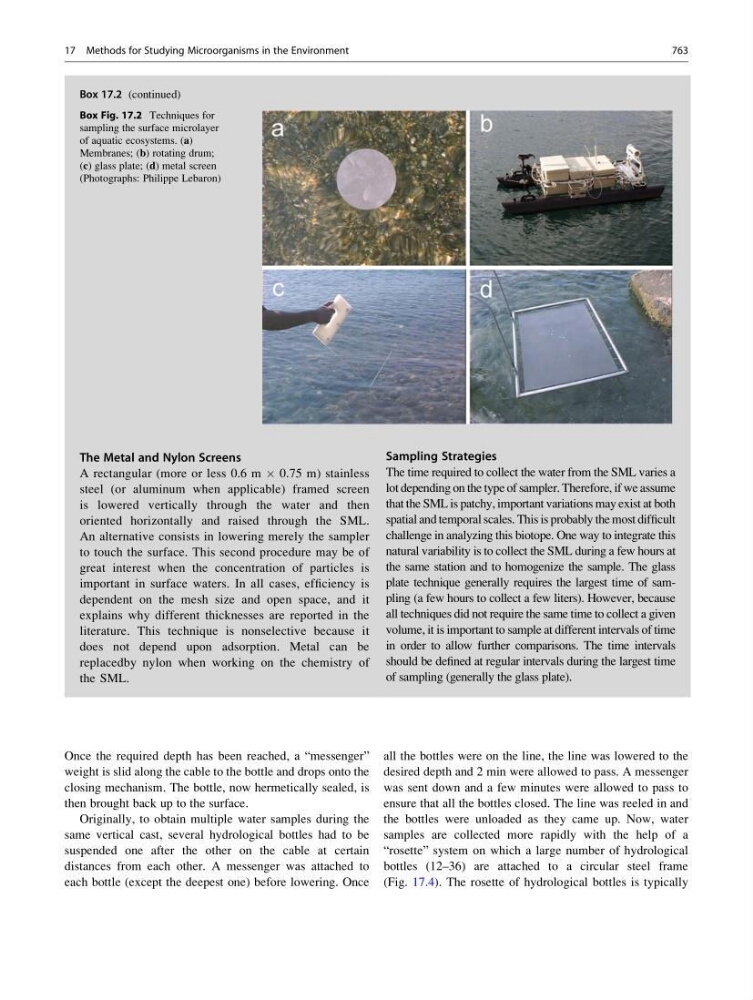
The Metal and Nylon Screens
A rectangular (more or less 0.6 m  0.75 m) stainless
steel (or aluminum when applicable) framed screen
is lowered vertically through the water and then
oriented horizontally and raised through the SML.
An alternative consists in lowering merely the sampler
to touch the surface. This second procedure may be of
great interest when the concentration of particles is
important in surface waters. In all cases, efficiency is
dependent on the mesh size and open space, and it
explains why different thicknesses are reported in the
literature. This technique is nonselective because it
does not depend upon adsorption. Metal can be
replacedby nylon when working on the chemistry of
the SML.
(continued)
Box 17.2 (continued)
Sampling Strategies
The time required to collect the water from the SML varies a
lot depending on the type of sampler. Therefore, if we assume
that the SML is patchy, important variations may exist at both
spatial and temporal scales. This is probably the most difficult
challenge in analyzing this biotope. One way to integrate this
natural variability is to collect the SML during a few hours at
the same station and to homogenize the sample. The glass
plate technique generally requires the largest time of sampling (a few hours to collect a few liters). However, because
all techniques did not require the same time to collect a given
volume, it is important to sample at different intervals of time
in order to allow further comparisons. The time intervals
should be defined at regular intervals during the largest time
of sampling (generally the glass plate).
Box Fig. 17.2 Techniques for
sampling the surface microlayer
of aquatic ecosystems. (a)
Membranes; (b) rotating drum;
(c) glass plate; (d) metal screen
(Photographs: Philippe Lebaron)
17 Methods for Studying Microorganisms in the Environment
763