

Box 17.2: Sampling the Surface Microlayer
of Aquatic Ecosystems
Philippe Lebaron
The surface microlayer (SML) of aquatic ecosystems
has been defined as the top 1–1,000 μm of the water
surface, i.e., the interfacial region where many important bio-physicochemical processes and exchange
of gases are taking place. SML plays an important
role in photochemical and biologically mediated
transformations of organic matter at sea surface.
Depending on the type of transformations occurring
in these layers, they may have important consequences
in the transfer of pollutants to marine food webs.
(continued)
1
2
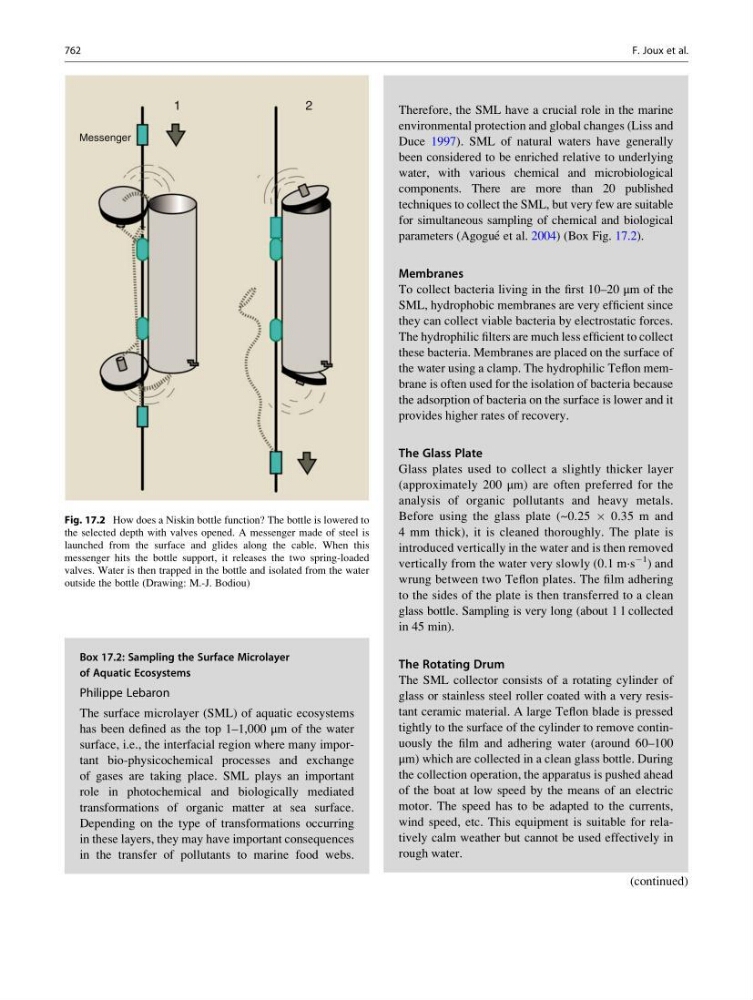
Messenger
Fig. 17.2 How does a Niskin bottle function? The bottle is lowered to
the selected depth with valves opened. A messenger made of steel is
launched from the surface and glides along the cable. When this
messenger hits the bottle support, it releases the two spring-loaded
valves. Water is then trapped in the bottle and isolated from the water
outside the bottle (Drawing: M.-J. Bodiou)
Box 17.2 (continued)
Therefore, the SML have a crucial role in the marine
environmental protection and global changes (Liss and
Duce 1997). SML of natural waters have generally
been considered to be enriched relative to underlying
water, with various chemical and microbiological
components. There are more than 20 published
techniques to collect the SML, but very few are suitable
for simultaneous sampling of chemical and biological
parameters (Agogue ´ et al. 2004) (Box Fig. 17.2).
Membranes
To collect bacteria living in the first 10–20 μm of the
SML, hydrophobic membranes are very efficient since
they can collect viable bacteria by electrostatic forces.
The hydrophilic filters are much less efficient to collect
these bacteria. Membranes are placed on the surface of
the water using a clamp. The hydrophilic Teflon membrane is often used for the isolation of bacteria because
the adsorption of bacteria on the surface is lower and it
provides higher rates of recovery.
The Glass Plate
Glass plates used to collect a slightly thicker layer
(approximately 200 μm) are often preferred for the
analysis of organic pollutants and heavy metals.
Before using the glass plate (~0.25 Â 0.35 m and
4 mm thick), it is cleaned thoroughly. The plate is
introduced vertically in the water and is then removed
vertically from the water very slowly (0.1 m·s
À1 ) and
wrung between two Teflon plates. The film adhering
to the sides of the plate is then transferred to a clean
glass bottle. Sampling is very long (about 1 l collected
in 45 min).
The Rotating Drum
The SML collector consists of a rotating cylinder of
glass or stainless steel roller coated with a very resistant ceramic material. A large Teflon blade is pressed
tightly to the surface of the cylinder to remove continuously the film and adhering water (around 60–100
μm) which are collected in a clean glass bottle. During
the collection operation, the apparatus is pushed ahead
of the boat at low speed by the means of an electric
motor. The speed has to be adapted to the currents,
wind speed, etc. This equipment is suitable for relatively calm weather but cannot be used effectively in
rough water.
(continued)
762
F. Joux et al.