

16.9.3.2 Environmental Applications
Contamination by chromium which is widely used in the
automotive, metallurgic, mining, or tannery industries may
reach high levels in some ecosystems. The most oxidized
form, Cr(VI) or chromate, is highly soluble and highly toxic
(mutagenic compound), while trivalent chromium (Cr(III),
reduced form) is very insoluble and 1,000 times less toxic
(Lofroth and Ames 1978). Processes for the treatment of
wastes contaminated by chromium combine chemical reduction of Cr(VI) to Cr(III) and precipitation of the reduced
chromium by increasing the pH (usually by the addition of
calcium carbonate). Biological reduction of chromium is also
possible as an alternative treatment. Indeed, the ability to use
chromium as electron acceptor is present in many strict or
facultative anaerobic prokaryotes belonging to the genera
Bacillus, Pseudomonas, Desulfovibrio, Aeromonas, or some
enterobacteria (Wang 2000). Depending on the organisms
involved, this reduction can be achieved under oxic or anoxic
conditions. To be effective, the bacterial biomass must be
high, and thus the treatments need high amounts of electron
donors, most of the time organic ones. This can be an advantage since chromium reduction can be coupled to the degradation of organic molecules such as phenols commonly found
in the chromium-rich industrial effluents. The main limitation
of the use of methods involving bacterial reduction of chromium is related to its inhibition by the presence of other
metals such as zinc or copper which may be present in the
chromium-contaminated effluent. Nevertheless, some successful biological treatments were obtained on the basis of
biofilms (fixed cultures) grown in bioreactors (Wang 2000).
Microbial bioreduction of uranium (Lovley et al. 1991) is
especially designed for the treatment of wastes from the
nuclear industry. Some microorganisms can develop using
uranium in its oxidized form (U(VI), UO 2
2+ soluble) and
reduce it to U (IV) insoluble (UO 2 ). This is the case of
Geobacter metallireducens in the presence of acetate and
Shewanella putrefaciens in the presence of hydrogen (H 2 ),
which are capable of growth in the presence of uranium
concentrations up to 8 mM.
Acetate þ 4 U VI
ð Þ ! 2HCO 3 þ 4 U IV
ð Þ þ 9H
þ
The addition of acetate in situ stimulates the activity of
bacteria belonging to the genus Geobacter which indicates a
significant reduction of the oxidized form of uranium in 50
days (70 % decrease of the amount initially present). These
studies have demonstrated the possibility of immobilization
treatments for uranium that could be present in an aquifer
(Anderson et al. 2003). The ability to reduce uranium in
insoluble U0 2 demonstrated in sulfate-reducing microorganisms has been used to concentrate uranium in radioactive wastes mixed with other chemicals. Some other studies
demonstrated the efficiency of processes for soils
contaminated with oxidized uranium. This treatment
includes a first chemical step (uranium extraction with bicarbonate) and a second step involving the reduction of the
extracted uranium through sulfate-reducing bacteria activity
(Phillips et al. 1995).
Finally, numerous investigations focused on the speciation
of metalloids by microorganisms. Their role in the speciation
of tellurium (Te) and selenium (Se) is studied because they
are part of the group VI of the periodic table of the elements,
as well as sulfur and polonium. Selenium can be incorporated
into organic matter (as sulfur) in the form of selenium amino
acids. Thus, selenium is an essential trace element that
undergoes a complex biogeochemical cycle. Tellurium is an
Cell
Accumulation
Acides
e
-
M
M
Anionic
ligands
- - -
M +
M +
-
- -
M +
M +
Bioprecipitation
CO 3
2HPO 4
2H 2 S
OH
-
MCO 3
MPO 4
MS
MOH
M
M
Resistance/
alkylation
Chelator
M-Chelator
Chelation
Degradation
M (free)
CH 3 -M
M (reduced)
M (oxidized)
Direct
bioreduction
M (reduced)
M (oxidized)
Biooxidation
M (insoluble)
M (soluble)
Solubilization
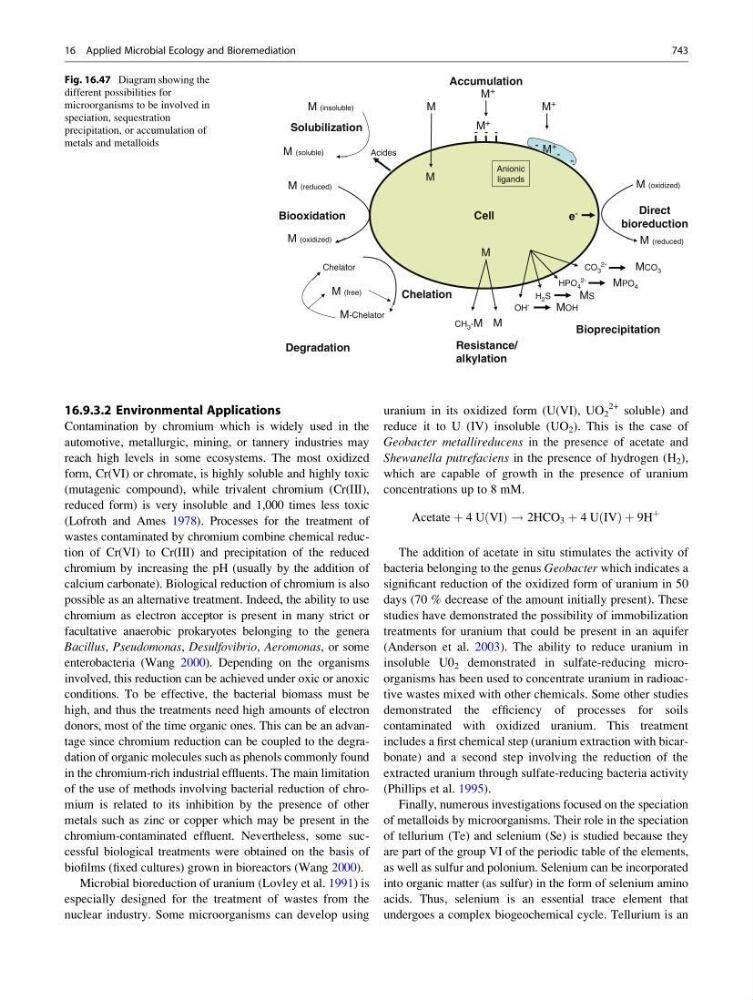
Fig. 16.47 Diagram showing the
different possibilities for
microorganisms to be involved in
speciation, sequestration
precipitation, or accumulation of
metals and metalloids
16 Applied Microbial Ecology and Bioremediation
743