

extremely rare element, well studied because of its use in the
industry due to its semiconductor properties. It is also chemically similar to polonium (the first radioactive element discovered by Marie and Pierre Curie), which is a product of the
desintegration of the radioactive uranium (U238). Another
metalloid, arsenic, is studied because of its toxicity and its
frequent occurrence in groundwaters, potential sources of
drinking water. Leaching of rocks rich in arsenic (arsenopyrite), its use as an herbicide (lead arsenate), and in wood
treatments also contribute to increase its concentration in
water in the form of arsenite (AsIII) or arsenate (ASV).
Unlike most metals, the reduced form is the most toxic.
Organic arsenic (methyl forms) is much less toxic and it is
in this form that the biological removal is the most effective.
Numerous microorganisms are involved in the mobilization,
reduction, oxidation, methylation, and precipitation of arsenic
(Oremland and Stolz 2003).
The main risk associated with treatment of metals by in
situ microbial reduction processes concerns the possible
long-term changes under environmental conditions that
may influence their speciation. A metal present in an ecosystem in its reduced form (less toxic most of the times) may
be remobilized (reoxidized) by both physicochemical and
biological processes and end up in a toxic and mobile form.
It is therefore necessary in the context of an in situ treatment
to monitor metal speciation to ensure that their chemical
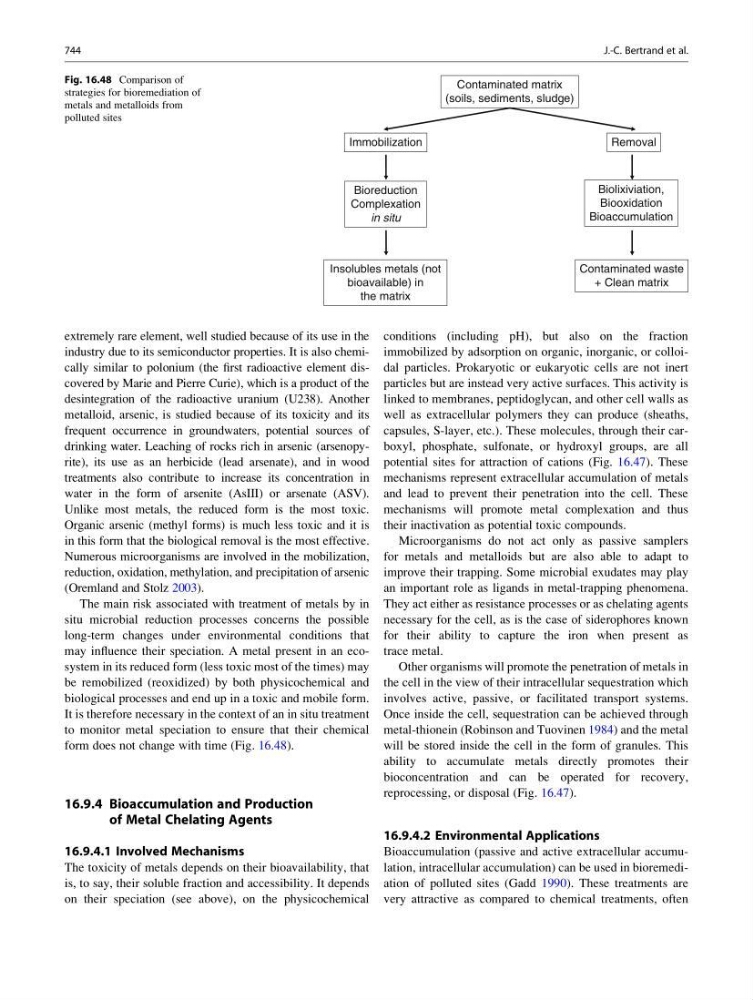
form does not change with time (Fig. 16.48).
16.9.4 Bioaccumulation and Production
of Metal Chelating Agents
16.9.4.1 Involved Mechanisms
The toxicity of metals depends on their bioavailability, that
is, to say, their soluble fraction and accessibility. It depends
on their speciation (see above), on the physicochemical
conditions (including pH), but also on the fraction
immobilized by adsorption on organic, inorganic, or colloidal particles. Prokaryotic or eukaryotic cells are not inert
particles but are instead very active surfaces. This activity is
linked to membranes, peptidoglycan, and other cell walls as
well as extracellular polymers they can produce (sheaths,
capsules, S-layer, etc.). These molecules, through their carboxyl, phosphate, sulfonate, or hydroxyl groups, are all
potential sites for attraction of cations (Fig. 16.47). These
mechanisms represent extracellular accumulation of metals
and lead to prevent their penetration into the cell. These
mechanisms will promote metal complexation and thus
their inactivation as potential toxic compounds.
Microorganisms do not act only as passive samplers
for metals and metalloids but are also able to adapt to
improve their trapping. Some microbial exudates may play
an important role as ligands in metal-trapping phenomena.
They act either as resistance processes or as chelating agents
necessary for the cell, as is the case of siderophores known
for their ability to capture the iron when present as
trace metal.
Other organisms will promote the penetration of metals in
the cell in the view of their intracellular sequestration which
involves active, passive, or facilitated transport systems.
Once inside the cell, sequestration can be achieved through
metal-thionein (Robinson and Tuovinen 1984) and the metal
will be stored inside the cell in the form of granules. This
ability to accumulate metals directly promotes their
bioconcentration and can be operated for recovery,
reprocessing, or disposal (Fig. 16.47).
16.9.4.2 Environmental Applications
Bioaccumulation (passive and active extracellular accumulation, intracellular accumulation) can be used in bioremediation of polluted sites (Gadd 1990). These treatments are
very attractive as compared to chemical treatments, often
Contaminated matrix
(soils, sediments, sludge)
Immobilization
Removal
Bioreduction
Complexation
in situ
Biolixiviation,
Biooxidation
Bioaccumulation
Contaminated waste
+ Clean matrix
Insolubles metals (not
bioavailable) in
the matrix
Fig. 16.48 Comparison of
strategies for bioremediation of
metals and metalloids from
polluted sites
744
J.-C. Bertrand et al.