

carried out for the recovery of uranium from contaminated
soils by nuclear wastes. However, in this case, the process of
bacterial metal reduction seems more effective (Lloyd et al.
2003).
16.9.3 Microbial Bioreduction of Metals
16.9.3.1 Involved Mechanisms
Microorganisms may be involved in metal availability by
modifying their speciation through oxidation and reduction
processes (Barton et al. 2003). Some microorganisms will
reduce metals and contribute to decrease their solubility and
therefore their availability and consequently their toxicity
(Fig. 16.47). The reduction can be direct (e.g., metal used as
electron acceptor) or indirect (cf. Sect. 14.5). A large number
of metals can be directly reduced by microorganisms (respiratory metabolism) or indirectly reduced (Lloyd et al. 2003).
These metals include those arising from the nuclear industry
(cf. Sect. 14.5.1) and metalloids (arsenic, selenium, and
tellurium). This reduction can be done under oxic or anoxic
conditions. In the latter case, the role of sulfate-reducing
microorganisms and bacteria of the genus Geobacter are
well documented. Finally, some metals can be reduced
through detoxification mechanisms as it is the case for mercury (Box 14.15).
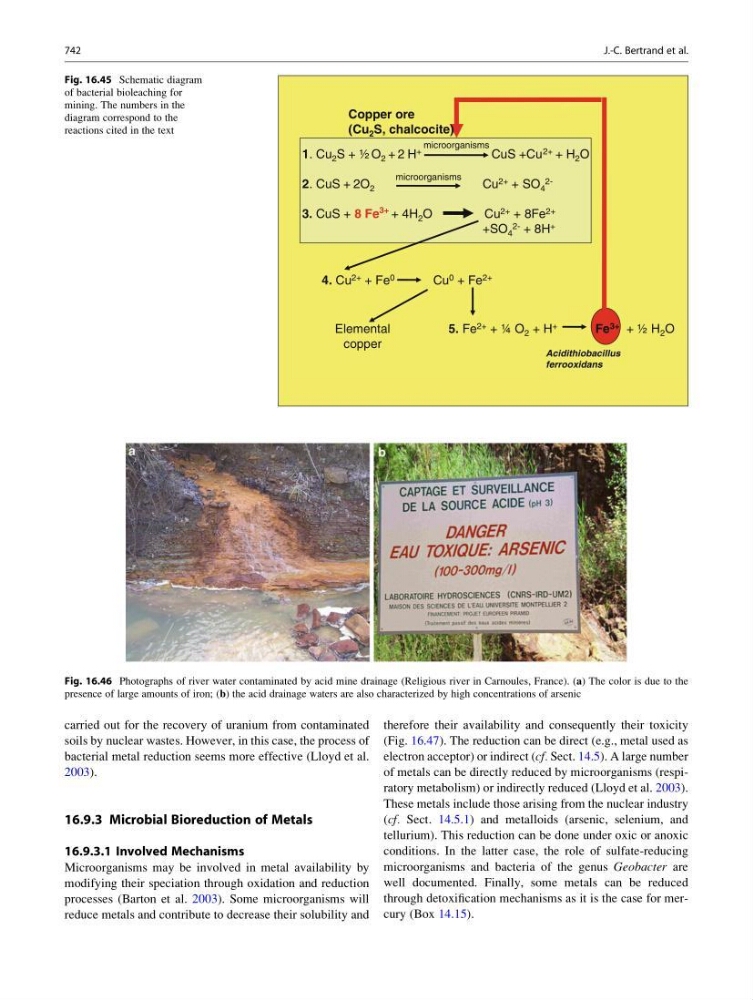
1. Cu 2 S + ½ O 2 + 2 H +
CuS +Cu 2+ + H 2 O
2. CuS + 2O 2
Cu 2+ + SO 4
23. CuS + 8 Fe
3+ + 4H 2 O
C u 2+ + 8Fe 2+
+SO 4
2- + 8H +
4. Cu 2+ + Fe 0
Cu 0 + Fe 2+
5. Fe 2+ + ¼ O 2 + H +
Fe 3+ + ½ H 2 O
Acidithiobacillus
ferrooxidans
microorganisms
microorganisms
Copper ore
(Cu 2 S, chalcocite)
Elemental
copper
Fig. 16.45 Schematic diagram
of bacterial bioleaching for
mining. The numbers in the
diagram correspond to the
reactions cited in the text
Fig. 16.46 Photographs of river water contaminated by acid mine drainage (Religious river in Carnoules, France). (a) The color is due to the
presence of large amounts of iron; (b) the acid drainage waters are also characterized by high concentrations of arsenic
742
J.-C. Bertrand et al.