

families recalcitrant to biodegradation processes that enable
such identifications are typically pentacyclic terpanes
(hopanes), regular and reordered steranes, etc.
16.8.2.3 Origin of Petroleum Products
in the Marine Environment
The following part in this chapter will be dedicated to
the origin and fate of petroleum products in the marine
environment: it is the environment that is quantitatively
submitted to the largest hydrocarbon pollutions. The
assessment of the different hydrocarbon sources released
into the sea is, at the Earth scale, difficult to establish.
The analysis of estimations provided by different expert
groups shows that the huge and spectacular oil input
generated by ships running aground is less important than
chronic inputs linked to transportation, refining operations,
city, and industrial wastes (Table 16.8). If hydrocarbon
inputs into the sea remain important, the overall amount
of released hydrocarbons diminished the past 10 years; the
“National Research Council” estimates that the average
total amount of petroleum released in 1985 to the sea
was 9 Â 10
6 tons. The same organism gives an estimate
of 1.3 Â 10
6 tons for the period 1990–1999 (National
Research Council 2002).
S
S
S
S
S
S
S
S
N
N
N
O
N
O
O
O
O
O
S
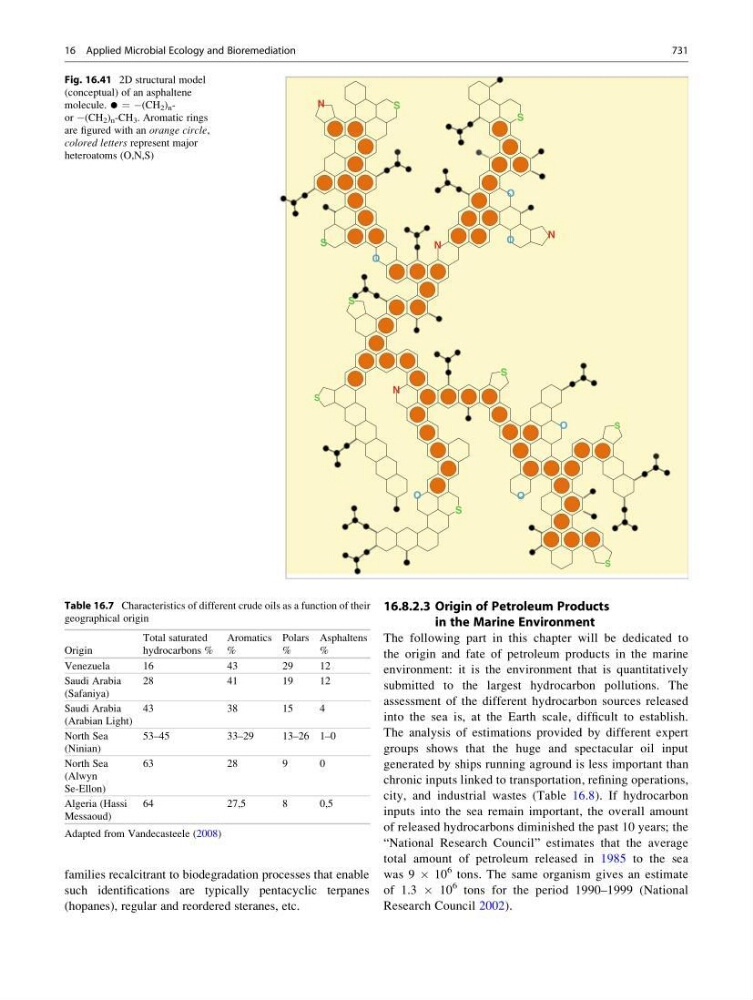
Fig. 16.41 2D structural model
(conceptual) of an asphaltene
molecule. ● ¼ À(CH 2 ) n -
or À(CH 2 ) n -CH 3 . Aromatic rings
are figured with an orange circle,
colored letters represent major
heteroatoms (O,N,S)
Table 16.7 Characteristics of different crude oils as a function of their
geographical origin
Origin
Total saturated
hydrocarbons %
Aromatics
%
Polars
%
Asphaltens
%
Venezuela
16
43
29
12
Saudi Arabia
(Safaniya)
28
41
19
12
Saudi Arabia
(Arabian Light)
43
38
15
4
North Sea
(Ninian)
53–45
33–29
13–26 1–0
North Sea
(Alwyn
Se-Ellon)
63
28
9
0
Algeria (Hassi
Messaoud)
64
27,5
8
0,5
Adapted from Vandecasteele (2008)
16 Applied Microbial Ecology and Bioremediation
731