

structures were described for the molecules involved in
crude oil composition. Hydrocarbons make the majority
and represent about 95 % of petroleum (Fig. 16.33).
The other petroleum components are asphaltenes, resins,
sulfur, oxygen, nitrogen compounds, and metals. The latter
are only present as traces: the most abundant are vanadium,
nickel, iron, sodium, copper, and uranium. Asphaltenes
and resins represent 5–20 % of crude oil. They are
compounds with a complex structure built with condensed
aromatic cycles of naphtenoaromatics, branching, and
heteroatoms (O, N, and S) (Fig. 16.41). It is worth noting
that asphaltenes are not soluble in organic solvents
(pentane, hexane) and this solubility criterium defines
them as a class.
The chemical composition of a given petroleum depends
on its geographical area (Table 16.7), the physicochemical
conditions that prevailed when it was formed (diagenesis,
catagenesis) and on the living organisms from where it
stems. Thus, each petroleum has a specific chemical composition. The notion of “molecular fingerprint” derived from
studies in petroleum geochemistry enables to identify the
petroleum origin when a pollution occurs. The molecular
Living
organisms
LYSE
Molecular fossils
Oil
Biogeochemical markers
Pollution
a
b
c
(1)
(2)
(3)
(4)
(5)
(6)
(7)
(8)
(9)
Ut ilis ati on
(8)
(9)
d
U t il iz a t io n
E x c r e t io n
S e c r e t io n
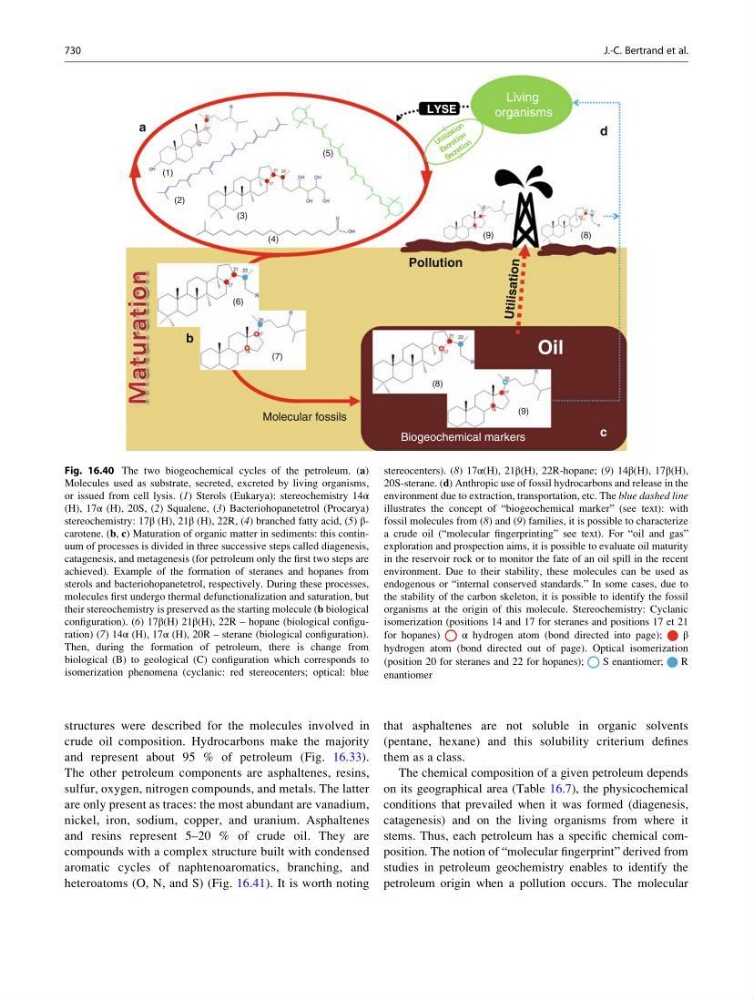
Fig. 16.40 The two biogeochemical cycles of the petroleum. (a)
Molecules used as substrate, secreted, excreted by living organisms,
or issued from cell lysis. (1) Sterols (Eukarya): stereochemistry 14α
(H), 17α (H), 20S, (2) Squalene, (3) Bacteriohopanetetrol (Procarya)
stereochemistry: 17β (H), 21β (H), 22R, (4) branched fatty acid, (5) βcarotene. (b, c) Maturation of organic matter in sediments: this continuum of processes is divided in three successive steps called diagenesis,
catagenesis, and metagenesis (for petroleum only the first two steps are
achieved). Example of the formation of steranes and hopanes from
sterols and bacteriohopanetetrol, respectively. During these processes,
molecules first undergo thermal defunctionalization and saturation, but
their stereochemistry is preserved as the starting molecule (b biological
configuration). (6) 17β(H) 21β(H), 22R – hopane (biological configuration) (7) 14α (H), 17α (H), 20R – sterane (biological configuration).
Then, during the formation of petroleum, there is change from
biological (B) to geological (C) configuration which corresponds to
isomerization phenomena (cyclanic: red stereocenters; optical: blue
stereocenters). (8) 17α(H), 21β(H), 22R-hopane; (9) 14β(H), 17β(H),
20S-sterane. (d) Anthropic use of fossil hydrocarbons and release in the
environment due to extraction, transportation, etc. The blue dashed line
illustrates the concept of “biogeochemical marker” (see text): with
fossil molecules from (8) and (9) families, it is possible to characterize
a crude oil (“molecular fingerprinting” see text). For “oil and gas”
exploration and prospection aims, it is possible to evaluate oil maturity
in the reservoir rock or to monitor the fate of an oil spill in the recent
environment. Due to their stability, these molecules can be used as
endogenous or “internal conserved standards.” In some cases, due to
the stability of the carbon skeleton, it is possible to identify the fossil
organisms at the origin of this molecule. Stereochemistry: Cyclanic
isomerization (positions 14 and 17 for steranes and positions 17 et 21
for hopanes)
α hydrogen atom (bond directed into page);
β
hydrogen atom (bond directed out of page). Optical isomerization
(position 20 for steranes and 22 for hopanes);
S enantiomer;
R
enantiomer
730
J.-C. Bertrand et al.