

countries, associated to the petroleum cost increase, will lead
to an increased exploration and drilling exploitation in areas
free of any human activity (Siberia, Arctic, etc.). The price
increase of the petroleum barrel will make profitable the
exploitation of new resources in spite of complex and dangerous drilling conditions (deep environments, reservoirs under
high pressure or high temperature). Prospecting in extreme
environments will unavoidably increase the number of
polluted sites. Consequently, petroleum hydrocarbons are
and will remain the source of pollutions that had, have, and
will have detrimental consequences on human health, air and
water quality, the ecosystem functioning, etc.
16.8.2.1 The Two Petroleum
Biogeochemical Cycles
The petroleum origin and fate imply a long biochemical
cycle, corresponding to their geological formation and a
short cycle related to their fate in the contemporary environment (Fig. 16.40).
16.8.2.2 Petroleum Chemical Composition
The average elementary composition of crude oil is as
follows (American Petroleum Institute, 20038002-05-9):
carbon (84 %), hydrogen (14 %), sulfur (1–3 %), nitrogen
(1 %), and others (0.1 %). More than 20 000 different
R
COO
-
-OOC
R=CH 3 -(CH 2 )n-OOC
COO
-
R
CH 3
CH 3
R
CH 3
CO 2
R
CH 3
COO
-
ALKANES
AROMATICS
a
b
c
d
COO
-
-OOC
-OOC
COO
-
CH 3
H 2 O
2H
+ + 2e
-
CH 3
CH 3
CH 3
OH
COO
-
CO 2
H
+
e
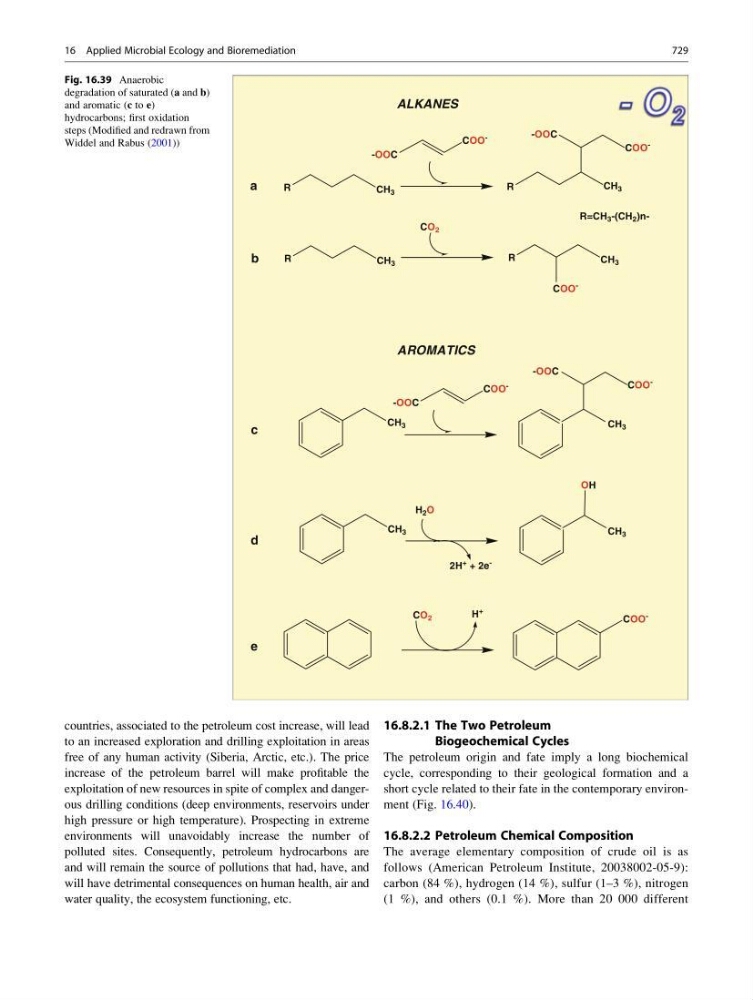
Fig. 16.39 Anaerobic
degradation of saturated (a and b)
and aromatic (c to e)
hydrocarbons; first oxidation
steps (Modified and redrawn from
Widdel and Rabus (2001))
16 Applied Microbial Ecology and Bioremediation
729