

Anaerobic Biodegradation
Anaerobic hydrocarbon biodegradation that was controversial for a long while is now well established (Widdel and
Rabus 2001; Rabus 2005; Carmona et al. 2009). A number
of hydrocarbons, essentially aromatics, but also alkanes and
alkenes, are degraded by bacteria mainly belonging to
proteobacteria that use nitrate, sulfate, and even iron as
terminal electron acceptors (Widdel and Rabus 2001; van
Hamme et al. 2003; Heider 2007; Kunapuli et al. 2008;
Callaghan et al. 2009). A hyperthermophile sulfate-reducing
Archaea, Archaeoglobus fulgidus, oxidize n-alk-1-enes in
the presence of thiosulfate as a terminal electron acceptor
(Khelifi et al. 2010). Other strains are fermenting these
substrates (Pelobacter acetylenicus ferment acetylene)
(Seitz et al. 1990); one photosynthetic strain (Blastochloris
sulfoviridis, strain TOP1) assimilates toluene by using light
as energy source (Zengler et al. 1999). The used aromatic
compounds make a long list: benzene, alkylbenzenes
(toluene,
xylene,
ethylbenzene,
propylbenzene,
ethyltoluene, cymene), naphthalene, 2-methylnaphtalene,
etc. The alkane biodegradation was described for long carbon chains, between C 3 and C 20 , whereas that of alkenes
occurs between C 7 and C 23 (Grossi et al. 2008). Alike for
aerobic biodegradation, hydrocarbon primary oxidation is
the critical step (Fig. 16.39). As to n-alkanes, the initial
biodegration step takes place either by fumarate addition or
by carboxylation. For aromatic compounds, the initial step is
carried out either by fumarate addition, hydroxylation or
carboxylation (Fuchs et al. 2011).
16.8.2 Petroleum Products
Petroleum hydrocarbons are currently the most important
primary energy source to be commercialized: they will remain
so over several decades. The increasing demand of emergent
0
1
2
3
4-5
6-10
None
Very slight
Slight
Moderate
Heavy
Severe
Carbon atom
number
Methane
C 1 -C 5
Ethane
Gases
Propane
Isobutane
n- Butane
Pentanes (8)
n- Alkanes (1,2,3)
C 6 -C 15
Isoalkanes (4)
Isoprenoid alkanes (6,7)
BTEX aromatics (15,16,17,18)
Alkylcyclohexanes (9)
n- Alkanes, Isoalkanes (1,2,3,4)
C 15 -C 35
Isoprenoid alkanes(6,7)
Naphtalenes (20)
Phenanthrenes (26),
Dibenzothiophenes (42)
Crysenes
Regular steranes (11)
C 30 -C 35 Hopanes (14)
C 27 -C 29 Hopanes
C 15 -C 35
Triaromatic steroid hydrocarbons
Biomarkers
Monoaromatic steroids hydrocarbons,
Gammacerane, Oleanane
C 21 -C 22 steranes
Tricyclic terpanes (12)
25-norhopanes
Composés azotés
Alkylcarbazoles (28)
Composés oxygénés Carboxylic acids (34)
Biodegradation scale
Degradation
Time
Major alteration
Removal
Minor removal
Methane generation and
possible destruction
Hydrocarbons
Hydrocarbons
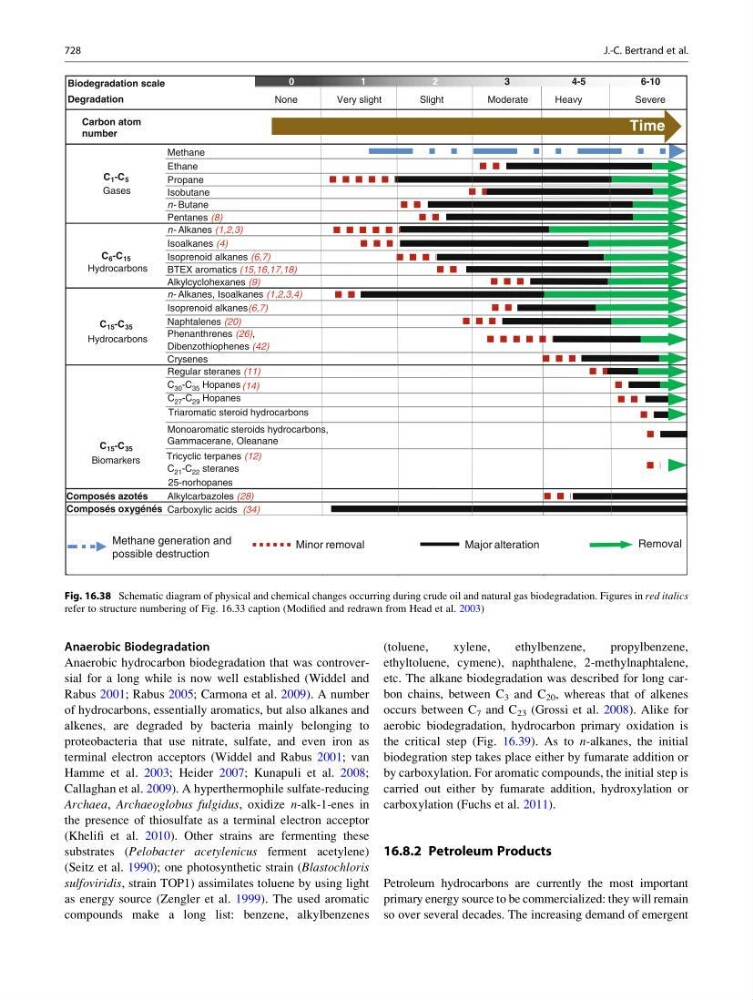
Fig. 16.38 Schematic diagram of physical and chemical changes occurring during crude oil and natural gas biodegradation. Figures in red italics
refer to structure numbering of Fig. 16.33 caption (Modified and redrawn from Head et al. 2003)
728
J.-C. Bertrand et al.